The China Africa Trade Platform I Built That Nobody Paid For
I spent roughly two years building a China Africa trade platform and never sent a single invoice. The corridor problem was real. My method for testing it was not.

The Challenge
I spent roughly two years building a China Africa trade platform and never sent a single invoice. Not one. No customer moved money to me for anything, at any point, across the entire life of the project.
The Approach
Take the size first. China Africa trade hit a record US$348.05bn in 2025 on Chinese customs data, up 17.7 percent year on year, with exports into Africa climbing 25.8 percent to US$225.03bn. A great many containers moving in one direction, most of them ordered by people who will never see the factory.
Broader Impact
Enthusiasm is free. A letter of intent is free. A wire transfer is not. It is the only feedback that cannot be given out of politeness.
Detailed Narrative
I spent roughly two years building a China Africa trade platform and never sent a single invoice. Not one. No customer moved money to me for anything, at any point, across the entire life of the project.
That sentence is the essay. Everything below is me working out what it means, because the meaning is not the obvious one and it took an embarrassingly long time to see it.
Some context on where I was standing. I live in Shenzhen and have been inside China's tech ecosystem for eight years. I speak Mandarin well enough to argue about lead times and tolerances. I can be on a factory floor and back the same day. The corridor I wanted to fix is one I watch constantly: African buyers sourcing from Chinese suppliers, losing money to payment friction, losing money to goods that do not match the sample, losing money to counterparties nobody can verify from the other side of the world.
The problem is real. That is the part that made it dangerous.
The corridor problem is real, which is exactly the trap
Take the size first. China Africa trade hit a record US$348.05bn in 2025 on Chinese customs data, up 17.7 percent year on year, with exports into Africa climbing 25.8 percent to US$225.03bn. A great many containers moving in one direction, most of them ordered by people who will never see the factory.
Now the friction. On payments, Sub-Saharan Africa remains the most expensive region in the world for cross-border transfers, running above 8 percent of the amount sent against a global average closer to 6, per the World Bank's Remittance Prices Worldwide series. That series tracks consumer remittances rather than trade settlement, but it measures the same underlying condition: thin correspondent banking, long intermediary chains, a fee and a compliance review at every hop.
On financing, the African Development Bank puts unmet trade finance demand on the continent at US$74bn to US$92bn in 2024, with 37 percent of small and medium enterprise applications rejected across 2020 to 2024. The buyer who cannot get a letter of credit pays cash in advance to a stranger.
On quality, the OECD and EUIPO valued global trade in counterfeit goods at USD 467 billion in 2021, roughly 2.3 percent of world imports, with China and Hong Kong (China) the leading provenance economies for seized goods. Nigeria's answer is SONCAP, a conformity assessment programme requiring regulated products to be certified before shipment. A country builds a pre-shipment inspection regime when post-shipment surprises have become routine.
Every one of those numbers is an argument for building something. That is precisely the trap. A problem being real tells you nothing about whether your particular solution is wanted, by whom, at what price, this quarter. Real problems are abundant. Paying customers are not.
Enthusiasm is free. A letter of intent is free. A wire transfer is not. It is the only feedback that cannot be given out of politeness.
Why a China Africa trade platform feels like the obvious build
A corridor presents itself to an engineer as a system. You can see all the parties at once. The buyer, the supplier, the agent, the inspector, the forwarder, the bank. You watch the same three failures repeat across hundreds of transactions and the abstraction assembles itself in your head almost against your will. Payment, verification, trust. Three services, one platform. It is a beautiful diagram and it is very hard to stop drawing.
The second seduction is scope. A marketplace serves everybody in the corridor, which sounds like ambition and functions as avoidance. If your customer is "African importers" then you never have to name one. You never have to call a specific person on a specific Tuesday and ask for a specific amount of money. The abstraction protects you from the conversation.
The third is the worst and it is specific to people who have some advantage. Mine were real. Mandarin, eight years of local context, the ability to stand in front of a supplier. Those advantages did not save me. They extended my runway on the wrong path. Someone with fewer of them hits a wall in six months and is forced to ask a different question. I could keep going, and going was the failure mode.
Two years without an invoice is a diagnosis, not an accident
For a long time I filed the no-revenue part under context. Background. The thing that was happening while the real work happened. It is the other way round. The absence of an invoice was not a consequence of the project's state. It was the project's state.
Here is the distinction I missed. Building produces artifacts. It does not produce information. Every week I had more of the thing and no more knowledge about whether the thing was wanted. Schema, flows, a payment integration, a supplier verification model. All real work, all perfectly compatible with learning nothing.
The only fact that could have changed my mind was somebody paying, and I had arranged the work so that fact could never arrive. Two years is not bad luck. Two years is a structural refusal to run the experiment, sustained long enough to look like a plan.
There is a particular cowardice available to technical founders and I held a full subscription. You can always find a legitimate engineering task. There is always something genuinely broken, genuinely worth fixing, sitting between you and the phone call. Nobody calls you lazy for shipping. And the code compiles, which asking a stranger for money does not.
What some call the Lena heuristic
The rule I use now goes by several names. Some builders call it the Lena heuristic. Solve one narrow problem manually for one real customer, charge real money for it, and only then consider building software.
Three clauses, each carrying weight. One narrow problem, not a corridor. Manually, with your hands and your evenings and no system in between. Real money, which is the entire point.
Money is the only honest signal because it is the only one with a cost attached to the sender. Enthusiasm is free. A letter of intent is free. A waitlist signup is free, a warm introduction is free, a partner telling you this is exactly what we need is free and will be said to you many times. A wire transfer is not free. It is the only feedback that cannot be given out of politeness.
The ancestor here is Paul Graham's 2013 essay Do Things that Don't Scale, which told founders to recruit users manually because startups do not start themselves. The heuristic adds the harder half. Recruit them by hand and make them pay you by hand. Free manual work is still avoidance, only more tiring.
What the manual version would have looked like
I can describe the counterfactual method. I cannot tell you how it would have turned out, because I did not run it.
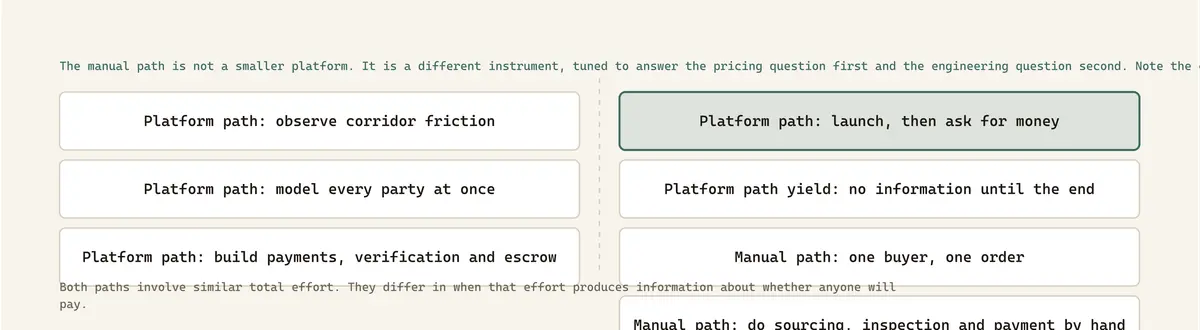
Pick one buyer. Not a segment, a person, with a real order they are about to place. Pick one product category, narrow enough to learn its failure modes properly. Then do the whole job by hand. Find the supplier, negotiate the terms, go and look at the goods myself, push the payment through whatever slow ugly path exists today, deal with the forwarder, take the call when the carton count is wrong. Then invoice for it.
Then do it again. And a third time. Somewhere in there the answers arrive without being asked for. Which part they will actually pay for, and I would have guessed inspection over payment, but a guess is exactly what I did not have. What price clears. Whether they come back. Which step is eating my evenings.
That last one is the specification. Software is for the part of the manual job that becomes unbearable at volume, and you cannot know which part that is until it has been bearable, then annoying, then unbearable, in your own hands. I built for the parts that were interesting to model. Those are not the same parts and there is no reason they would be.
The strongest argument against everything above
Some infrastructure genuinely cannot be tested by hand, and pretending otherwise is its own dishonesty.
You cannot manually pilot a settlement rail. In December 2025 Standard Bank became the first African bank to connect directly to China's Cross-Border Interbank Payment System, following regulatory approval in April and a licence granted that June. That required a balance sheet, a clearing membership, a regulator and a counterparty relationship, none of which one motivated person can simulate with a spreadsheet and a group chat. The same holds for anything needing a payments licence, a custody arrangement or a certification authority. For that class of problem, build then sell is the only sequence available, because the manual version does not exist at any useful scale.
I concede that completely. Then I would push on one thing.
Those businesses are still sold before they are finished. The bank had mandates, corporate clients and a visible book of demand long before the rail went live. What cannot be done manually is the delivery. What can always be done early is the commitment. A signed contract for a thing that does not exist yet is still someone paying, and it carries most of the same information. If nobody will commit before you build, you are probably not in the infrastructure case.
Most of us who reach for that exemption reach for it because it is the most flattering explanation on the shelf. I would have reached for it. I was not building a clearing rail. I was building a web application with escrow logic in it, and there was a version of that I could have run out of a notebook in month one.
The corridor is still open
The problem did not go away when I stopped. Buyers across the continent are still wiring money in advance to counterparties they cannot enforce against, still accepting cartons nobody verified. Chinese exports into Africa grew more than 25 percent last year. The demand is louder now than when I started.
And I am still not sure I am the right person to fix it, which is the part I cannot settle. The version of the work that would have worked is the version I did not want to do. Standing in a warehouse counting somebody else's cartons is not what I trained for. Writing the system that counts them is. The whole lesson is that the first is the qualification for the second, and I ran it backwards for two years while telling myself I was being efficient.
What bothers me is not what that says about me. It is what it implies about method. If the manual version of your business feels beneath you, you will build the platform version instead. And a platform built by someone who never did the manual work will be wrong in ways that are invisible from the inside, which is where you will be standing.
Sources
China-Africa trade hits record US$348bn as deficit balloons, NTU-SBF Centre for African Studies, citing China's General Administration of Customs: https://www.ntu.edu.sg/cas/news-events/news/detail/china-africa-trade-hits-record-us-348bn-as-deficit-balloons
Remittance Prices Worldwide, World Bank: https://remittanceprices.worldbank.org/
Africa's trade finance gap tops US$74bn as banks retreat, AfDB warns, Global Trade Review: https://www.gtreview.com/news/africa/africas-trade-finance-gap-tops-us74bn-as-banks-retreat-afdb-warns/
Mapping Global Trade in Fakes 2025, OECD and EUIPO: https://www.oecd.org/en/publications/mapping-global-trade-in-fakes-2025_94d3b29f-en.html
China's cross-border interbank payment system goes live with Standard Bank as first African bank to offer service: https://corporateandinvestment.standardbank.com/cib/global/who-we-are/about-us/news/china-cross-border-interbank-payment-system-goes-live-with-standard-bank-as-first-african-bank-to-offer-service
Do Things that Don't Scale, Paul Graham, July 2013: https://paulgraham.com/ds.html
SONCAP conformity assessment programme, Standards Organisation of Nigeria: https://son.gov.ng/soncapservice/
🏷️ Tags
Thinking through a system like this one? I'm open to a conversation about the subject matter.
Start a conversation