How to Start a Tech Community in a City Where You Are Foreign
The mechanics nobody writes down: why first meetings fail as coordination problems, why narrow definitions travel further than broad ones and what the Greater Bay Area gives an African engineer.


The Challenge
The advice on how to start a tech community is mostly about promotion. Where to post, which channel, how to get the word out. Promotion is the easy part. The hard part happens in the twenty minutes before the first meeting, when you are standing in a room you booked, in a city where you hold a residence permit rather than a birthright, with no way of knowing whether anyone is coming.
The Approach
People do not stay away from a first meeting because they are uninterested. They stay away because they cannot tell whether anyone else will be there, and nobody wants to be the person who turned up to an empty room. That is a coordination problem rather than a marketing problem, and it has a different solution.
Broader Impact
A community doing its job produces people who need it less. From the inside that is indistinguishable from decline.
Detailed Narrative
The advice on how to start a tech community is mostly about promotion. Where to post, which channel, how to get the word out. Promotion is the easy part. The hard part happens in the twenty minutes before the first meeting, when you are standing in a room you booked, in a city where you hold a residence permit rather than a birthright, with no way of knowing whether anyone is coming.
I founded and chair the Shenzhen Afro-Tech Forum, started in 2025, which connects African and diaspora engineers with the Greater Bay Area technology ecosystem. Eight years in China, most of them writing software before moving into AI and technical leadership. What follows is mechanics rather than inspiration, because mechanics are the part nobody writes down.
A foreigner starting something carries one structural disadvantage that shapes every other decision. You cannot borrow legitimacy. A local organiser has an alumni network, a former employer, a hometown, a group chat that already exists for other reasons. You have an invitation and whatever is written on it. The invitation has to do the work that reputation would otherwise do.
How to start a tech community: the first meeting is a coordination problem
People do not stay away from a first meeting because they are uninterested. They stay away because they cannot tell whether anyone else will be there, and nobody wants to be the person who turned up to an empty room. That is a coordination problem rather than a marketing problem, and it has a different solution.
The solution is specificity. A fixed date. A fixed room. A topic narrow enough to be argued with. A named person who has agreed to speak for twenty minutes about something they actually did. Each of those details removes a reason to hesitate. An invitation to come and network with other engineers removes none of them, because it gives a person nothing to picture.
Friction is worth planning for rather than discovering on the night. Buildings ask visitors for identification. Invitations travel further when they exist in two languages. Working hours in this region make a seven o'clock start on a weekday optimistic. None of it is interesting and all of it decides attendance.
The other thing that decides attendance is asking directly. Not posting. Asking. A message written to one person, naming why you thought of them, converts at a rate no broadcast matches. The first meeting is assembled by hand. Ten conversations, ten commitments, and you accept that several will not arrive. This does not scale and it is not meant to. It happens once.
A community doing its job produces people who need it less. From the inside that is indistinguishable from decline.
The second meeting is where the community actually starts
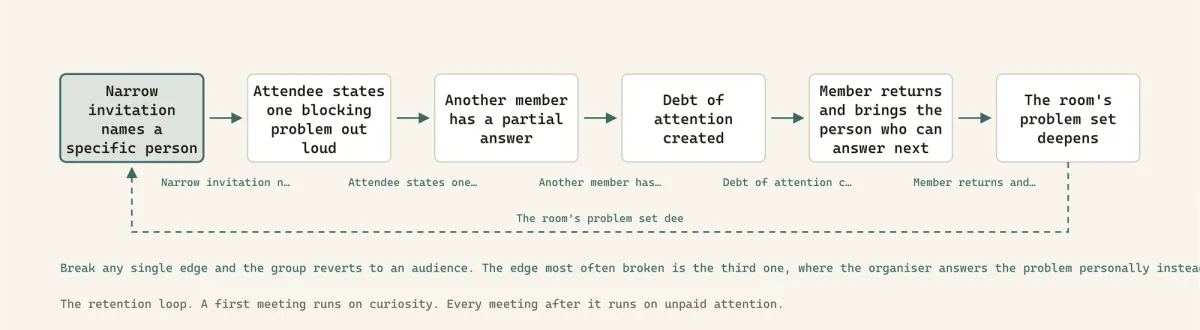
Curiosity gets people to a first meeting. Curiosity is a depreciating asset. Nobody returns because the room was pleasant.
They return for one of three reasons. They got a specific answer to a specific problem they had that week. They met somebody they could not have reached alone. Or they left owing attention to a person who helped them and they want to square it.
All three are engineered rather than hoped for. The mechanism is making people state a problem out loud. Not an introduction, a problem. Go around the room and have each person name one thing currently blocking them, in one sentence. Half the value of the evening gets produced in the four minutes afterwards, when two people realise they are stuck on opposite sides of the same wall. The organiser's job in that window is to listen for matches and say them out loud. That is the whole job. Not speaking. Matching.
Two more things. Announce the date of the next meeting before people leave the first one, because a group with a schedule is a different object from a group with intentions. And finish when you said you would finish. People who stay late by choice are a sign of health. People trapped in a session that overran are learning to decline the next invitation.
The first meeting proves the thing can exist. The second proves it is not about you.
A narrow door lets more people through
The instinct when you have nobody is to widen the definition. Open to everyone in tech. Open to all nationalities. Open to students, founders, engineers, designers. It feels generous. It performs badly.
A broad definition means no individual reading it recognises themselves in it. Engineers in Shenzhen describes hundreds of thousands of people and addresses none of them. African and diaspora engineers working with the Greater Bay Area technology ecosystem describes a much smaller set, and every person inside that set knows immediately the sentence is about them. Recognition is what makes someone forward a message to a friend. Nobody forwards a message addressed to nobody.
Precision is also a referral mechanism. If a member cannot say in one line who the group is for, they will never introduce anyone to it.
Narrow is not the same as closed. A definition names a centre of gravity, not a wall. In practice a room with a clear identity is easier for an outsider to walk into than a room without one, because the visitor knows what they are visiting and what the conversation will be about. Chinese engineers, European founders and people with no connection to the theme all show up at groups like this. They show up because there is something specific to show up to.
Wide invitations produce audiences. Narrow invitations produce rooms.
A community has obligations. An audience has metrics.
The two look identical in the first year and then diverge permanently.
An audience faces one direction. Attention flows toward the organiser, who is the product. Growth is the goal because growth is the only available measure. Audiences can be bought and the price is well understood.
A community faces itself. Attention flows between members and most of the valuable exchange happens in conversations the organiser never hears about. Growth is a side effect rather than a target.
Two tests separate them. First, what happens when the founder does not come. An audience does not meet. A community meets and somebody else runs the agenda. Second, whether anyone other than the founder has ever proposed what the group should do next and been allowed to do it. If the answer stays no, you have subscribers.
The pressure runs one way. Audience numbers are visible, countable and gratifying. Community health is invisible, uncountable and slow. The drift is rarely a decision. It happens by attending to whatever is easy to see.
The correction costs something specific. It means giving away the parts of the work that generate visibility. The talk you could have delivered. The introduction you could have made personally and been thanked for. Handing those over is how the second test starts passing, and it takes from the founder exactly what it gives the group.
What the Greater Bay Area gives an African engineer
There is a reason the group is anchored to a region rather than to a nationality.
The Guangdong-Hong Kong-Macao Greater Bay Area covers eleven cities across roughly 56,000 square kilometres, with a population above 88 million and a GDP above 15 trillion yuan in 2025, according to the Hong Kong government's own figures. In September 2025 the World Intellectual Property Organization ranked the Shenzhen, Hong Kong and Guangzhou cluster first in the world for science and technology activity, ahead of Tokyo and Yokohama, after five consecutive years in second place. That ranking rests on patent filings, scientific publications and venture capital deals, and the cluster recorded 117,542 filings under the Patent Cooperation Treaty between 2020 and 2024. Shenzhen's research and development spending passed 6 percent of city GDP in 2023, at 6.46 percent, with companies rather than institutions accounting for about 93 percent of it.
Those numbers explain the density. They do not explain what is actually different, which is tempo.
An engineer anywhere can read a datasheet. Being here means the component sits on a shelf in a market you can walk through this afternoon, the board house that will fabricate your prototype is a short drive away, and the factory that would assemble a thousand units is in the same province. The distance between an idea and an object you can hold is measured in days. That compression changes what you attempt, because it changes the cost of being wrong. Iteration speed is a form of education that cannot be imported.
There is a second thing, less discussed. China and Africa traded a record 348 billion dollars in 2025 on China's own customs figures, and Chinese exports to the continent, at 225 billion dollars, are dominated by machinery, electronics and green technology. Most African engineers encounter those products at the end of the chain. Working in this region puts you near the front of it. That vantage point does not transfer through documentation.
The African presence in Guangdong is older than the technology story and smaller than the reporting suggests. Numbers like 100,000 or half a million circulate freely and do not survive checking. Roberto Castillo, who has studied the Guangzhou community for years, traces them to hotel records counted on a person-times basis, where one trader entering three times became three people. Official statements put the legally resident African population of Guangzhou at around 16,000 at its 2014 peak, and public security figures cited in that research show it falling below five thousand by April 2020 before recovering as travel restrictions eased. The exact figure matters less than the habit. A population routinely miscounted from outside has good reason to describe itself accurately from inside.
Identity is a floor that can become a ceiling
The strongest objection to everything above is not that it fails. It is that it works, and then holds you in place.
A group organised around who its members are, rather than what they do, can quietly become the outer limit of a person's professional world. The failure is comfortable, which is what makes it hard to notice. You get introduced to opportunities sized to the group's imagination rather than the market's. You rehearse your case in a room that already agrees with you and skip the harder work of becoming legible to the wider ecosystem, in Mandarin, inside Chinese professional norms, on terms set by people who have never once thought about your background. Identity groups also select for the most present rather than the most capable, because presence is the only thing the room can see. And there is a particular hazard when outsiders begin treating the group as a single interface to an entire population. One person's judgment then stands in for many people's careers, and nobody voted for that.
I do not have a clean answer. The partial one is that membership can be defined by identity while activity is defined by practice. Who is invited and what gets discussed are separate questions. Keep the agenda technical and the identity stays a floor. Let the agenda become belonging itself and the floor rises to meet the ceiling.
The honest position is that this remains unresolved. The forum started in 2025. Anyone claiming to have solved a problem that takes a decade to surface is selling something.
The measurement problem
The numbers that are easy to collect measure the wrong thing, and the thing worth measuring shows up as absence.
A community doing its job produces people who need it less. The engineer who came looking for an introduction gets one, and the next one arrives through a network she built herself. The person who could not get a meeting now takes them. Eventually they stop coming, not because anything went wrong but because everything went right, and their seat is empty.
From the inside that is indistinguishable from decline. Attendance falls either way. Nothing in the room separates a member who outgrew it from a member who lost interest, and a founder who wants to feel good about the work has an obvious incentive to read every departure as the first kind.
I have not found a way to tell them apart. I am not sure one exists. What I have instead is a rule easier to state than to follow. When somebody leaves, the question is not how to bring them back. It is what they can now do that they could not do before, and whether the room had anything to do with it.
Sources
Guangdong-Hong Kong-Macao Greater Bay Area overview, HKSAR Government: https://www.bayarea.gov.hk/en/about/overview.html
WIPO Global Innovation Index 2025, Innovation Cluster Ranking: https://www.wipo.int/en/web/global-innovation-index/2025/innovation-clusters
WIPO Global Innovation Index 2025, top 100 innovation clusters ranking (PDF): https://www.wipo.int/documents/d/global-innovation-index/docs-en-2025-gii-2025-clusters-top100-ranking.pdf
Shenzhen-Hong Kong-Guangzhou innovation cluster tops global ranking, State Council of the PRC: https://english.www.gov.cn/news/202509/02/content_WS68b6cfe4c6d0868f4e8f5438.html
Shenzhen leads nation with R&D investment, China Daily: https://regional.chinadaily.com.cn/en/2024-11/14/c_1045397.htm
Roberto Castillo, How many Africans are there in Guangzhou?, Africans in China: https://africansinchina.net/how-many-africans-are-there-in-guangzhou/
China-Africa trade hits record US$348bn, NTU-SBF Centre for African Studies: https://www.ntu.edu.sg/cas/news-events/news/detail/china-africa-trade-hits-record-us-348bn-as-deficit-balloons
Guide to Huaqiangbei electronics market, Global Sources: https://www.globalsources.com/knowledge/huaqiangbei-electronics-market/
Tags
Thinking through a system like this one? I'm open to a conversation about the subject matter.
Start a conversation