Presenting technical work in a second language changes the preparation
Second place at Tencent's OpenClaw hackathon in Shenzhen, pitched and defended in Mandarin. What changes about preparation, and what reading Chinese sources first-hand actually buys.


The Challenge
Shenzhen, March 2026. Tencent ran a hackathon on OpenClaw and I finished second. Presenting technical work in a second language was the whole texture of that day. I pitched in Mandarin, took the questions in Mandarin and defended the design choices in Mandarin, a language I started learning as an adult, in China, from zero.
The Approach
In your first language you can talk your way out of a gap. You feel a question landing badly, you hear yourself heading somewhere weak, you reroute mid-sentence and nobody notices. That channel is much thinner in a language you learned at thirty. Improvisation costs working memory that is already going on grammar and tone.
Broader Impact
Comprehension is cheap now. What a language buys is the right to be interrupted.
Detailed Narrative
Shenzhen, March 2026. Tencent ran a hackathon on OpenClaw and I finished second. Presenting technical work in a second language was the whole texture of that day. I pitched in Mandarin, took the questions in Mandarin and defended the design choices in Mandarin, a language I started learning as an adult, in China, from zero.
OpenClaw was an unlikely thing to be building on. It launched in November 2025 under the name Warelay, became Moltbot in January 2026 after a trademark dispute, then OpenClaw three days later. An open-source agent that lives behind a messaging app, calls tools through a skills system and runs on whichever model you point it at. Chinese developers wired it to domestic models and domestic apps almost immediately.
My build connected a consumer messaging interface to a physical robot arm. Text in at one end, motion out at the other. What follows is less about that build than about what changes in your head when the defence has to happen in a language you acquired on purpose, and about what the language quietly buys you the rest of the year.
Presenting technical work in a second language rewards structure over fluency
In your first language you can talk your way out of a gap. You feel a question landing badly, you hear yourself heading somewhere weak, you reroute mid-sentence and nobody notices. That channel is much thinner in a language you learned at thirty. Improvisation costs working memory that is already going on grammar and tone.
So the argument gets built before the room, as a structure rather than a performance. Three claims, ranked by how much of the work they carry. Under each one, the evidence that holds it up and the single sentence that would make me abandon it. If you cannot name what would falsify your claim, you do not have a claim. You have a slide.
Then the questions. Not a list of topics. Actual sentences, said out loud, in advance. Technical Mandarin is not the Mandarin you use to order food or argue with a landlord. The vocabulary for latency, for state, for failure mode and for the difference between a demo constraint and an architectural one has to already be in your mouth before you reach for it. Reading a term is not the same as saying it. The first time a word leaves your body should not be in front of judges.
The demo carries the weight the sentences cannot. A physical object that moves when you send it a message is evidence that needs no translation. Spoken arguments degrade when your language degrades. An arm that picks something up does not.
None of this is exotic. It is what good preparation always was. The second language removes the option of skipping it.
Comprehension is cheap now. What a language buys is the right to be interrupted.
Fluency and recovery are different skills
Fluency is producing the prepared thing. Recovery is what happens when a judge misunderstands your premise, or asks about the one edge case you had filed under unlikely, or speaks with an accent you have not spent much time around. Recovery is where the second language actually costs you, and it costs you at the precise moment the result is being decided.
There is a research literature that touches this and it deserves careful handling. Keysar, Hayakawa and An reported in Psychological Science in 2012 that people reason more deliberately in a foreign language. Framing effects shrank. Loss aversion dropped. The proposed mechanism is distancing, the idea that a second language demands effort and effort recruits controlled processing. Later meta-analyses disagree about how well that finding holds up, particularly in moral dilemmas, and the moderators are still being argued over. Suggestive rather than settled.
The subjective version I can report without a citation is this. Nothing is automatic. Every clause is a decision you make on purpose. That is slower, and it also means you do not say the confident thing you have not checked, because the confident thing is not sitting there available and free. The bluff is expensive, so you stop bluffing. Some of what reads as rigour in a second language is really just the cost of lying being too high.
The interesting conversation in Chinese AI is not translated
The stage is the visible part. The reading is the part that compounds.
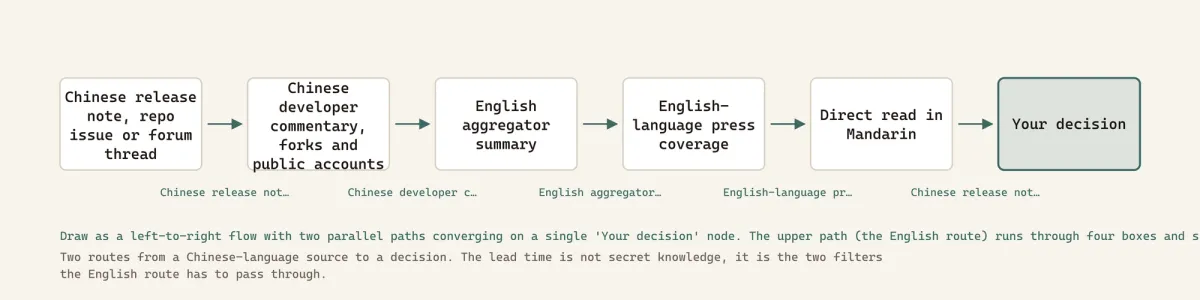
Chinese release notes, repository issue threads, WeChat public accounts, developer forums, the comment sections underneath all of it. That material reaches English coverage weeks or months later and it arrives filtered twice. Once by whoever decided it was worth translating. Once by whoever decided what the translation meant.
Take one week in March 2026. Shenzhen's Longgang district circulated draft measures backing OpenClaw builders and one-person companies, with equity investment reported at up to 10 million yuan per project alongside compute credits and subsidised housing. Within days came reporting of central directives restricting the same software on machines inside government agencies, state-owned enterprises and banks. Both things were true in the same week. English coverage tends to arrive carrying one of the two stories with a headline that resolves the contradiction. Read the Chinese sources and you get the contradiction itself, intact, which is the more useful object to be holding.
Scale makes this matter more than it did a few years ago. Hugging Face's open models report in August 2026 put Alibaba's Qwen family past three billion downloads, ahead of Google's 418 million and Meta's 227 million across the year. The centre of gravity in open-weight models has moved, and a large share of the primary documentation for it is written in Chinese first and English second, when English happens at all.
The lead time is not secret knowledge. It is a few weeks of knowing which way things are moving before the English summary tells you, plus a much better read on which claims the Chinese developer community actually believes as opposed to which claims got amplified. At an event where Tencent shipped its WeChat OpenClaw plugin on the morning of the competition, according to reporting at the time, a few weeks of orientation is not nothing.
Two thousand two hundred hours against a free translate button
Here is the strongest version of the case against everything above.
The Foreign Service Institute puts Mandarin in its hardest tier. Roughly 88 weeks, about 2,200 class hours of full-time instruction, to reach professional working proficiency on the ILR scale. That is two years of doing nothing else, or the far longer part-time version a working engineer would actually attempt. Against that, machine translation got very good very quickly. General benchmarks on Chinese to English have saturated. A model renders a release note in under a second, free, on your phone, at a quality that would have been publishable a decade ago.
For most engineers the arithmetic does not work. Read the translation. Ship the thing. That is the correct answer and I am not going to pretend otherwise to make my own investment look smarter.
Where it still breaks is narrower than language-learning advocates claim and wider than translation optimists admit. HardMTBench, published in May 2026, assembled 10,000 hand-curated Chinese-English sentence pairs across twelve knowledge-intensive domains, packaged as 20,000 directional test items, specifically because general benchmarks had compressed twenty-two systems into a 7.87-point range and stopped separating anything. On terminology accuracy the top closed systems cluster around 64 per cent. Smaller open systems land between 40 and 46 per cent.
Sixty-four per cent, rising, is fine for most reading. It is not fine for the one sentence that determines whether an approach deserves a week of your time, and you cannot identify which sentence that was until afterwards. The disagreement is about variance, not averages. Most people are right to take the average.
What the language buys is the right to be interrupted
Translation gives you the text. It does not give you the room.
Speaking to someone with no layer in between changes what they say to you. Interpreters flatten follow-ups. They compress the second and third questions, the ones that arrive after the polite first one, into something shorter and safer. The follow-up is the valuable part. The first question is protocol. The third question is what the person actually wanted to know.
There is a social effect too and it is smaller than people outside China assume. Being a Nigerian who works in Mandarin in Shenzhen is a novelty for about two minutes. Then the conversation moves on to whatever was being discussed before you arrived, which is exactly where you wanted it to go. The language does not make you interesting. It gets you past the part where you are interesting.
The transferable version, for anyone nowhere near China: what a language buys is not comprehension. Comprehension is cheap now. What it buys is the right to be interrupted.
The tool eats the advantage it was built with
The uncomfortable part is the shape of the thing I built.
An agent behind a consumer messaging interface, taking instructions in ordinary language and turning them into movement in the physical world. That class of system crosses languages better every quarter. OpenClaw itself came from nowhere in November 2025 under a different name, was renamed twice inside two months and had Chinese developers adapting it to domestic models within weeks. The thing I presented in Mandarin belongs to the category of thing most likely to make the Mandarin optional.
I do not think that resolves cleanly and I am suspicious of anyone who says it does. Models will translate the release notes. They do not translate the fact that a subsidy draft and a restriction directive landed in the same week, that everyone in the relevant group chats knew both and had a view, and that the view was not what either document said. They do not translate tone, or which claims people are quietly ignoring, or the difference between a consensus and a loud minority. That information exists in Chinese and mostly stays there, because it never gets written down in a form anyone would bother to translate.
And the room was still a room. People, chairs, a clock, questions asked out loud in one language. That remains the format for most decisions that matter, and it is the format least amenable to a translation layer sitting in the middle of it. Until the judges are agents too.
Tools referenced
OpenClaw
Sources
OpenClaw (framework history, Chinese adoption, March 2026 restrictions) - Wikipedia: https://en.wikipedia.org/wiki/OpenClaw
Nigerian Francis Okafor Wins Second Place at Tencent OpenClaw Hackathon in China - Techeconomy: https://techeconomy.ng/nigerian-francis-okafor-wins-second-place-at-tencent-openclaw-hackathon-in-china/
Shenzhen Longgang Backs OpenClaw with Millions in Subsidies for One-Person AI Companies - NYU Shanghai RITS: https://rits.shanghai.nyu.edu/ai/shenzhen-longgang-backs-openclaw-with-millions-in-subsidies-for-one-person-ai-companies
HardMTBench: Stress-Testing Chinese-English Translation on Knowledge-Intensive Domains (arXiv:2605.28315, May 2026): https://arxiv.org/abs/2605.28315
FSI Language Difficulty Ranking (88 weeks / 2,200 hours to S-3/R-3 for Mandarin): https://www.fsi-language-courses.org/blog/fsi-language-difficulty/
Alibaba AI models hit 3 billion downloads, passing Meta and Google - Fortune, 15 August 2026: https://fortune.com/2026/08/15/alibaba-qwen-open-ai-models-3-billion-downloads-meta-google/
Keysar, Hayakawa & An, The Foreign-Language Effect - Psychological Science (2012): https://journals.sagepub.com/doi/abs/10.1177/0956797611432178
Decision-making depends on language: A meta-analysis of the Foreign Language Effect - Bilingualism: Language and Cognition: https://www.cambridge.org/core/journals/bilingualism-language-and-cognition/article/decisionmaking-depends-on-language-a-metaanalysis-of-the-foreign-language-effect/357CDDF948DB7FC3C101534F1EA3442A
Tags
Thinking through a system like this one? I'm open to a conversation about the subject matter.
Start a conversation