Volunteer Organisation Succession Planning Starts With a Membership Record
Volunteer bodies decay when the rules live in one person's head. The order that prevents it: membership record and constitution first, programmes last, with a gate between every step.

The Challenge
Most diaspora associations do not collapse. They fade. The person who carried the thing takes a new job, or moves city, or simply runs out of evenings, and underneath all that activity there was nothing that could hold its own shape. A group chat goes quiet. Nobody can access the account. Two people disagree about who is allowed to call a meeting and neither can point to a document that settles it.
The Approach
The failure mode has a literature. It is usually called founder's syndrome, which is a poor name because it points at a personality. Stephen Block and Steven Rosenberg surveyed Colorado nonprofits in 2002 and found something more mechanical than a character flaw. Board term limits existed in 31 percent of founder-led organisations against 49 percent of the rest. Founder-led bodies also tended to run smaller budgets. The term limits number says nothing about anyone's ego. It says something about absent machinery, specifically the machinery that makes people leave office on a schedule whether or not anyone wants them to.
Broader Impact
Written in advance, a constitution is a shared instrument. Written after a dispute, it is the winning side's account of the dispute, and everybody can tell.
Detailed Narrative
Most diaspora associations do not collapse. They fade. The person who carried the thing takes a new job, or moves city, or simply runs out of evenings, and underneath all that activity there was nothing that could hold its own shape. A group chat goes quiet. Nobody can access the account. Two people disagree about who is allowed to call a meeting and neither can point to a document that settles it.
Volunteer organisation succession planning sounds like an administrative topic for people who enjoy administration. It is closer to load-bearing engineering. I am President of the Nigerians in Shenzhen Association, and when I took the work seriously I organised it into five gated workstreams with one ordering principle: structure and data before programmes. That order is unpopular. Programmes are the visible part. Programmes are what people thank you for. Structure and data are what make the programmes survivable by somebody else.
The single point of failure has a name
The failure mode has a literature. It is usually called founder's syndrome, which is a poor name because it points at a personality. Stephen Block and Steven Rosenberg surveyed Colorado nonprofits in 2002 and found something more mechanical than a character flaw. Board term limits existed in 31 percent of founder-led organisations against 49 percent of the rest. Founder-led bodies also tended to run smaller budgets. The term limits number says nothing about anyone's ego. It says something about absent machinery, specifically the machinery that makes people leave office on a schedule whether or not anyone wants them to.
Elizabeth Schmidt, writing in the Nonprofit Quarterly, pushed harder and argued that founder's syndrome is largely a stereotype. The symptoms usually attributed to founders (grandiosity, poor delegation, failed succession, resistance to change) appear across every kind of organisation, and the only empirical study she could locate on the question was inconclusive. Her conclusion is the useful one. Stop diagnosing the person. Look for the missing structure.
The absence bites harder in a volunteer body, and the reason is worth stating plainly. The energetic person becomes load-bearing through a process nobody chooses. Every undefined thing routes to them. Somebody asks a question the group has never answered, the answer becomes whatever that person says, and then that answer is precedent. Do that for two years and the organisation's rules live in one head: undocumented, unversioned and unreadable to anyone else. That is a compliment to the person. It is also a defect.
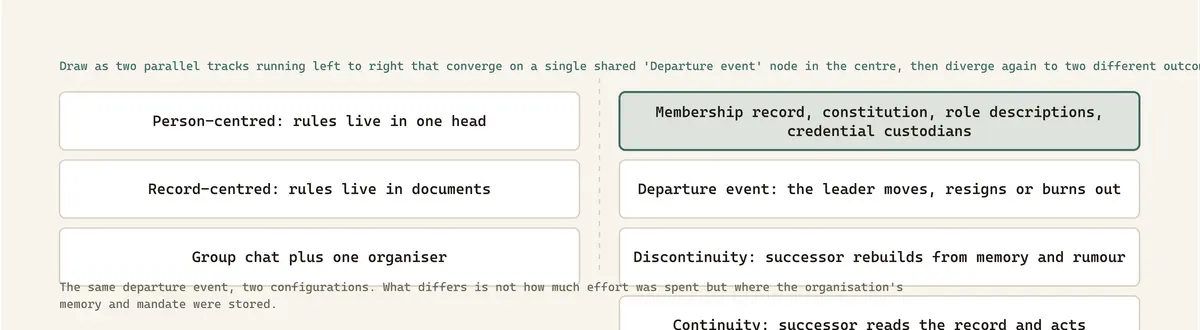
Written in advance, a constitution is a shared instrument. Written after a dispute, it is the winning side's account of the dispute, and everybody can tell.
A membership record beats a great launch event
A launch event proves that people will come once. That is all it proves. It measures curiosity plus catering. A membership record proves something harder and far more useful: that you can find those people again, that you know who they are, and that they have agreed to be contacted.
Audience and membership are different objects. An audience is a number that decays the moment the room empties. Membership is a list with fields: identity, contact route, joining date, status and consent. Consent matters more than people expect. A list nobody agreed to be on is not an asset, it is a liability, and the first time you misuse it you lose the trust that made it possible.
The constitution is the second file and it does one job. It answers questions before they are contested. Who decides. Who votes and on what. Who may spend, against what authority. How an officer is removed. How the document itself is amended. Written in advance, a constitution is a shared instrument. Written after a dispute, it is the winning side's account of the dispute, and everybody can tell.
There is a specific reason this matters for a national diaspora body rather than a friendship circle. Nigeria is not one community. The association's own framing is that it holds people from every part of the country, and a group like that cannot run on the implicit norms of a single chat, because there is no single chat whose norms everyone shares. Familiar people improvise. Strangers need a document.
What gating means in practice
A gate is not a milestone. A milestone marks that time has passed. A gate refuses passage.
Five workstreams, run in sequence, each opening only when the one before it passes a written test that a person who was not in the room can verify. That last clause is the entire mechanism. If the only evidence a workstream is finished is that the people who did it feel good about it, there is no gate. There is a feeling.
The particular division matters less than the discipline, so here is the shape of the test rather than my own list. A gate asks whether the output exists as an artefact rather than as an intention. Whether a second person can operate it without asking the first. Whether it survives the original team leaving. Whether the next workstream would have to be rebuilt if this one turned out to be wrong.
That last question is why gates exist at all. Rework is the tax on bad sequencing. Build a programme on a membership list that turns out to be a chat export and you rebuild the programme, not the list. Run activities in the association's name before there is a mandate defining what the name covers and you have created borrowed authority, which is fine right up until somebody objects and there is no document to point at. Take money before there is a rule about who may spend it and you have manufactured a future argument with real names attached.
Gating costs speed. That is not a hidden cost. It is the whole price, paid openly. What you buy is that nothing downstream rests on a personality.
You cannot direct volunteers, only unblock them
Sequencing matters more in a volunteer organisation than in a company, for a narrow reason. A company absorbs a bad sequence by spending paid hours on the rework. A volunteer body pays for a bad sequence in goodwill, and goodwill does not refill on a schedule.
You cannot assign work to a volunteer. You can only make acting easier than not acting. That is not a motivational claim, it is closer to a physical constraint. The research on episodic volunteering is instructive. Hyde, Dunn, Bax and Chambers, studying volunteers across three phases of involvement, found satisfaction predicting retention at every phase. For first-time volunteers, social norm (roughly, having been asked by someone) and social or enjoyment motives predicted whether they returned. For long-sustained volunteers, commitment and social norm did the work.
Read that as a design brief rather than as psychology. Being asked matters, which means the organisation has to know who to ask, which returns you to the membership record. Satisfaction matters at every stage, which means the task must be completable, and a task is completable when it is small, bounded in time and scoped before it is offered. A volunteer's scarce resource is not effort. It is the attention needed to work out what the task actually is. Structure spends that in advance, on their behalf.
Volunteer organisation succession planning is designed, not hoped for
BoardSource has been asking nonprofit boards for years whether they hold a written executive succession plan, and the share reporting one has stayed well under a third. Those are organisations with staff, budgets and legal obligations. A volunteer association has fewer reasons to be disciplined and more reasons to need it.
Designed succession has parts and most of them are dull. Written role descriptions, so that an office is a defined thing rather than one person's habits. A deputy for each role who does part of the work rather than holding a title. Records in shared custody: the membership record, the constitution, the minutes, the accounts. Term limits and scheduled elections, so that transfer is a routine event rather than a crisis with a name attached. A handover artefact per role, produced during the term rather than in its final week. And a public record of who has held office before, which sounds ceremonial and is not, because it is what makes an office feel like something held in trust rather than something owned. The association's site lists its elected executives, its coordinators and its past executives at nigeriansinshenzhen.org. That visibility is a design decision.
Succession usually fails at the credential layer and almost nobody writes about it, because it is embarrassing. The bank mandate. The domain registrar. The social accounts. The document store. An organisation can have an elegant constitution and still be one person's phone away from starting over. Enumerate the credentials, name a custodian for each, and rehearse the handover before you need it.
The case for one person and a group chat
The strongest argument against everything above is that it is often unnecessary and sometimes actively harmful.
During the COVID-19 pandemic, thousands of mutual aid groups formed and did real work. Fernandes-Jesus and colleagues, interviewing organisers across the United Kingdom, found that most of these groups had no legal status and no formal chairs, that coordination was shared and assumed informally, and that participants valued the absence of formal rules as consistent with the principle of mutual aid. What sustained them was distributing the workload and supporting each other, not governance documents. Speed and local knowledge were the assets.
Take that seriously rather than as a foil. Every form is a tax on somebody's evening. Every gate is a delay, and delay has a specific cost in a volunteer body, because the enthusiasm that would have carried a project has a short half-life. A constitution in the hands of a procedural personality becomes a weapon: motions, points of order, three meetings to approve what one person could have done in an afternoon. Schmidt's warning applies here too. Best practice imported wholesale is its own failure mode.
The honest boundary runs like this. Informality performs well when the task is single, urgent and legible to everyone, because then the coordination problem is small and shared understanding does the work a document would otherwise do. It degrades when the task list is open-ended, when the population turns over, and when the time horizon is longer than any one person's stay. A diaspora association in a city people move to for a few years is squarely the second case.
One more thing about that mutual aid research, and the authors say it themselves. They did not study the groups that folded. Which is the exact population the argument turns on.
The part no constitution can compel
Everything described here can be built by someone who intends never to leave. Term limits get suspended by a vote nobody contests. Deputies receive titles and no work. The membership record exists and one person has the password. The machinery is easy to build and easy to hollow out, and the hollowing has no alarm attached, because the person who would raise it is usually the person doing it.
So the real gate is not written down anywhere. It is whether the officer wants to be replaceable, and wanting that is an odd thing to want. Most of what makes someone good at holding a volunteer organisation together (absorbing the ambiguity, answering at midnight, being the one who always shows up) is the same behaviour that makes them hard to replace. The skill and the defect are the same act.
I will not know whether the sequencing was right for years. The evidence, if it ever arrives, will be a decision made correctly by people I have never met, about a record I started, using a rule I wrote down and then forgot.
Sources
Block & Rosenberg (2002), Toward an Understanding of Founder's Syndrome, Nonprofit Management and Leadership: https://onlinelibrary.wiley.com/doi/abs/10.1002/nml.12403
Elizabeth Schmidt, Rediagnosing "Founder's Syndrome", Nonprofit Quarterly: https://nonprofitquarterly.org/rediagnosing-founder-s-syndrome-moving-beyond-stereotypes-to-improve-nonprofit-performance/
BoardSource, Executive Transition and Succession Planning (Leading with Intent): https://boardsource.org/fundamental-topics-of-nonprofit-board-service/executive-transition/
Hyde, Dunn, Bax & Chambers (2016), Episodic Volunteering and Retention, Nonprofit and Voluntary Sector Quarterly 45(1): https://journals.sagepub.com/doi/10.1177/0899764014558934
Fernandes-Jesus et al. (2021), More Than a COVID-19 Response: Sustaining Mutual Aid Groups, Frontiers in Psychology 12:716202: https://pmc.ncbi.nlm.nih.gov/articles/PMC8563598/
Nigerians in Shenzhen Association: https://www.nigeriansinshenzhen.org
Tags
Thinking through a system like this one? I'm open to a conversation about the subject matter.
Start a conversation