An AI research assistant for literature review does not read for you
Gemini Notebook answers only from sources you supply. That fence moves the error rather than deleting it, and the part it cannot do, judging whether your corpus is any good, stays with you.
An AI research assistant for literature review is a different machine from a general chatbot. The difference is scope, not intelligence. Gemini Notebook, which Google renamed from NotebookLM on 16 July 2026, answers only from the documents sitting in the notebook. Google's help page puts it flatly: it "answers questions based on the information provided in your uploaded sources". The designed behaviour when you ask about something outside that set is to tell you it cannot find it, not to fill the gap from general knowledge.
That fence is the product. It is also the thing most engineers misread, myself included for longer than I would like to admit. Restricting a model to sources you trust does not make its output trustworthy. It moves the error somewhere quieter, and the new location is harder to notice because every line on screen now has a citation hanging off it.
Here is the tradeoff nobody puts in the README. Grounding closes exactly one of the five gates where a wrong claim can enter your notes, and it is not the gate that fails most often.
Grounding changes the error profile, it does not remove it
The mechanism is retrieval augmented generation. Your documents get parsed to text, split into chunks, embedded and indexed. A query retrieves the chunks that score as relevant, and generation is conditioned on those chunks instead of on the model's general knowledge. An open-context assistant like Claude will happily reason from everything it absorbed in training plus whatever you paste. A source-grounded notebook reasons from a set you chose. That is a real architectural difference and it produces a real behavioural difference.
It produces five distinct places to be wrong. Corpus error: the answer is not in what you uploaded, and the tool has no way to know that, so it answers from what is there. Extraction error: the parser dropped it. Google documents that only the text content of an HTML page is scraped, with images, embedded video and nested pages left out, and that footnotes and comments are not imported from Google files. A number living in a scanned table is not in your notebook at all. Retrieval error: the passage exists and never gets surfaced, so an omission arrives wearing the clothes of a finding. Faithfulness error: generation flattens a hedge, merges two sources or drops a scope condition. Citation error: the pointer lands on a real span and the reading of that span is wrong.
Two public measurements are worth holding, with the caveat that neither one measures this product. Magesh and colleagues at Stanford ran a preregistered evaluation of legal research tools whose vendors marketed retrieval augmented generation as eliminating hallucination, and found hallucination rates between 17 percent and 33 percent depending on the system, published in the Journal of Empirical Legal Studies in 2025. Separately, Liu, Zhang and Liang audited four generative search engines and found that on average only 51.5 percent of generated sentences were fully supported by their citations, and only 74.5 percent of citations supported the sentence they were attached to.
Different systems, different corpora, different task. What transfers is the shape of the result. A visible citation is a weak signal of a correct claim, and every vendor who has marketed grounding as a cure for hallucination has so far been measured and found optimistic.
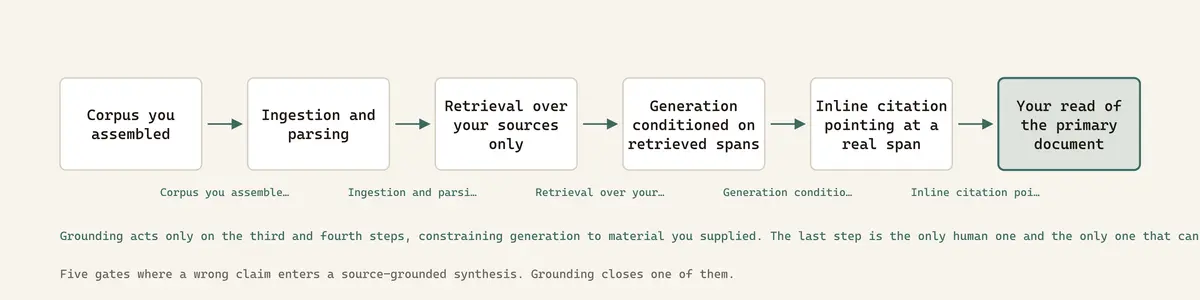
Every citation checks out. The claim does not exist in either source.
Where an AI research assistant for literature review earns its place
Orientation is the strongest case. You have thirty PDFs on a topic you do not know and no idea which six matter. Asking which sources define a given term, and where, produces a map with pointers in about ninety seconds. That is genuinely hard to do by hand and cheap to verify, because every claim resolves to a span you can open.
The through-line is the second case. Ask what assumption all these documents share and you sometimes get the thing none of them states, because none of them thought it needed stating. That is the kind of observation that is invisible when you read documents one at a time.
Disagreement is where I get the most value. The query I run first on any new corpus is some form of: where do these sources contradict each other, quote both sides. Contradiction detection is a retrieval and comparison task rather than a knowledge task, which is exactly the shape a constrained system handles well. It is also the query whose output is hardest to fake, because a fabricated contradiction falls apart the moment you open either citation.
The version I would not ship again is the summary request. Asking for a summary of the corpus produces the worst ratio of usefulness to verification cost in the whole tool. It reads beautifully, it flattens every qualifier and you have to check all of it anyway. Ask for contradictions, scope conditions and pointers instead.
The Chinese and English literatures on the same topic do not agree
I read on both sides. Living in Shenzhen and working in Mandarin, I end up holding two bodies of writing on the same technical question, and they are not translations of each other. They disagree about baselines. They disagree about which failure modes deserve writing down. Sometimes they are arguing about different objects using words a dictionary maps onto each other.
Standards make this concrete. A Chinese national standard can be an identical adoption of an ISO or IEC text, a modified adoption or an independent document, and the modifications are precisely where the engineering decisions live. English commentary tends to assume the international text. Chinese commentary tends to assume the modified one. Neither side usually says which.
A notebook holding both literatures is very good at showing me where the divergence sits. Ask which sources give a different value for the same parameter and require a citation on each side, and it finds them. What it will not do is tell me which one governs the case in front of me.
Then the failure I keep meeting. Asked to synthesise rather than to compare, it smooths. It produces a middle position that neither literature actually holds, phrased with confidence and cited correctly to both. Every citation checks out. The claim does not exist in either source. That is the moment to close the tool and open the primary document, and it is the single strongest argument for reading the original that I know.
There is a mechanical wrinkle underneath all this. The Chinese national standards portal at openstd.samr.gov.cn provides free online reading for a large share of GB and GB/T texts, and part of that set is read-online only rather than downloadable, particularly documents adopted from copyrighted international standards. You cannot upload what you cannot export. So a slice of the corpus stays outside the notebook permanently, and the notebook has no way of telling you it is reasoning without it. For what I can export, I run scanned or table-heavy PDFs through MinerU first so tables and formulas survive as text rather than as images the parser silently discards, and I keep DeepL open to cross-check a term of art rather than trusting one rendering of it.
Judging source quality stays with you
Every document in the notebook is equally authoritative to the tool. A superseded revision of a standard, a vendor whitepaper written to sell something, a preprint that never survived review, a blog post that misquotes the clause it links to. The tool synthesises across all of them, weights them evenly and cites each one accurately. The citations will be right. The synthesis will be wrong.
So the work moved earlier, to corpus construction, which is the part a tool that only sees what you already handed it cannot help with by definition. Rules I hold to. One document per source, so a citation resolves to something findable. Designation and revision year in the filename, so a superseded text cannot pass as current. Primary documents and commentary in separate notebooks, unless the question is specifically about the gap between them.
This is also the honest boundary between this class of tool and its neighbours. Elicit searches a literature and brings candidates to you. Glean indexes an organisation's own material and helps you find what exists. Those tools help assemble a corpus. A source-grounded notebook assumes the corpus question is already settled, and in technical work the corpus question is usually the one that decides the answer.
A grounded citation can still be a misreading
The discipline is short and it is not optional. Open the cite and read the sentences on either side of it, because the hedge usually lives just outside the retrieved span. Check whether the source is asserting the claim or reporting somebody else's claim, since a retriever cannot distinguish "X found Y" from "X argues Y is mistaken" and literature reviews are made almost entirely of the second kind of sentence. Check scope conditions: under laboratory conditions, for samples above a threshold, in the revision before last.
Check numbers against the table rather than the prose, and if the table came in as an image, treat it as absent. Check that a claim attributed to two sources really appears in both. Conflation is the most common failure I meet in practice, and it is the hardest to catch, because the output looks stronger for having two citations rather than one.
The rule I use to keep this affordable: verify every number and every claim that would change a decision. Skip verification only on output that is orientation rather than evidence, and never let orientation output migrate into a document somebody else will act on.
A workflow for a standards corpus
Build the corpus deliberately before you open anything. The base standard, its amendments, the normative references it actually depends on and the two or three papers that criticise it. Keep the first pass small.
Normalise before upload. Extraction step for scanned and table-heavy documents, designation and year in every filename, one document per file.
Make the first query an inventory rather than a synthesis. Which sources define this term, and in which clause. You are building a map, not an answer.
Make the second query about disagreement. Where do these documents give different values, thresholds or scopes for the same thing, with a citation on each side.
Make the third query about dependency. Which clauses here rely on normative references that are not in this notebook. This is the query that surfaces the hole in your corpus, and it is the one people skip.
Verify every retained claim against the primary document, keeping a column for checked and not checked. Then write the through-line yourself, with the notebook closed. If you cannot write it without the tool open, you do not have it yet, and that test has caught me more than once.
The limits that are not in the marketing copy
Google publishes the free-tier numbers directly. One hundred notebooks, up to 50 sources each, 500,000 words per source, up to 200MB for a local upload, and daily ceilings of 50 chat queries and 3 audio generations. Paid tiers multiply the standard limits rather than restating them: AI Plus at two times, AI Pro at four times, AI Ultra at five or twenty times AI Pro depending on subscription. Google does not publish absolute per-tier source counts, whatever the aggregator blogs assert.
The ingestion limits matter more than the counts for technical work. Paywalled pages are unsupported. Only HTML text is scraped. YouTube sources must be public and captioned. Google Sheets are capped around 100,000 tokens and Slides at 100. Footnotes and comments do not come across from Google files, which is a quiet disaster for any corpus where the qualifications live in the footnotes.
The unwritten limit is quality against corpus size. Liu and colleagues showed in TACL in 2024 that model accuracy over long inputs traces a U-shaped curve by position, worst when the relevant material sits in the middle. That result concerns position within a long context window rather than chunk retrieval in this specific product, so treat it as a mechanism worth knowing rather than a measurement of Gemini Notebook. It does match what I see. For a review I intend to defend, I work with twenty to thirty well-chosen sources, comfortably under the documented ceiling, and split anything larger into separate notebooks by question.
The counter-argument: fluency about a corpus you have not read
The strongest case against everything above is that synthesis tools manufacture the sensation of having read. Known ignorance is a functional state. You move carefully, you hedge, you go and check. Fluent half-knowledge is not functional at all. You cite with confidence, you make the call and the error travels downstream wearing your name. The citation interface makes this worse rather than better, because a visible footnote produces the feeling of verification in a reader who never clicked it. I think this objection is correct, and I do not think the tooling is going to solve it.
What I would say against it is narrow. The failure is not caused by grounding. It is caused by stopping. The same person skimming abstracts and quoting them as findings has been producing this failure since long before retrieval augmented generation existed. What is new is throughput, which raises the cost of the habit rather than creating it.
The tension I have not resolved is worse than the objection. This tool is most valuable exactly where I am least equipped to audit it, in a corpus I do not know, in a field whose conventions I have not internalised. The better it performs in unfamiliar territory, the less able I am to tell whether it performed at all. I have no procedure that closes that gap. Only the slow thing: reading the primary sources, in the order the tool suggested, until the map and the ground agree or the map turns out to have been drawn of somewhere else.
Tools referenced
Gemini Notebook, reviewed here: Gemini Notebook review.
Claude, reviewed here: Claude review.
Elicit, reviewed here: Elicit review.
Glean, reviewed here: Glean review.
MinerU, reviewed here: MinerU review.
DeepL, reviewed here: DeepL review.
Sources
Gemini Notebook Help, frequently asked questions (usage limits): https://support.google.com/notebooklm/answer/16269187?hl=en
Gemini Notebook Help, add or discover new sources for your notebook: https://support.google.com/gemininotebook/answer/16215270?hl=en&co=GENIE.Platform%3DDesktop
Gemini Notebook Help, manage your usage limits by plan: https://support.google.com/gemininotebook/answer/17670842?hl=en&co=GENIE.Platform%3DDesktop
Google blog, NotebookLM is now Gemini Notebook (16 July 2026): https://blog.google/innovation-and-ai/products/gemini-notebook/notebooklm-gemini-notebook/
Magesh et al., Hallucination-Free? Assessing the Reliability of Leading AI Legal Research Tools, Journal of Empirical Legal Studies 2025: https://onlinelibrary.wiley.com/doi/full/10.1111/jels.12413
Liu, Zhang and Liang, Evaluating Verifiability in Generative Search Engines, Findings of EMNLP 2023: https://aclanthology.org/2023.findings-emnlp.467/
Liu et al., Lost in the Middle: How Language Models Use Long Contexts, TACL 2024: https://aclanthology.org/2024.tacl-1.9/
国家标准全文公开系统, Chinese national standards full-text portal (SAMR): https://openstd.samr.gov.cn/bzgk/gb/index
Frequently Asked Questions
Does a source-grounded tool like NotebookLM still hallucinate?
Yes, though differently. Restricting a model to your uploaded sources removes the class of error where it invents a document that does not exist, but it leaves retrieval misses, flattened hedges, conflated sources and citations that point at a real passage while misreading it. A Stanford evaluation published in the Journal of Empirical Legal Studies in 2025 found legal research tools marketed as hallucination-free through retrieval augmented generation still hallucinated on 17 to 33 percent of queries depending on the system.
How many sources can one Gemini Notebook hold, and how long can they be?
On the free tier Google documents 100 notebooks, up to 50 sources per notebook, 500,000 words per source and up to 200MB for a local upload, with daily ceilings of 50 chat queries and 3 audio generations. Paid tiers multiply the standard limits: AI Plus at two times, AI Pro at four times, and AI Ultra at five or twenty times AI Pro depending on the subscription. Google publishes multipliers rather than absolute per-tier source counts.
Is an inline citation the same thing as a verified claim?
No. A citation confirms that the generated sentence was produced from a specific span of a specific document you supplied. It says nothing about whether that span was read correctly, whether the qualifying clause sat just outside the retrieved text, or whether the source was asserting the claim or reporting somebody else's claim in order to disagree with it. Verification means opening the cite and reading around it.
What is a source-grounded notebook genuinely better at than a general chatbot?
Three things. Orienting you in an unfamiliar corpus by telling you which documents address a term and where. Finding the assumption every document shares without stating. And surfacing where sources contradict each other, with a citation on each side, which is a retrieval and comparison task rather than a knowledge task. It is weakest at exactly the thing it looks best at, which is producing a clean summary.
Can it work across Chinese and English sources in the same notebook?
Yes, and cross-language comparison is one of the better uses for it, because the two literatures on a technical topic frequently disagree about baselines and scope rather than merely translating one another. The caution is that when asked to synthesise rather than compare, it tends to produce a middle position neither literature holds, correctly cited to both. Ask it where the sources diverge, then read the primary document.
What should the corpus look like for a standards review?
The base standard, its amendments, the normative references it actually depends on and a small number of critical papers, with the designation and revision year in every filename and one document per file. Keep it to roughly twenty to thirty sources for a review you intend to defend. Standards that are read-online only and cannot be exported stay outside the notebook, and the notebook will not tell you it is reasoning without them.

About Francis Okafor
Nigerian engineer, eight years inside China's tech ecosystem, writing from Shenzhen. I build agentic AI systems that drive physical hardware, and I write about how these systems behave once they are carrying real load.