When to Use a Service Mesh: Day One Is Usually Too Early
A mesh gives you enforcement your code cannot. It also charges per pod from day one. What ambient mode changed, what a gateway plus disciplined timeouts still covers and when the tradeoff flips.

The question of when to use a service mesh almost never arrives in that form. It shows up as a ticket that says enable mTLS. Somebody said zero trust in a design review, somebody else read the Istio quickstart, and by Friday there is a plan to label every namespace. I have been in that room. I have also been in the later room, the one where four people argue about whether a 503 came from the application, from the sidecar or from a control plane that pushed new config a few seconds ago.
Meshes are not the problem. Sequencing is. A mesh solves a real class of problem, and that problem gets strictly harder to solve by hand as a fleet grows. It also bills you from the first day, in resident memory per pod, in extra hops per request and in the cost of holding a second networking model in your head alongside the one Kubernetes already gave you. The bill is immediate. The value is deferred, and conditional on growth you have not had yet.
So this is about what you should be able to point at before that complexity is earned. What the cheaper path covers. Where it stops covering. And what ambient mode changed about the arithmetic.
What a mesh gives you that your code cannot
Identity on every hop. Not TLS, which you can bolt on anywhere, but workload identity: a certificate asserting that this is the checkout service in the payments namespace, issued and rotated automatically and usable in policy. Authorization stops being a network question and becomes an identity question. That genuinely changes how you reason about a compromised pod.
Uniform L7 behaviour across languages. This is the one I would fight for. Retries, timeouts, outlier ejection and circuit breaking, stated once and true everywhere, including in the Python service nobody owns and the Node service a contractor wrote years ago. A shared library gives you the same behaviour only in the languages you wrote it for and only in the services that upgraded.
Traffic shifting on internal calls, by weight or by header, without a deploy and without a feature flag threaded through every caller. Plus per-hop telemetry you never instrumented: rate, errors and latency for every edge in the call graph, including the edges you did not know existed. The mesh sees them because it sits in the path.
Underneath all of it is one property a library cannot give you. Enforcement. A library is advice, and somebody can skip the import, pin an old version or construct a raw client at 2am during an incident. A sidecar is not optional and cannot be bypassed by the code it wraps. Most of what you pay a mesh for is the distance between those two facts.
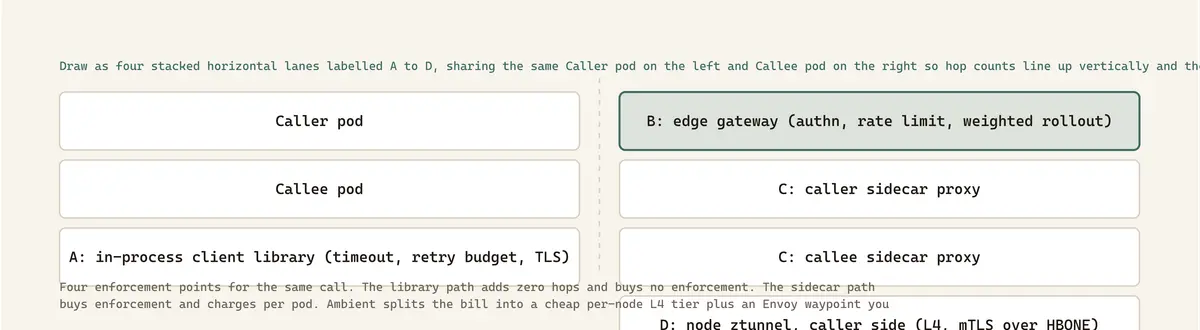
A library is advice. A sidecar is a rule. Most of what you pay a mesh for is the distance between those two facts.
The bill: a proxy per pod, a control plane and a second network to debug
Start with the number that is easiest to verify. Istio publishes its own performance data, benchmarked against 1.24 on the CNCF Community Infrastructure Lab: roughly 0.20 vCPU and 60 MB of memory per sidecar proxy, measured at 1,000 requests per second with 1 KB payloads and two proxy worker threads. Per proxy means per pod. Three hundred pods is about 18 GB of memory running no business logic and 60 vCPU of headroom you now have to schedule. On a small fleet that is noise. On a fleet already arguing about node sizes it is a line item, and it is the line item most likely to get the mesh blamed for a cost review it did not cause.
Latency is harder to state honestly, and how vendors report it tells you something. Istio's own page gives P90 and P99 comparison charts rather than a single headline millisecond figure. Buoyant, which sells a Linkerd distribution, published a benchmark in April 2025 run by a Linkerd Ambassador reporting Istio sidecar P99 sitting 22.83 ms above Linkerd at 200 requests per second and 163 ms above at 2,000, with ambient in between. Vendor numbers, published as deltas without absolute baselines on the page. Discount them accordingly. The direction is not in dispute: two extra proxy hops per request cost tail latency, and the cost grows with load.
The line nobody budgets is debugging. A meshed request has more places to be wrong, and the new places are unfamiliar. Envoy response flags enter your incident vocabulary. Permissive versus strict mTLS becomes a per-namespace state somebody has to know at 3am. Pod lifecycle becomes a concern, though this one has genuinely improved: Kubernetes native sidecars, first available in 1.28 and stable since 1.33, let an init container with restartPolicy Always start before the app containers and terminate after them, which killed the old class of bugs where a Job never completed because the proxy kept running.
And the default configuration is a trap for exactly the team most likely to install a mesh early. Istio documents that HTTP requests are retried twice by default and that the Envoy request timeout is disabled by default. Read those two sentences together. Out of the box you get retry amplification with no ceiling. One slow dependency at the bottom of a three-hop chain, every hop retrying, and the mesh you installed for resilience becomes the mechanism converting a slow service into an outage. It is not a hidden bug. It is documented. It is also the failure mode I keep meeting, because the team that installs a mesh to get resilience is precisely the team that has not yet written a retry budget.
The honest alternative for a small fleet
Two pieces, and the second one is where teams fail.
A gateway at the edge. You already terminate TLS somewhere. That box can do authentication, rate limiting, weighted rollouts and header routing for north-south traffic, and under roughly fifteen services most of the traffic worth shaping is north-south anyway. One configuration surface, one team that understands it, no per-pod cost.
A shared client for east-west. If your services speak gRPC, much of what you want is already in the library: retry and hedging policies live in gRPC service config and are set per method. The gRPC default is instructive. Retry is enabled as a capability but there is no default retry policy, so nothing is retried until you state what to retry and how often. That is the opposite of Istio's default and it is the safer one. For plain HTTP, a thin wrapper per language that sets a connect timeout, a request timeout, a deadline that propagates and a retry budget rather than a retry count.
The discipline is the part that rots. A library is advisory, so make it non-advisory by other means. Put a static analysis rule in CI that fails the build when an HTTP or gRPC client is constructed without an explicit timeout. Semgrep is the usual tool and the rule takes an afternoon. In a thirty-service fleet that one rule prevents more real incidents than a mesh will, because the incident you actually get is not a missing certificate. It is a default-infinite timeout on a call to something that got slow.
If you need workload identity without a mesh, you can have it. SPIFFE and SPIRE graduated from the CNCF in September 2022 and issue short-lived X.509 identities to workloads based on platform attestation, which your services then use for mutual TLS directly. More wiring per application, no traffic management, but it decouples the identity decision from the proxy decision. That is the decoupling that matters.
State the limit plainly, because it is real. This path is per-language, advisory rather than enforced, and it degrades exactly as your fleet goes polyglot and teams stop reviewing each other's clients. It works because the fleet is small enough that a person can hold the exceptions in their head. That property expires without warning.
Ambient and proxyless move the cost, they do not delete it
Istio's ambient mode reached general availability in 1.24 on 7 November 2024, with ztunnel, waypoints and the associated APIs marked stable. It splits the data plane in two. A per-node ztunnel, written in Rust and shipped as a DaemonSet, handles L4: mTLS over HBONE, L4 authorization and telemetry. Optional waypoint proxies, which are Envoy, handle L7 and exist only where you asked for L7.
The resource argument is strong and it is Istio's own number. Under the same benchmark conditions, ztunnel costs roughly 0.06 vCPU and 12 MB against roughly 0.20 vCPU and 60 MB for a sidecar. A waypoint costs about 0.25 vCPU and 60 MB, but there is one per namespace or per service rather than one per pod. If your needs are met by mTLS and identity-based authorization at L4, ambient removes most of the per-pod tax that made early adoption hard to justify in 2022.
What it does not remove: the control plane, the second networking model and the debugging surface. It also reshapes failure in a way worth arguing about. A sidecar that dies takes one pod with it. A ztunnel that dies takes the L4 path for every workload on that node. Linkerd's public position leans on exactly this. One Rust micro-proxy per pod, a single tier, a blast radius of one pod, and enabling L7 features changes configuration rather than topology. That is a fair argument and I have not seen it answered well.
Before choosing Linkerd on those grounds, understand the release model. Since February 2024 the open source project no longer publishes stable release artifacts. You take edge releases, which ship roughly weekly from main and are meant to be usable in production but can carry breaking changes, or you take a vendor distribution. Linkerd 2.20 stable arrived in June 2026 through Buoyant. The code is Apache 2.0. The stable build is a procurement conversation. Not a reason to reject it, but it belongs in the decision, and it never appears on an architecture diagram.
Proxyless is the third direction and the narrowest. gRPC speaks xDS natively, so an all-gRPC fleet can take discovery, load balancing and routing straight from istiod with no data plane proxy and no added hops. The catch has three parts. It covers gRPC only, so the first plain HTTP call puts you back on a proxy. The feature set trails Envoy. And you have moved mesh behaviour inside your application binary, which means a policy change is now a redeploy and your dependency graph is coupled to your control plane's xDS version. For a homogeneous gRPC fleet that is a good trade. For everyone else it is a partial answer wearing a full answer's name.
The counter-argument I take most seriously: retrofitting mTLS is worse than adopting early
If you know that every service-to-service hop will have to be encrypted and identity-authenticated for an audit with a date on it, install the mesh now. At twelve services. Not because it is cheaper today, because it is not, but because the retrofit cost does not scale linearly and the part that does not scale is not the install.
Here is the mechanism. You cannot flip a running fleet to strict mTLS in one change, so you run permissive mode, which means operating two authentication modes at once, per namespace, across services carrying production traffic, for as long as the migration takes. Every workload that is not meshed becomes an exception somebody tracks. Headless services. StatefulSets doing direct pod addressing. Anything talking to a database outside the cluster. Anything with a client that pins its own TLS config. The install is a day. The exception list is the project. At twelve services that list fits on a page. At a hundred and twenty it has a manager.
The other half of the cost is human. Adopting a mesh changes what your dashboards mean and what an error looks like. Do it while the fleet is small and the new behaviour is simply how things have always worked. Do it at a hundred and twenty services and you are rewriting every runbook, then retraining everyone who reads them.
Ambient makes this case stronger specifically. You can put a namespace into the L4 overlay with a label, without editing pod specs, and get mTLS and L4 authorization immediately, adding waypoints later only where L7 policy is actually required. That is a far better early adoption story than sidecar injection ever offered, and it makes the compliance-driven argument harder to dismiss than it was two years ago. The boundary I would hold is the word certainly. An auditor with a scope document and a date is a certainty. A compliance slide in next year's roadmap deck is not. And one thing I would not defer either way: workload identity. Skip the mesh if you like, but get SPIFFE identities or the cloud equivalent early. Proxies are replaceable and people replace them. The identity model ends up wired into authorization decisions everywhere, and that is the genuinely expensive thing to change later.
Signals that mean you now need one
None of these is a service count. Service count is the worst available trigger and it is the one most teams use. Fifty stateless Go services behind one gateway with one shared client do not need a mesh.
First, a policy has to be reimplemented per language. Three or more languages in the request path and no single timeout or retry rule that is true in all of them. The moment the policy exists in three places it is already wrong in one. Second, cross-service incidents are debugged by elimination, because you have per-service metrics and no per-hop attribution, so finding the slow edge means adding logs and waiting for it to happen again. Third, internal rollouts require a deploy: you want five percent of an internal RPC on the new version and your only lever is shipping code.
Fourth, the same missing timeout keeps coming back, and the CI rule you wrote to catch it keeps getting worked around. That is where advisory stops working and you need enforcement in the path. Fifth, there is a date on a calendar and an auditor attached to it. Two of these together is enough. One is a conversation.
What ambient does not settle
The weakness in every sequencing argument, mine included, is that it assumes you will notice the threshold when you cross it. Teams do not. Every signal above is a lagging indicator. By the time you can name three incidents caused by inconsistent timeout policy, you have already paid for the mesh in outages, and now you get to install it into a fleet that is under load and staffed by people who are tired. Which is the most expensive moment to install anything.
Ambient makes this worse for my own position, not better. When the L4 tier costs 12 MB per node and a namespace label, the case for waiting stops being about resources. What is left is the control plane, the second routing model and the fact that a mesh gives your outages a new place to hide. None of that got cheaper in 1.24, or in 1.30 in May 2026, and none of it shows up in a benchmark.
So the test I would actually apply has nothing to do with the mesh. Take your current on-call rotation. Hand them a request that is slow. Time how long it takes to establish whether the slowness is in the application, in the network or in something sitting between the two. If that already takes hours, putting a proxy on every hop will not shorten it. It will give the ambiguity somewhere better to live.
Tools referenced
Semgrep, reviewed here: Semgrep review.
Sources
Istio: Fast, Secure, and Simple, Ambient Mode Reaches General Availability in v1.24 (7 November 2024): https://istio.io/latest/blog/2024/ambient-reaches-ga/
Istio: Performance and Scalability, per-proxy CPU and memory figures benchmarked against 1.24: https://istio.io/latest/docs/ops/deployment/performance-and-scalability/
Istio: Traffic Management concepts, default retry behaviour and disabled default request timeout: https://istio.io/latest/docs/concepts/traffic-management/
Kubernetes: Sidecar Containers, stable since v1.33, first available in v1.28: https://kubernetes.io/docs/concepts/workloads/pods/sidecar-containers/
Linkerd: Releases and Versions, edge versus stable release model since February 2024: https://linkerd.io/releases/
Linkerd vs Ambient Mesh 2025 Benchmarks (vendor-published, 24 April 2025): https://linkerd.io/2025/04/24/linkerd-vs-ambient-mesh-2025-benchmarks/
gRPC: Retry documentation, retry and hedging policy in service config: https://grpc.io/docs/guides/retry/
CNCF: SPIFFE and SPIRE Graduate from the CNCF Incubator (20 September 2022): https://www.cncf.io/announcements/2022/09/20/spiffe-and-spire-projects-graduate-from-cloud-native-computing-foundation-incubator/
Frequently Asked Questions
Do I need a service mesh for a small Kubernetes cluster?
Usually not. Below roughly a dozen services in one or two languages, an edge gateway plus a shared client library that sets explicit timeouts and a retry budget covers most of what a mesh would give you, at no per-pod cost. The exception is compliance. If you face an audit with a date that requires encrypted and identity-authenticated service-to-service traffic, adopt early, because the retrofit cost is dominated by the exception list rather than the install.
How much CPU and memory does a service mesh sidecar actually use?
Istio's published performance data, benchmarked against version 1.24, puts a sidecar proxy at roughly 0.20 vCPU and 60 MB of memory at 1,000 requests per second with 1 KB payloads and two proxy worker threads. That figure is per pod. Istio's ambient ztunnel, which runs per node rather than per pod, costs roughly 0.06 vCPU and 12 MB under the same conditions, and an ambient waypoint proxy costs about 0.25 vCPU and 60 MB per namespace or service.
Is Istio ambient mode production ready?
Yes. Ambient mode reached general availability in Istio 1.24 on 7 November 2024, with ztunnel, waypoints and the associated APIs marked stable by the Istio TOC. Istio has shipped several releases since, reaching 1.30 in May 2026. Sidecar mode has not been deprecated, the two modes coexist, and Istio documents a gradual and reversible migration path from sidecars to ambient.
Can you get mTLS between services without a service mesh?
Yes. SPIFFE and SPIRE, which graduated from the CNCF in September 2022, issue short-lived X.509 identities to workloads based on platform attestation, and services then perform mutual TLS with those identities directly. You get identity and encryption without any proxy in the path. You do not get traffic management, per-hop telemetry or centrally enforced retry and timeout policy, and there is more wiring per application.
Why is Istio's default retry configuration risky?
Istio documents that HTTP requests are retried twice by default and that the Envoy request timeout is disabled by default. Together those defaults produce retry amplification with no ceiling: one slow dependency at the bottom of a multi-hop chain gets multiplied by every meshed hop above it. Set explicit request timeouts and a retry budget rather than a retry count before you rely on a mesh for resilience.
Is Linkerd still free to use?
Linkerd remains Apache 2.0 licensed, but since February 2024 the open source project no longer publishes stable release artifacts. You can run the freely available edge releases, which ship roughly weekly from the main branch and can carry breaking changes, or take a stable build from a vendor distribution. Linkerd 2.20 stable was released in June 2026 through Buoyant.

About Francis Okafor
Nigerian engineer, eight years inside China's tech ecosystem, writing from Shenzhen. I build agentic AI systems that drive physical hardware, and I write about how these systems behave once they are carrying real load.