The Four Levels of AI Fluency and Why Level Three Never Arrives on Its Own
 Francis Okafor
On this page
- Level one: the prompter
- Level two: the automator
- Level three: the builder, who owns evaluation
- Level four: the orchestrator, who owns the failure modes
- Level two is the trade of the decade in Lagos and Nairobi
- The objection I take seriously
- Reading the levels of AI fluency off a job description
- The rung nobody gets promoted for
- Tools referenced
- Sources
Nigeria ranks sixth in the world for workforce AI literacy and nineteenth for enterprise AI adoption. Same country. Same index, same month. The Ataraxis Global Outsourcing AI Readiness Index, last updated June 2026, scores the Nigerian workforce 66 out of 100 and Nigerian enterprises 34. A 32-point spread, the widest of the 25 countries it covers. That one number is the clearest case I know for treating the levels of AI fluency as a ladder rather than a switch. The people climbed. The institutions stayed where they were.
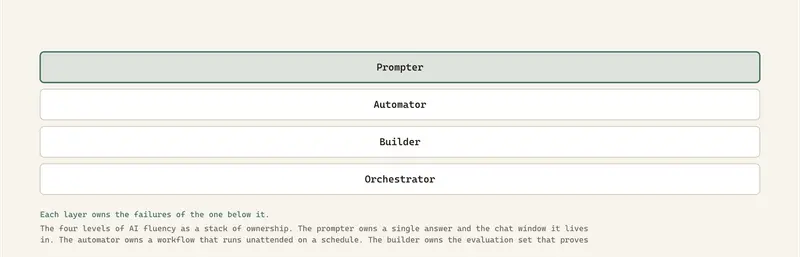
Four rungs. Prompter, automator, builder, orchestrator. Which rung you stand on has nothing to do with the tools you can name in an interview. It has everything to do with what you own at the moment the thing goes wrong.
Level one: the prompter
Level one gets better answers out of a model. That is a real skill and it is dismissed too casually by people who have never watched a good prompter work. A strong one will restructure a forty-page procurement document into a decision memo in eleven minutes, catch the two clauses that matter and know to ask for the counter-argument before accepting the summary.
What level one cannot do: reproduce the result tomorrow, hand the method to a colleague who will get the same output, or notice a confident error in a domain they do not already understand. The work exists in a chat window and dies there.
Stack Overflow's 2025 developer survey, 48,945 respondents, found 84% using or planning to use AI tools while 3.1% said they highly trust the accuracy of what comes back. Nineteen point six percent highly distrust it. Fifty-one percent of professional developers use these tools daily anyway. That is a workforce at level one, doing level one things, correctly suspicious of them.
Moving up costs about two weekends. Learn to read one scripting language even if you cannot write it fluently. Learn what a token is and what it costs. Learn to write the same task three different ways and compare the outputs side by side instead of accepting the first one. That is the whole curriculum.
Nobody in that shop has a better prompt than the stall next door. They have an evaluation set.
Level two: the automator
An automator turns a prompt into something that runs on Tuesday whether or not they are awake. Ticket triage. Invoice extraction into a spreadsheet. A nightly digest of competitor pricing. The tooling is n8n, Make, Zapier, Dify, or a cron entry and a single Python file, and the choice matters less than the habit of removing work permanently rather than doing it faster.
The market has priced this rung honestly. n8n's valuation doubled to $5.2 billion on 12 May 2026 when SAP took a minority stake of roughly 1.3 percent and agreed to embed the workflow canvas inside Joule Studio, with general availability targeted for Q3 2026. The 2026-07-28 revision of the Model Context Protocol spec moved to a stateless architecture, which in practice means an automation no longer has to hold a session open to reach a tool server.
The economics are close to free. DeepSeek publishes V4-Flash at $0.22 per million input tokens off-peak and $0.66 per million output, with a cache hit at $0.007. Two thousand support tickets a day at roughly 800 input and 150 output tokens each comes to about $0.55 a day. Sixteen dollars fifty a month. There is no capital requirement here at all.
What an automator cannot do: tell you whether the output is any good. The workflow reports success when the HTTP call returns 200, not when the classification is right. Failure is silent, and silent failure at scale is worse than no automation, because someone downstream is now trusting it.
Level three: the builder, who owns evaluation
A builder ships software with a model inside it, to users who did not ask how it works. That means retrieval that actually retrieves, a latency budget, a cost per request, a fallback when the provider returns 503 and, above all, an evaluation set.
The single question that separates level three from level two: did last Tuesday's prompt change make the system better or worse, and by how much? If the answer is a feeling, you have an automator with a larger budget. Builders answer with a number, because they run Promptfoo in CI against a fixed set of cases and watch Langfuse, Arize Phoenix or Braintrust in production. ClickHouse acquired Langfuse on 16 January 2026 alongside a $400 million Series D led by Dragoneer. The open source project ended 2025 above 20,000 GitHub stars and more than 26 million SDK installs a month. Evaluation stopped being a research nicety somewhere around then.
The rest of the level three stack is unglamorous. pgvector when the data already lives in Postgres and Qdrant when it does not. Ollama or vLLM when the data is not allowed to leave the building. Chunking decisions that nobody will ever thank you for.
I walk Huaqiangbei most months. Futian district, more than 115,000 registered business entities and something near 1.1 million distinct component types packed into a core trading area you can cross on foot. AI products went from 41% of what is on the shelves in 2025 to 61% by July 2026, with AI glasses sales doubling and drones and robots up 60 to 70 percent. Every stall has a phone open with a model running on it, generating listings. That is not the interesting part. The interesting part, reported in early August, is a PCB manufacturer in the same district that put a model inside its own quoting and prototyping flow and took a prototype run from 500 to 800 yuan down to roughly 20 yuan, with turnaround falling from about a week to twelve hours. Nobody in that shop has a better prompt than the stall next door. They have an evaluation set.
Level four: the orchestrator, who owns the failure modes
Level four designs systems where agents and humans hand work to each other, and owns what happens when that goes wrong. LangGraph, the OpenAI Agents SDK, AgentScope, Temporal for durable execution when a run spans hours rather than seconds. The tools are the easy part.
Anthropic's engineering team published a study of long-running agent harnesses on 24 March 2026 that is the most useful public document on this rung. Same brief, two setups. A solo agent finished in 20 minutes for $9. The full harness took six hours and $200, and produced something worth keeping. They named two failure modes worth memorising: coherence decay as the context window fills, and what they called context anxiety, where the agent wraps up prematurely because it believes it is close to its limit. The third finding is the one that should worry every team shipping agents. Asked to evaluate their own output, agents confidently praised work a human would call mediocre.
The fix was not a bigger model. It was a planner, a generator and a separate evaluator agent tuned toward scepticism, running Playwright against the actual application. That is an organisational design decision expressed in software, which is exactly what orchestration means.
Security lives here too. NVIDIA's garak shipped v0.15.0 on 1 May 2026 with an agent-breaker probe aimed specifically at the tools exposed to an agent, then v0.16.0 on 4 August 2026 with intent annotation and an adaptive attacks probe. NeMo Guardrails enforces policy at request time. An orchestrator owns the kill switch, the spend ceiling, the audit trail and the answer to who is accountable at three in the morning.
Level two is the trade of the decade in Lagos and Nairobi
Level two is reachable with a laptop, a browser and no permission from anyone. Self-hosted n8n runs comfortably on a six-dollar VPS. Inference is somebody else's electricity bill, which matters enormously in a market where power, bandwidth and GPU access are the three named bottlenecks in every credible assessment of Nigeria's AI ecosystem. That $16.50 a month workflow costs roughly ₦22,000 at the official rate of about ₦1,340 to the dollar in late August 2026. Against a salaried person doing the same classification by hand, the arithmetic is not close.
This is also why the Ataraxis gap is 32 points and not five. Level two sidesteps every infrastructure constraint. Level three walks straight into all of them, which is where an individual climbing alone runs out of road and needs an employer to buy something.
The honest version of the emerging-market advice is narrow. Do not start by fine-tuning. Do not start by standing up a GPU cluster. Pick one repeated process inside a business that already pays you, remove it, measure what it cost before and charge for the difference. Do that four times and you have a portfolio that reads as level two, which is currently scarce and paid in foreign currency.
The objection I take seriously
The strongest counter-argument is that the ladder dissolves. Model progress erases rungs. Anthropic noted in that same March 2026 write-up that Opus 4.6 needed materially less scaffolding than 4.5, plans more carefully and sustains agentic work for longer. Extrapolate two years and level four is a text box, level three is a text box, and the entire ladder collapses into level one with better models underneath it. People who bet careers on orchestration will look like people who specialised in manual server provisioning in 2011.
I think this is half right and the half that is wrong is the expensive half.
Every generation so far has raised the ceiling of each rung rather than deleting rungs. Better models made prompters more productive, made automators able to attempt things that used to need a builder and made builders able to attempt orchestration. The distribution shifted up. It did not compress. And the strongest evidence sits inside the very document the objection cites: the fix for agents that praise their own mediocre work was not a larger model, it was a separately instantiated evaluator with different instructions. That is a structural choice a human made.
Accountability compresses least of all. When an agent misprices 400 orders overnight, nobody asks which model it was. They ask who approved the spend ceiling, what the rollback path was and how long it took to notice. Eighty-four percent adoption against three percent high trust is precisely what a system looks like when capability has outrun verification. The rung that gets scarcer, not more abundant, is the one that verifies.
Reading the levels of AI fluency off a job description
There is a test for each rung that takes ten seconds and beats any interview.
If the work product is a document a human reads and edits before it goes anywhere, the role needs level one. Hire for domain judgement and teach the tooling in a fortnight.
If it runs on a schedule and someone would notice within a day that it had stopped, the role needs level two. Ask the candidate to describe a process they deleted, not a tool they used.
If a customer or a regulator sees the output with no human in between, the role needs level three and there is no negotiating it down. Ask how they knew a change was an improvement. Listen for a number.
If two or more automated steps can act on each other's output without a person between them, the role needs level four, because that configuration is where errors compound instead of cancelling. Ask what the agent is not allowed to do and how that is enforced. A candidate who has never written a deny-list has never run one of these in anger.
Most job adverts I read describe level four, test for level one and pay level two.
The rung nobody gets promoted for
Prompting is the only level that is visible in a meeting. You can demo it. It looks like magic on a projector and it takes four minutes.
An evaluation suite does not demo. A spend ceiling and an audit trail look like paranoia right up until the week they look like foresight, and by then the person who built them has usually moved on because nothing in the promotion criteria rewarded it.
Ataraxis puts Nigeria's workforce at 66 and its enterprises at 34. The obvious reading is a skills shortage. The obvious reading is wrong. It is 32 points of people who already know how, sitting in organisations where nobody has been given permission to change a process, waiting for the meeting where a demo finally loses to a number.
Tools referenced
Dify, reviewed here: Dify review.
LangGraph, reviewed here: LangGraph review.
OpenAI Agents SDK, reviewed here: OpenAI Agents SDK review.
AgentScope, reviewed here: AgentScope review.
Temporal, reviewed here: Temporal review.
Langfuse, reviewed here: Langfuse review.
Sources
Ataraxis Global Outsourcing AI Readiness Index (updated June 2026): https://ataraxismgmt.com/global-outsourcing-ai-readiness-index/
Stack Overflow 2025 Developer Survey, AI section (48,945 respondents): https://survey.stackoverflow.co/2025/ai
Anthropic Engineering, Harness design for long-running application development (24 March 2026): https://www.anthropic.com/engineering/harness-design-long-running-apps
DeepSeek API pricing, official documentation: https://api-docs.deepseek.com/quick_start/pricing
ClickHouse welcomes Langfuse (16 January 2026): https://clickhouse.com/blog/clickhouse-acquires-langfuse-open-source-llm-observability
n8n valuation doubles to $5.2bn as SAP makes strategic investment (12 May 2026): https://www.prnewswire.com/news-releases/n8n-valuation-doubles-to-5-2bn-as-sap-makes-strategic-investment-and-plans-to-embed-the-ai-platform-into-joule-studio-302767227.html
NVIDIA garak release notes, v0.15.0 and v0.16.0: https://github.com/NVIDIA/garak/releases
Shenzhen's 'one-kilometer' supply chain draws global buyers for AI hardware (6 August 2026): http://www.ecns.cn/cns-wire/2026-08-06/detail-ihfhziqh0063782.shtml
Frequently Asked Questions
What are the four levels of AI fluency?
The four levels of AI fluency are prompter, automator, builder and orchestrator. A prompter gets better answers from a model inside a chat window. An automator chains steps into a workflow that runs on a schedule without them, using tools like n8n, Dify or a scheduled script. A builder ships software with a model inside it to real users and owns an evaluation set that proves whether a change made the system better. An orchestrator designs systems where multiple agents and humans hand work to each other, and owns the failure modes: spend ceilings, kill switches, audit trails and accountability. Each level is defined by what you own when the system breaks, not by which tools you can name.
How do you move from prompting to automating with AI?
The jump from level one to level two takes weeks, not years, and needs no capital. Pick one task you repeat at least weekly, write it down as explicit steps, then rebuild it in a workflow tool such as n8n, Make or Zapier, or as a Python script on a cron schedule. Learn three things along the way: how to read an API response, what a token is and what it costs, and how to add error handling so the workflow tells you when it fails instead of failing silently. Inference costs make this trivial to fund. DeepSeek lists V4-Flash at $0.22 per million input tokens off-peak and $0.66 per million output, so a workflow classifying 2,000 items a day costs under $20 a month.
Why do most organisations stall at level one AI fluency?
Because level one is the only level that is visible in a meeting. Prompting demos well in four minutes, while evaluation suites, spend ceilings and audit trails look like overhead until something fails expensively. The measurable result is a gap between individual skill and institutional capability. The Ataraxis Global Outsourcing AI Readiness Index, updated June 2026, scores Nigeria's workforce 66 out of 100 for AI literacy but Nigerian enterprises only 34 for AI adoption, a 32-point spread that is the widest of the 25 countries covered. Stack Overflow's 2025 survey of 48,945 developers found the same pattern globally: 84% use or plan to use AI tools while only 3.1% highly trust the accuracy of the output. Adoption is not capability.