Remote Work Brain Drain and the Engineer Who Never Left
 Francis Okafor
On this page
- Twenty billion dollars arrives, nine hundred million does not
- The salary that breaks the local employer
- What the payslip does not show
- The strongest version of the objection
- What actually comes back
- Policy that could plausibly move something
- The employer that does not exist has no lobby
- Tools referenced
- Sources
A former colleague lives in Lekki and earns more than most engineering managers in Lagos. He has never applied for a visa. His employer is a Series B company in Colorado with no legal entity in Nigeria, no office, no Nigerian customers and no intention of acquiring any. He is the entire African footprint of that business. He is also a line item in a payroll system that files nothing with anyone in Abuja. This is remote work brain drain, and it appears in no migration statistic, because nobody migrated.
The old version is easy to count. A person boards a plane. One country loses a body and the skills attached to it, another gains both, and everyone gets to argue about it with numbers. The remote version keeps the body. It moves the rest.
I have spent eight years in Shenzhen, a city built on precisely the opposite arrangement, and I want to be careful with the claim. For the individual, remote work is almost always the better outcome. For the country, it is not the same thing as retention. It is not neutral either.
Twenty billion dollars arrives, nine hundred million does not
The Central Bank of Nigeria reported personal remittance inflows of $20.93 billion for 2024, up 8.9 percent on the year. Transfers through licensed international money transfer operators, the slice the CBN can actually see and count, rose 43.5 percent to $4.73 billion from $3.30 billion in 2023.
Then it wobbled. IMTO receipts for the first half of 2025 came in at $2.07 billion against $2.34 billion in the same period of 2024, a fall of 11.78 percent. The first quarter of 2026 recovered hard: $1.29 billion, roughly 45 percent above the $888 million recorded in Q1 2025, and higher than any first quarter going back to 2019.
Now put that beside investment. Nigeria's total capital importation for 2025 was $23.21 billion, an 88 percent jump on the year before. Foreign direct investment inside that figure was $923.01 million. Portfolio flows made up about 85 percent of the total, and portfolio flows leave in the same week they arrive if a yield curve moves somewhere else.
So the diaspora sends roughly twenty dollars for every one dollar the world commits to building something physical in Nigeria. That comparison gets used constantly in Nigerian policy writing, almost always as good news. Sit with what it actually describes. Remittances arrive in households. Direct investment arrives in firms. Households buy things. Firms hire people, train them and get taxed.
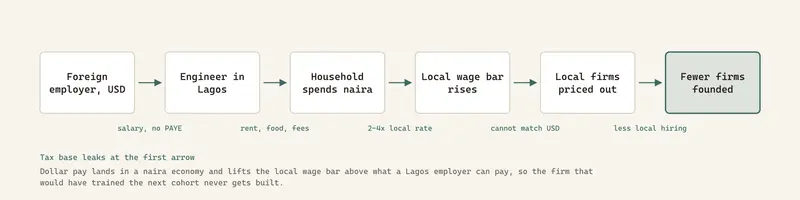
Retention is the wrong frame. Asking why no domestic buyer can pay market rate for this labour is a completely different question, and it is a question about the Nigerian economy rather than about the engineer's loyalty.
The salary that breaks the local employer
On 26 August 2026 the naira closed at about ₦1,346.90 to the dollar on the official window, with the parallel market near ₦1,400. A remote salary of $70,000 is therefore about ₦94 million a year. Nigerian salary aggregators put senior local engineers somewhere between ₦12 million and ₦48 million. Treat those as a shape rather than a measurement: they are self-reported, and the sample is whoever felt like filling in a form.
The shape is the point. Two to four times.
Google's Africa Developer Ecosystem Report surveyed 1,600 developers and found 38 percent of them working for at least one company headquartered outside the continent. That was the 2021 edition. Nothing comparable has been published since, which tells you how seriously this is being measured. A Nigerian founder quoted around that time said talent was becoming more unaffordable than it was scarce. That was before the naira went from roughly ₦460 on the official window ahead of the June 2023 float to where it sits today.
A Lagos startup is not losing candidates on mission or culture or free lunch. It is losing them on an exchange rate it does not set, to a buyer that does not know it is bidding.
What the payslip does not show
Start with tax, because it is the most concrete. The Nigeria Tax Act 2025 was signed on 26 June 2025 and took effect on 1 January 2026. Residents are taxable on worldwide income regardless of whether that income is brought into Nigeria. The bands run nil up to ₦800,000, then 15 percent, 18, 21, 23 and 25 percent above ₦50 million. On paper the remote engineer is fully inside the net.
In practice there is no withholding agent. A company in Colorado does not run PAYE for Lagos. The whole structure rests on a person voluntarily self-assessing income that lands in a domiciliary account or, increasingly, a stablecoin wallet. FIRS collected ₦22.59 trillion in the first nine months of 2025, about 90 percent of its ₦25.2 trillion target, and nearly every naira came from entities with a physical Nigerian presence and a legal obligation to deduct at source. Foreign-sourced employment income is the one category where the state has written the rule and holds no mechanism.
Second loss: the room. The senior engineer who would have been the one person on the floor who had shipped something to ten million users is instead in a Slack workspace, reviewing pull requests at two in the morning Lagos time. His review discipline goes to juniors in Denver. The junior sitting forty minutes away in Yaba gets a YouTube tutorial.
Third: the company that never gets founded. Andela is the case everyone in Lagos knows. It started in 2014 as a Nigerian training pipeline and is now a global talent marketplace with contractors across more than 135 countries. The talent development worked. The institution moved.
Fourth, and hardest to price, the cluster. China approved the Shenzhen Special Economic Zone on 26 August 1980, when the place was a town of roughly 310,000 people. The design constraint that mattered was not the tax holiday. It was that foreign capital had to physically arrive. Factories, joint ventures, foreign engineers standing next to Chinese engineers on a line. I can walk out of an office in Nanshan and have a custom connector in my hand inside two hours, because the person who makes it is a short ride away and his other customer is my competitor. That density is the residue of four decades of firms having no choice but to land somewhere. DeepSeek and Qwen were built by teams sitting in the same few cities as the people who taught them.
Lagos is growing anyway. Dealroom's Global Tech Ecosystem Index 2025 ranked it first among Rising Stars, with ecosystem value up 11.6 times since 2017 and five unicorns to point at. That growth is real and I do not want to minimise it. It is also happening while a large share of the country's strongest engineers work for entities with no Nigerian address, no Nigerian tax exposure and no reason at all to train anyone in Yaba.
The strongest version of the objection
Here is the argument against everything above, stated as well as I can state it.
People are not national assets. An engineer in Lekki owes Nigeria no more than a Danish engineer owes Denmark when she takes a job in Berlin, and nobody writes concerned essays about that. The language of brain drain smuggles in a claim of ownership that nobody would accept if it were applied to them, and it has a long, ugly history of being used to justify exit taxes, bonding schemes and other policies that punish individuals for the failures of institutions.
The counterfactual is also wrong. The alternative to a remote job is almost never that the same person founds a Nigerian company. It is that he emigrates, and then the country loses the person, the spending, the household and the possibility of return. Remote work is the outcome where Nigeria keeps the most it was ever going to keep. He pays Lagos rent. He buys Lagos food. He employs a driver and a cleaner, and he puts three siblings through school. That is more domestic economic activity than any retention policy has ever generated for anyone.
I accept nearly all of it. Two things survive.
The first is that individually rational and collectively costly is an ordinary shape in economics, and describing it is not a moral accusation. Traffic works this way. Nobody thinks the commuter is a bad person.
The second is a distinction about which question is being asked. Retention is the wrong frame and I have no interest in anyone being kept anywhere. But why no domestic buyer can pay market rate for this labour is a completely different question, and it is a question about the Nigerian economy rather than about the engineer's loyalty. The answer involves the exchange rate, the cost of capital, the thinness of the domestic software market and the fact that Nigerian firms mostly sell to Nigerian consumers whose spending power collapsed in dollar terms after 2023. None of that is his fault. All of it is still true.
What actually comes back
The knowledge return is real and underrated. An engineer who spends three years inside a competent foreign engineering organisation comes back with things Nigeria cannot easily teach: incident reviews that do not hunt for someone to blame, on-call rotations that are humane, testing discipline, the habit of writing decisions down. I watched the same transfer run in the other direction in Shenzhen, where a generation who cut their teeth inside Foxconn and Huawei went on to staff the hardware startups that now sell to the world. Standards travel through people. Slowly, and they do travel.
The capital return is where the story gets thin. The African Business Angel Network's 2025 survey covered 62 angel networks across 37 countries and recorded more than $4.4 million in disclosed deployment for the whole year. More than 90 percent of individual angels wrote cheques below $25,000, up from 76 percent in 2024. HoaQ, the diaspora syndicate that is the obvious vehicle for exactly this money, reports roughly $4 million across about 120 deals since it started in 2020.
Read those figures next to $20.93 billion in remittances. The continent's organised angel networks deploy in a year what a single mid-sized Series A absorbs in an afternoon. The money comes home as school fees, generator diesel and land in Ibeju-Lekki. It does not come home as equity, and equity is what builds employers.
Policy that could plausibly move something
The proposals that surface first are the ones that will not work. Exit taxes. Bonding graduates to the country that trained them. Anything that treats a better job as a defection.
The ones with a chance are dull.
Make self-assessment cheaper than evasion. A 23 percent marginal rate on self-declared foreign employment income with no withholding agent is a rate designed to produce non-filing. A flat, low, final schedule on foreign-sourced salary, collected at the point the money lands in a Nigerian account, would raise more than the current design will. Governments collect what they can observe, not what they legislate.
Attack the transfer cost, the least glamorous number in this piece and probably the largest. Remittance costs into sub-Saharan Africa run above 7 percent against a Sustainable Development Goal target of 3. On roughly $20 billion a year, the gap between those two rates is on the order of $800 million leaving annually as fees. Publishing corridor-level pricing every quarter, the way the World Bank's Remittance Prices Worldwide does, is cheap and it moves prices.
Build on the plumbing that already exists. The CBN and NIBSS launched the Non-Resident BVN on 13 May 2025 so Nigerians abroad could open and hold accounts without flying home, aiming at $1 billion a month in formal flows. The same logic pointed inward would let a Lagos resident earning dollars hold, invest and be taxed on that income inside the formal system without an FX haircut. A CBN directive dated 24 March 2026, effective 1 May, moved the other way and required IMTOs to pay recipients only in naira at the prevailing market rate. Whether that formalises flows or pushes them into channels nobody counts is this year's live experiment.
And the lever nobody wants to fund: be a buyer. The Nigerian state and large Nigerian firms could pay market rate for domestic engineering instead of importing systems and complaining about talent. It is expensive. It is also the only intervention that changes the demand side rather than scolding the supply side.
The employer that does not exist has no lobby
Shenzhen got its engineers because capital had no choice but to show up in person. For software that constraint is gone, permanently. Nigeria is now running an experiment nobody designed and nobody is instrumenting: what happens to a place across fifteen years when its most capable engineers are physically present and institutionally absent.
The engineer in Lekki is having a good decade. Colorado is having a good decade. The party not having a good decade is the Lagos company that would have hired him, trained four juniors and paid company income tax. That company has no revenue, no staff and nobody to speak for it, because it was never founded. Nothing in the national accounts has a column for that.
Tools referenced
DeepSeek, reviewed here: DeepSeek review.
Sources
Central Bank of Nigeria, 2024 remittance and IMTO inflow figures (April 2025): https://x.com/cenbank/status/1909995674952933452
Nairametrics, Nigeria's IMTO inflows drop 11.78% to $2.07 billion in H1 2025: https://nairametrics.com/2025/12/26/nigerias-imto-inflows-drop-11-78-to-2-07-billion-in-h1-2025/
Nairametrics, Remittances across the MINT economies (14 July 2026), transfer costs and the March 2026 CBN IMTO directive: https://nairametrics.com/2026/07/14/remittances-across-the-mint-economies-what-mexicos-64-7-billion-machine-can-teach-nigeria/
Vanguard, Nigeria's capital importation jumps 88% to $23.21bn in 2025, FDI at $923.01m (NBS data): https://www.vanguardngr.com/2026/03/nigerias-capital-importation-jumps-88-to-23-21bn-in-2025/
KPMG, Nigeria: Reforms of the Personal Income Tax Regime, bands and worldwide income rules under the Nigeria Tax Act 2025: https://kpmg.com/xx/en/our-insights/gms-flash-alert/flash-alert-2025-168.html
Techpoint Africa on Google's Africa Developer Ecosystem Report, share of developers working for firms outside the continent: https://techpoint.africa/insight/african-developers-report-remote-work/
African Business Angel Network, 2025 Angel Investment Survey Report (PDF): https://abanangels.org/wp-content/uploads/2026/04/Final-ABAN-2025-Angel-Survey-Report-.pdf
NIBSS, CBN and NIBSS launch the Non-Resident BVN platform, 13 May 2025: https://nibss-plc.com.ng/cbn-launch-nrbvn-for-nigerians-in-the-diaspora/
Frequently Asked Questions
Is remote work a form of brain drain?
It is a partial one. Conventional brain drain removes the person, the spending and the tax residency all at once. Remote work for a foreign employer keeps the person, the household spending and the local consumption in the country, but moves the tax base, the mentorship that would have gone to local juniors and the labour supply that a domestic company could have hired. Economists sometimes call this the difference between physical presence and institutional presence. For the individual it is usually the better outcome than emigrating; for the domestic economy it is better than emigration and worse than employment by a local firm.
How much does Nigeria receive in diaspora remittances?
The Central Bank of Nigeria reported personal remittance inflows of $20.93 billion in 2024, an increase of 8.9 percent over 2023. Flows through licensed international money transfer operators, which the CBN tracks separately, rose 43.5 percent to $4.73 billion in 2024 from $3.30 billion in 2023. IMTO inflows then fell 11.78 percent to $2.07 billion in the first half of 2025 before rebounding to a record $1.29 billion in the first quarter of 2026. For comparison, Nigeria attracted only $923.01 million of foreign direct investment across the whole of 2025.
Do Nigerians working remotely for foreign companies pay tax in Nigeria?
Legally, yes. The Nigeria Tax Act 2025 was signed on 26 June 2025 and took effect on 1 January 2026. It makes Nigerian tax residents liable on worldwide income regardless of whether that income is remitted into Nigeria. Residency is triggered by domicile, a permanent place of abode, substantial economic ties or 183 days of physical presence in a 12-month period. Rates run from nil on the first ₦800,000 up to 25 percent above ₦50 million. Because a foreign employer has no obligation to operate Nigerian PAYE, there is no withholding agent, so the liability is settled through annual self-assessment by the individual.