Technology as Soft Power Arrives Through the Side Door
 Francis Okafor
On this page
- Technology as soft power runs on defaults
- The market share numbers everyone repeats
- A trained engineer base is a twenty year lock-in
- Standards bodies are the quiet arena
- Open weights function as soft power dressed as generosity
- Broadcasting and language institutes are the visible half
- The strongest objection: African buyers are making rational choices
- The document nobody reads in translation
- Tools referenced
- Sources
Shenzhen taught me the mechanism before I had a word for it. A handset assembled an hour from my flat lands in Lagos with the keyboard already chosen, the browser already chosen, the app store already installed and a default search engine nobody in Lagos voted for. That is technology as soft power. It does not sound like soft power. It sounds like a bill of materials.
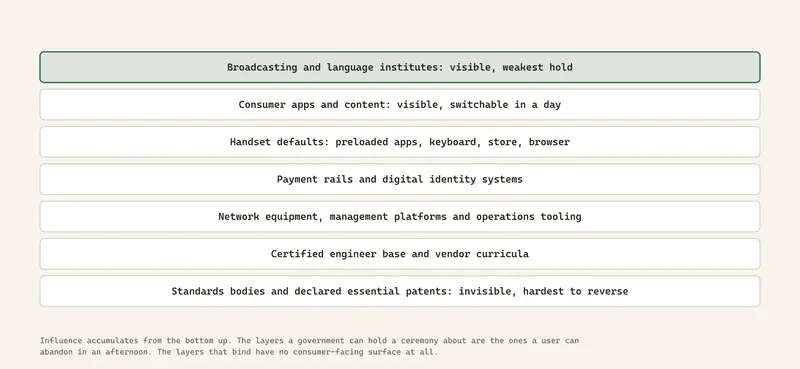
Governments fund the visible instruments. Broadcasters. Language institutes. Cultural weeks with a ribbon and a minister on a small stage. Those are the front door, and they are the half that works least well. The side door is the supply chain. The country that ships the handset, the base station, the payment rail or the model weights gets to set defaults, train the engineers who maintain them and sit in the rooms where the next specification is written. No argument is ever made. None is needed.
Technology as soft power runs on defaults
A default is a distribution channel that costs the user nothing to accept. That is its entire power. On a phone that sold for the equivalent of forty dollars at a kiosk counter, the four icons on the home screen are, for a first-time internet user, what the internet is. The browser default decides which search index sees their queries. The preinstalled keyboard decides which languages are typed comfortably and which are a fight. The over-the-air update channel hands one company a permanent silent write path to millions of devices, renewable monthly, with no further negotiation.
None of this is coercive. It is worse than coercive in the way that counts. Coercion produces a debate. Defaults produce nothing at all. There is no parliamentary committee on preinstalled keyboards.
The programming was the argument. The hardware was the influence.
The market share numbers everyone repeats
Here the writing gets harder, because the figures that circulate about African handset share are mostly second-hand. The most repeated one holds that Transsion, the Shenzhen company behind Tecno, Infinix and itel, took 48.2 percent of the African smartphone market in 2021. The number appears in Jeremy Garlick's Advantage China (2024) and in a hundred posts citing each other. The quarterly measurement underneath it sits behind an analyst paywall.
The free sources say something different, because they measure something different. IDC's public tracker for the first quarter of 2026 puts global smartphone shipments at 293.8 million units, down 2.9 percent year on year, with Samsung at 21.2 percent and Apple at 21.0 percent. It publishes no vendor breakdown for Middle East and Africa at all and forecasts the region falling roughly 23 percent across 2026, because it is concentrated in sub-200-dollar devices exposed to memory prices. StatCounter, which counts web page views rather than units sold, has Samsung leading Africa at 32.04 percent in July 2026, Apple at 18.01 percent, Xiaomi at 7.6, Oppo at 7.28 and Huawei at 6.24, with 9.9 percent unattributed. Transsion's brands do not appear in that top group.
Both readings can be true. Cheap phones sell in enormous numbers and browse comparatively little. Shipment share and browsing share are not the same quantity, and anyone quoting one as the other is guessing.
The same caution applies to the sentence you will meet in nearly every policy paper on this subject: that Huawei built about seventy percent of Africa's 4G networks. Follow the footnotes and they lead to other secondary works citing each other. I have not found a primary count of base stations behind it, and I will not repeat it as fact. What is documented, with a name and a date, is narrower. The CSIS Reconnecting Asia project catalogued seventy Huawei cloud and e-government agreements across forty-one countries through April 2021 and found that Africa accounted for thirty-six percent of them.
A trained engineer base is a twenty year lock-in
Huawei's own sustainability reporting claims more than 1.8 million students in over 110 countries and regions trained through its ICT Academy programme. Self-reported, unaudited and the kind of figure a company chooses how to count. Take it as a statement of scale and intent rather than a measurement.
The mechanism does not depend on the exact number. An engineer certified on one vendor's command syntax, alarm taxonomy and element management system is not a neutral party in the next procurement. When the tender gets drafted, the requirements quietly resemble what the operations team already knows how to run at three in the morning. Retraining a network operations centre is a line item no chief technology officer volunteers for. This is the most durable layer of the whole structure, precisely because it is not a contract. It is a habit distributed across a labour market, renewing itself every graduating class.
I have watched that argument happen in Shenzhen and in Lagos, in Mandarin and in English, and it is the same argument. Nobody in the room is thinking about geopolitics. They are thinking about who they can call when the link drops.
Standards bodies are the quiet arena
The formal version of the same advantage gets written into patents and specifications. WIPO's figures for 2024 put Huawei first among corporate applicants under the Patent Cooperation Treaty for the eighth consecutive year, with 6,600 published applications, and China first among origin countries with 70,160 filings against 54,087 from the United States. Declared essential patents become royalty positions. Royalty positions become seats at the table.
The table is small. Houlin Zhao, a Chinese national, served as Secretary-General of the International Telecommunication Union from January 2015 to December 2022, elected at Busan in 2014 and re-elected at Dubai in 2018. Between 2018 and 2020 Huawei and its subsidiary Futurewei advanced a set of proposals known as New IP at the ITU, the IETF and various IEEE venues. ICANN's Office of the Chief Technology Officer warned that what was proposed could make pervasive monitoring considerably easier. A 2023 paper from the University of Pennsylvania Carey Law School reached a more careful conclusion, that it was not necessarily a trojan horse, and researchers on the SCION project argued that dismissing it without inspection did not do it justice.
The verdict is not the interesting part. The interesting part is that a proposal capable of reshaping addressing and routing for everybody was fought over by a few hundred specialists, most of them on vendor payrolls, in meetings no minister attended. That is the arena. Attendance is the whole game, and attendance costs money most delegations do not have.
Open weights function as soft power dressed as generosity
The newest version of the side door is a licence file. DeepSeek released R1 under the MIT licence in January 2025, V3-0324 under MIT that March and the V4 series under MIT in April 2026. Alibaba's Qwen models ship largely under Apache 2.0. Reuters reported in September 2024 that Alibaba had put out more than a hundred open-weight models with over forty million downloads, and there are now more than two hundred thousand Qwen derivatives listed on Hugging Face.
Read as generosity, it is genuinely generous. Read as distribution, it is the handset story with the physical object removed. A team in Nairobi that cannot pay dollar-denominated API bills starts from a free checkpoint. What arrives with that checkpoint goes well beyond weights: a tokenizer with particular language coverage, an evaluation suite that defines what good means, a fine-tuning recipe, a serving stack, a set of prompt conventions and a research community whose papers you now read first.
The tokenizer is the sharpest example for anyone building in African languages. If Hausa or Amharic costs three or four times the tokens of English for the same sentence, the unit economics of building in that language were fixed by a vocabulary decision taken somewhere else, by people who were not being hostile and simply had other priorities. That is a default with a price tag attached to every request, forever.
Something else travels with open weights: the story about them. DeepSeek's reported training figure for V3, 2.788 million GPU hours and roughly 5.58 million dollars, has been criticised for covering only part of the true cost. The criticism is correct and it lost. The number went round the world. The caveat stayed home.
Broadcasting and language institutes are the visible half
Set that against what the front door has produced. Confucius Institutes numbered around 530 in 2019 and stood at 498 institutes plus 773 classrooms across more than 160 countries and regions at the end of 2023. In the United States, 104 of 118 had closed or were closing by June 2022. A cultural institute can be shut by a parliamentary vote inside a news cycle. Nobody has ever shut down a keyboard layout.
StarTimes is the sharper case, because it is both halves at once. As of July 2020 it reported distributors in 37 countries, 13 million pay-TV subscribers and 20 million users of its streaming product. Its Access to Satellite TV for 10,000 African Villages project, pledged by Xi Jinping at the 2015 FOCAC summit in Johannesburg and rolled out country by country from 2017 onward, arrived with considerable ceremony. A 2024 Nigerian study found much of the installed equipment sitting idle once the free year ended, defeated by subscription costs and unreliable electricity.
The content play underperformed. The equipment stayed. Set-top boxes, digital terrestrial migration contracts, headend gear and the technicians trained to keep it running outlive whatever was broadcast through them. The programming was the argument. The hardware was the influence.
The strongest objection: African buyers are making rational choices
The honest problem with everything above is that it can flatten a continent of buyers into a map with arrows on it. Nobody in Computer Village buys a Tecno because of Beijing. They buy it because it costs a fraction of the alternative, because it holds charge through a day with four hours of grid power, because it takes two SIMs on the sound assumption that one network will fail. And because the camera was tuned for darker skin at a time when the incumbents had not bothered to do the work. That last one is not geopolitics. That is a competitor losing on merit.
Ministries are not naive either. They run tenders. They compare export credit terms, and they know exactly what the Western bid costs, because they asked for it. Choosing the financeable option over the unfinanceable one is not capture. It is arithmetic under a budget constraint somebody else helped create.
So the objection lands against the lazy version of the argument. It does not touch the mechanism. Two things hold at once. The buyer chose freely, on price, with good reasons. The choice then compounds into a default the next buyer inherits without choosing anything. That is what a switching cost is. Agency at the moment of purchase and dependency ten years later are not contradictions. They are one transaction seen at two time scales, and the person who pays the second bill is almost never the person who signed the first.
The document nobody reads in translation
Working in Mandarin changes how this looks from the inside. I read the Chinese ministry documents and the vendor white papers on the day they publish. The African policy responses I read, where they exist, cite the English translation, which lands months later and sometimes never lands at all. That gap is not a plot. It is a staffing decision taken separately in a hundred ministries, each one defensible on its own.
The effect is that the argument about defaults reliably begins after the defaults are installed. It is happening again right now, in four paragraphs of licence text at the top of a model repository, text that will shape what a generation of African software gets built on and that almost nobody in the affected markets has read line by line. The front door is still well lit. Everyone is still standing at it.
Tools referenced
Chinese AI tools, reviewed here: Chinese AI tools review.
open-weight models, reviewed here: open-weight models review.
open source AI tools, reviewed here: open source AI tools review.
Sources
WIPO, PCT filings 2024: Huawei top corporate applicant, China leading origin: https://www.wipo.int/pressroom/en/articles/2025/article_0003.html
Huawei Sustainability, ICT Academy training figures: https://www.huawei.com/en/sustainability
StatCounter Global Stats, Mobile Vendor Market Share in Africa, July 2026: https://gs.statcounter.com/vendor-market-share/mobile/africa
IDC Smartphone Market Share tracker, Q1 2026 and MEA outlook: https://www.idc.com/promo/smartphone-market-share
CSIS Reconnecting Asia, Huawei's Global Cloud Strategy, May 2021: https://reconasia.csis.org/huawei-global-cloud-strategy/
New IP proposals to the ITU, IETF and IEEE, and the responses to them: https://en.wikipedia.org/wiki/New_IP
DeepSeek model releases, MIT licensing and reported training cost: https://en.wikipedia.org/wiki/DeepSeek
Qwen open-weight releases, Apache 2.0 licensing and derivative counts: https://en.wikipedia.org/wiki/Qwen
Frequently Asked Questions
What does technology as soft power actually mean in practice?
It means influence carried by supply rather than by persuasion. The party that provides the handset, the network equipment, the payment rail or the model weights sets defaults that most users never change, trains the engineers who maintain the system and accumulates the patent and standards positions that shape the next generation of equipment. No message is broadcast and no argument is made, which is exactly why it is hard to contest.
Is it true that Huawei built about 70 percent of Africa's 4G networks?
The figure is repeated constantly in policy writing, but the citation trail leads to secondary works quoting each other rather than to an independent count of base stations. I could not locate a primary measurement behind it and do not repeat it as fact. A narrower documented figure exists: the CSIS Reconnecting Asia project catalogued 70 Huawei cloud and e-government agreements across 41 countries through April 2021 and found Africa accounted for 36 percent of them.
Why do open-weight model releases count as soft power?
A permissively licensed model becomes the base checkpoint for teams that cannot pay dollar-denominated API bills. Along with the weights come a tokenizer with particular language coverage, an evaluation suite that defines what good means, a fine-tuning recipe and a serving stack. Those choices set the cost of building in Hausa or Amharic long before any local team gets a say.
Why are the African smartphone market share figures so hard to pin down?
Shipment data from IDC, Canalys and Counterpoint sits behind paywalls, so the numbers that circulate freely are second-hand. Free trackers measure different things. StatCounter counts web page views and had Samsung leading Africa at 32.04 percent in July 2026, while shipment-based accounts have long put Transsion's brands well ahead. Cheap phones sell in volume and browse comparatively little, so the two measures diverge.
Does this framing ignore the agency of African governments and consumers?
It does if stated carelessly. Buyers choose Transsion handsets for price, battery life, dual SIM and camera tuning that suits them, and ministries choose the bid they can actually finance. Both are rational. The mechanism still holds, because a free choice at the point of purchase compounds into a default the next buyer inherits without choosing. Agency now and dependency later are the same transaction at two time scales.