
Unitree UnifoLM
Unitree's open robot learning stack: world models, a vision-language-action policy, Isaac and MuJoCo training environments and the SDK that drives Go2, G1 and R1 hardware.
Overview
Unitree is the Hangzhou company that made quadrupeds affordable and is now doing the same to humanoids, R1 from around $4,900 and G1 from around $13,500. It shipped more than 5,500 humanoids in 2025 and listed on the Shanghai STAR Market on 19 August 2026, raising roughly 6.1 billion yuan. The software gets far less attention than the backflip videos, which is a mistake, because the software is the part other teams can actually use.
UnifoLM is the model family. WMA-0, released September 2025, is a world model with two jobs: generating synthetic interaction data and scoring candidate actions during policy learning. VLA-0 followed on 29 January 2026, a vision-language-action model demonstrated on the G1 across 12 task categories including drawer opening and connector insertion, all from a single policy network. Around those sit fifteen or so repositories: unitree_sdk2 for real hardware under BSD-3-Clause, unitree_rl_gym and unitree_rl_lab for Isaac training, unitree_mujoco for simulation without the NVIDIA stack and xr_teleoperate for capturing demonstrations through a Vision Pro or Quest.
Teams doing embodied AI research or already building on Unitree hardware should treat this as the default starting point, because nothing comparable exists in the open from Boston Dynamics or Agility. Everyone else needs to check two things carefully: the licence on whichever checkpoint they intend to ship, since some are CC BY-NC-SA 4.0 and cannot enter a product, and how deeply the code assumes Unitree kinematics. For a Shenzhen hardware team already sourcing locally, that is a short conversation. For a Western integrator with export-control exposure, it is a much longer one.
Key Features
- ✓ UnifoLM-WMA-0, a world model doing double duty as a synthetic interaction data generator and a policy scorer, released September 2025
- ✓ UnifoLM-VLA-0, a vision-language-action model for humanoid manipulation, code and weights out 29 January 2026
- ✓ unitree_rl_gym and unitree_rl_lab for Isaac Sim and IsaacLab reinforcement learning, at 3.5k and 1.3k GitHub stars
- ✓ unitree_mujoco for simulation with C++ and Python interfaces if you would rather not build on the NVIDIA stack
- ✓ xr_teleoperate for collecting demonstration data through Apple Vision Pro, PICO or Meta Quest
- ✓ unitree_sdk2 covering Go2, B2, H1, G1, H2, R1 and A2 under BSD-3-Clause, last updated 20 August 2026
Where it holds
- • No other humanoid vendor ships a stack this complete in the open: simulation, RL environments, teleoperated data collection, a manipulation policy and the SDK that talks to real joints.
- • The hardware is cheap enough to actually buy. An R1 at roughly $4,900 costs less than a month of one engineer, which changes what a pilot programme looks like.
- • The repositories are alive. unitree_sdk2 was updated on 20 August 2026, which is more than can be said for most robotics vendor code.
- • Sim-to-real path is short because the same company controls the URDF, the SDK and the policy weights.
Where it breaks
- • Licence terms across the weights are inconsistent. CC BY-NC-SA 4.0 on some UnifoLM checkpoints means legal review before anyone writes deployment code.
- • Almost all of it assumes Unitree kinematics. Porting a policy to another arm or humanoid is a project, not a config change.
- • Documentation is thin and much of the useful discussion sits in Chinese-language issues and forums.
- • VLA results are demonstrations across 12 task categories, not a fielded system. Treat the published numbers as a floor for your own testing.
My Take
A Shanghai listing on 19 August 2026 changed the calculus here. The stock more than quintupled on debut and the company banked roughly 6.1 billion yuan, so the open-source stack is now maintained by a business that will plausibly still exist in three years. That matters a lot when you are committing a robotics programme to someone else's SDK. Coverage runs from unitree_mujoco for free simulation through unitree_rl_lab for IsaacLab training to UnifoLM-VLA-0 as the manipulation policy, with xr_teleoperate capturing demonstrations off a headset. Read the weight licences first, because CC BY-NC-SA on a checkpoint kills a commercial pilot late and expensively.

Quick Info
- Pricing:
- open-source
- Openness:
- Open source
- Licence:
- Apache 2.0
- Starting at:
- Code and weights are free to download. Licensing is mixed and this matters: unitree_sdk2, unitree_ros and unitree_mujoco are BSD-3-Clause, while several UnifoLM checkpoints on Hugging Face carry CC BY-NC-SA 4.0, which blocks commercial use. Check licence per checkpoint. The real cost is hardware, R1 from around $4,900 and G1 from around $13,500.
- Added:
- Aug 2026
- Updated:
- Aug 2026
Use Cases
Judge it on your own work
The notes above say where Unitree UnifoLM holds and where it breaks. The fastest check is your own workload.
Visit website ↗Alternatives to Unitree UnifoLM

AgiBot World
open-sourceOpen manipulation data and policy weights from AgiBot (智元机器人): a million-plus real robot trajectories, the GO-1 VLA and the Genie Envisioner world model, all non-commercial.

RoboBrain 2.5
open-sourceBAAI's embodied brain model (悟界·RoboBrain), Apache 2.0 at 4B and 8B, shipped in parallel NVIDIA and Moore Threads builds. It plans and points in 3D for a controller underneath.
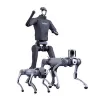
Unitree Robotics Developer Stack
open-sourceThe open repos behind Unitree's robots (宇树科技): BSD-3 C++ and Python SDKs, MuJoCo and IsaacLab RL training, ROS 2 packages and XR teleoperation for data capture.