Generative AI for engineering design is cheap. Verification is where the money goes.
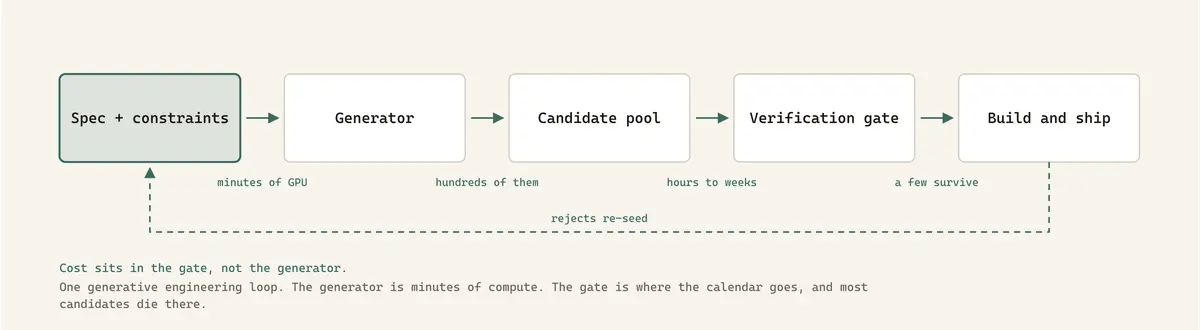
The generative step in engineering costs minutes of compute. Proving the output manufacturable, simulation-clean and safe costs weeks, and that ratio decides which applications are worth doing.

A generated bracket takes four minutes. Proving the bracket is worth having takes four weeks.
That ratio is the real story of generative AI for engineering design, and it is the part that never survives contact with a demo. You watch a solver produce a hundred and fifty bracket geometries that look like bone. It is genuinely impressive. Then somebody picks one, rebuilds it into geometry a five-axis mill or a laser powder bed can actually produce, runs structural and thermal simulation, builds it, tests it to failure and signs the drawing. The compute for the first step is a rounding error. Everything after it is the project.
I have spent eight years in Shenzhen, most of them shipping production software, now working across AI systems, manufacturing, vision and automation. What follows is a ranking of the engineering applications, sorted not by how impressive the generation looks but by how much the verification costs.
Where generative AI for engineering design already ships parts
The two examples everyone cites are old, and that is the interesting fact about them. In 2018 General Motors and Autodesk ran a seat bracket through Fusion's generative design workspace. The solver returned more than 150 candidates. The one GM took was a single piece of stainless steel replacing eight, 40 percent lighter and 20 percent stronger than the bracket it replaced.
Two years earlier, Autodesk's research group and The Living produced the A320 bionic partition with Airbus and APWorks. Forty-five percent lighter, roughly 30 kg saved per unit, printed as 122 parts in Scalmalloy on Concept Laser M2 and EOS M400 machines plus 40 titanium parts. Airbus put the fleet-wide figure at up to 465,000 tonnes of CO2 a year.
Both results are real. Both are also eight and ten years old and still the headline. If the generative step were the constraint, there would be a thousand of these by now. The constraint is downstream. Topology optimisation output is a voxel field or a mesh. It carries no tolerances, no datums, no revision history and no manufacturing metadata. Left unconstrained it produces razor-thin ribs, knife-edge junctions and overhangs that need more support material than part. Somebody rebuilds it as NURBS or T-splines or SubD surfaces, runs process-assurance simulation, finds it no longer meets the target and iterates. That rebuild loop is the job.
The 2025 academic work makes the point without meaning to. A reinforcement learning framework with physics-informed rewards reached up to 40 percent mass reduction on a wheel hub. A gear study reported 37 to 46 percent body mass reduction, with the additive-constrained variants saving the most mass and the machining-constrained variants coming out stiffer. Read that second result again. The generator did not decide anything. The manufacturing constraint decided, and the generator did arithmetic inside it.
Synthetic defects fixed our recall. They could not tell us the tolerance, and the tolerance lived in a Chinese-language spec sheet that nobody on the model team had read.
Synthetic defects are the strongest case on this list
Defect data is scarce by construction. A line running properly produces almost no defects, which is the entire point of the line, so the training set for the model that finds defects is starved of exactly the class it exists to find. Ten thousand good parts, three hundred scratches, eleven examples of the rare failure mode that actually costs money. No amount of collection fixes it, because collecting more means running worse.
So you generate. A Sensors paper from September 2024 fine-tuned Stable Diffusion with LoRA on NEU-seg, a steel surface set of 3,630 grayscale images at 200 by 200 pixels covering inclusions, patches and scratches, with 2,541 training images. Mixing in synthetic images at a 37 percent share took DeepLabV3+ from 71.31 to 76.26 mIoU and FPN from 72.39 to 76.70. Past roughly 50 percent synthetic, performance went down.
A second Sensors paper, November 2025, reconstructed objects from phone video with NeRF, added scratches procedurally in NVIDIA Omniverse and trained eleven YOLO variants against 300 real NEU-DET scratch images. Gains ran from 1.5 percent mAP at 0.5 IoU for YOLOv8s to 18.8 percent for YOLOv6n. YOLOv6s went 77.4 to 81.9. YOLOv8n went 59.2 to 62.4.
Look at the shape of those numbers rather than the size. The biggest gains land on the smallest models with the weakest baselines. Synthetic data buys the most where you had the least, which is a genuinely useful property, and it stops buying anything once you have enough real data or once the synthetic share crosses the point where the model starts learning the generator instead of the process.
Here is the part the papers do not price. On a line in Bao'an, mIoU is not a number anyone in the room argues about. They argue about escape rate and about how many false stops an operator will take before they start clearing the reject bin without looking. I have watched an inspection model with a clean validation curve get quietly overridden inside two shifts, because it was halting the line on cosmetic scratches under half a millimetre that the customer's own acceptance spec permitted. Synthetic defects fixed our recall. They could not tell us the tolerance, and the tolerance lived in a Chinese-language spec sheet that nobody on the model team had read.
This application works because the verifier is cheap, not because generation is better here. A held-out set of real defect images costs a few hundred labelled samples and runs in seconds. Compare that with a furnace or a fatigue rig. That asymmetry, rather than model quality, is why synthetic defect generation is in production while generative part design mostly is not.
One caution about benchmarks. MVTec AD, 5,354 images across fifteen categories, has been the standard industrial anomaly benchmark for years, and current methods sit around 99.8 to 99.9 mean AUROC on it. That is not the problem being solved. That is a benchmark that stopped measuring. MVTec's answer was AD 2: eight harder scenarios, more than 8,000 images, half the test set held privately and scored on their own server. Defect Spectrum, from ECCV 2024, took the other route and re-annotated four industrial datasets with per-defect-type semantics and captions, alongside a two-stage diffusion generator for low-data settings, reporting 10.74 percent higher recall and a 33.10 percent lower false positive rate in industrial simulation. Both moves are admissions that the easy version was finished.
Inverse design and layout, where the verifier is physics
MatterGen, published in Nature on 16 January 2025, is a diffusion model that jointly generates atomic fractional coordinates, element identities and lattice vectors, trained on 608,000 stable structures from the Materials Project and Alexandria and fine-tunable to condition on target properties. Microsoft reports structures more than twice as likely to be novel and stable as prior generative models and more than ten times closer to a local energy minimum.
Then the part that matters. They asked for a bulk modulus of 200 GPa. The model proposed TaCr2O6. A group at the Shenzhen Institutes of Advanced Technology, which is a bus ride from where I live, actually made it and measured 169 GPa, inside 20 percent of target, with compositional disorder between the tantalum and chromium sites that the model had not predicted.
One compound. Trained on 608,000. That is not a criticism of the work, it is the cost structure stated plainly: the generator explored a space no human could enumerate and the verifier was a furnace, a diffractometer and a team of people in Nanshan.
Chip layout is the counter-example that proves the rule. AlphaChip, the reinforcement learning floorplanner Google published in Nature in 2021 and named in September 2024, has placed blocks on TPU v5e, v5p and Trillium and on the Axion server CPU, producing layouts in hours where humans took weeks, and MediaTek extended it for their own parts. Layout worked early because the verifier was already there. Static timing analysis, design rule checking and signoff were automated decades ago. Generation slotted into a pipeline that could already reject bad candidates at machine speed. The 2021 paper attracted a long-running dispute about whether the human baseline was strong enough, which is worth knowing, and it is an argument about the measurement rather than about whether the chips taped out.
Embedded and control code, where fluency counts for nothing
The FormAI dataset generated 112,000 compilable C programs with GPT-3.5-turbo and ran ESBMC, a bounded model checker, over all of them. 51.24 percent contained at least one formally verifiable safety violation. FormAI-v2 pushed the collection to 331,000 programs across Gemini Pro, GPT-4, Falcon 180B, CodeLlama2 and smaller models. Models have improved a great deal since 2023. The measurement method is the durable point: nobody read that code, a checker did, and the checker does not care that it reads well.
The vericoding benchmark from September 2025 is sharper. 12,504 formal specifications, 3,029 in Dafny, 2,334 in Verus/Rust and 7,141 in Lean, of which 6,174 were previously unseen. Off-the-shelf models produced verified implementations for 82 percent of Dafny problems, 44 percent in Verus/Rust and 27 percent in Lean. Adding natural language descriptions of each problem barely moved the numbers, which tells you the difficulty is not comprehension.
A 2025 empirical study across seven models including DeepSeek Chat v3.1, GPT-4.1, o3, GPT-5, Claude Opus 4.1, Gemini 2.5 Pro and Grok Code Fast 1 found that none of them produced fully MISRA-compliant C even when explicitly instructed to. Putting a static analyser in the loop and feeding violations back cut them by 83 percent, which is the correct architecture and also a confession: the model is a candidate generator and the analyser is the engineer.
I have read far more generated diffs than I have written greenfield code in the last three years, and the difference between web work and embedded work is entirely about who the reader is. For an HTTP handler the reader is me, and generation saves real hours. For a motor control loop sitting behind a watchdog with a safety case attached, the reader is a tool, and generation saves the typing, which was never what took the time.
Four questions that price any generative engineering loop
Before believing any claim in this area, price the gate rather than the generator.
What does one candidate cost to verify? What fraction of candidates has to pass through? Is the verifier automatic and sound, or a person with a mouse and a deadline? What is the consequence when the verifier is wrong?
Cheap verifiers: a compiler, a static analyser, a held-out set of labelled real defects, a design rule check, a timing signoff. All automated, all already running in the pipeline before anyone said the word generative. Expensive verifiers: nonlinear finite element analysis on a full assembly, a furnace and a diffractometer, a twelve-week qualification campaign, a crash test, a regulator.
The pattern falls out on its own. Generation earns its keep where the verifier was already automated and already paid for. Inspection lines have a test set. Chip flows have signoff. Materials chemistry has no automated synthesis loop for arbitrary compounds, which is precisely why a single furnace-confirmed compound counts as a landmark result. Structural parts sit in between, and the gap is closing from the manufacturing side rather than the generation side.
The strongest objection: verification is getting cheap too
The best argument against everything above is that the gate is not fixed. Surrogate models trained on solver output return field predictions in milliseconds, so you can screen thousands of candidates before launching a single real solve. Re-surfacing tools now convert optimisation output into print-ready or CAD-native geometry automatically, which attacks the exact rebuild step I called the job. And on the formal side, the vericoding authors report Dafny verification success moving from 68 to 96 percent inside a single year. A bottleneck that improves 28 points in twelve months is a bottleneck about to stop being one. If throughput through the gate rises by an order of magnitude, generation stops being the cheap step and starts being the limit, and this article ages badly.
Two answers, and neither is a dodge.
First, surrogates move cost rather than remove it. A surrogate is trustworthy only inside the distribution it was trained on, and its own validation is against the solver it replaces. The candidates most worth screening are the strange ones, far from that distribution, which is exactly where a surrogate is least reliable. You end up running the real solve on the interesting cases, and the interesting cases were always the expensive ones.
Second, the gates that dominate physical engineering are not compute at all. A furnace has a cycle time. A fatigue rig runs in real seconds. A qualification campaign runs on a customer's calendar and a regulator's queue. Simulation getting a hundred times cheaper does not compress a twelve-week material qualification by a single day. Formal verification of code will keep improving quickly, because it is compute plus theory and both compound. Making a physical object and breaking it to find out when it fails does not compound.
The gate only checks what somebody wrote down
There is a failure mode neither side of that argument touches. Every verifier encodes an assumption about what can go wrong, and generative methods are unusually good at producing candidates that satisfy the encoded assumption while violating the one nobody encoded.
A topology solver returns a part that passes every load case in the spec and fails on a load case that was never written down, because the previous part's geometry made that load physically impossible and so nobody thought to specify it. A defect generator gives you excellent recall across the eleven classes in your taxonomy and no opinion whatsoever about the twelfth, which is the one that reaches the customer. The spec was never complete. It was propped up by the fact that the old design was a slow, conservative descendant of a design that had already survived twenty years of field failures.
That inherited caution was doing real work, and it appears in none of the datasets. We are now producing candidates considerably faster than we are writing down what we already know. The bottleneck was never the geometry. It was that somebody has to put their name on the drawing, and so far no generator has offered to do that.
Tools referenced
Roboflow, reviewed here: Roboflow review.
Ultralytics YOLO26, reviewed here: Ultralytics YOLO26 review.
NVIDIA Isaac Sim, reviewed here: NVIDIA Isaac Sim review.
FiftyOne, reviewed here: FiftyOne review.
Label Studio, reviewed here: Label Studio review.
CVAT, reviewed here: CVAT review.
Sources
Autodesk customer story: General Motors generative design seat bracket: https://www.autodesk.com/customer-stories/general-motors-generative-design
Autodesk Research: Bionic Partition, Airbus A320: https://www.research.autodesk.com/projects/bionic-partition/
Microsoft Research: MatterGen, with the TaCr2O6 synthesis at SIAT Shenzhen: https://www.microsoft.com/en-us/research/blog/mattergen-a-new-paradigm-of-materials-design-with-generative-ai/
Nature (2025): A generative model for inorganic materials design: https://www.nature.com/articles/s41586-025-08628-5
Google DeepMind: How AlphaChip transformed computer chip design: https://deepmind.google/blog/how-alphachip-transformed-computer-chip-design/
Sensors (Sept 2024): Latent diffusion models for steel surface defect segmentation: https://pmc.ncbi.nlm.nih.gov/articles/PMC11436218/
Sensors (Nov 2025): Synthetic defect generation pipeline for digital twin smart factory: https://pmc.ncbi.nlm.nih.gov/articles/PMC12656295/
arXiv 2509.22908: A benchmark for vericoding, formally verified program synthesis: https://arxiv.org/abs/2509.22908
Frequently Asked Questions
Does synthetic defect data actually improve industrial inspection models?
Yes, measurably, and with a ceiling. A September 2024 Sensors study fine-tuned Stable Diffusion with LoRA on the NEU-seg steel surface dataset and raised DeepLabV3+ segmentation from 71.31 to 76.26 mIoU and FPN from 72.39 to 76.70 mIoU by mixing in synthetic images at a 37 percent share. Above roughly 50 percent synthetic, accuracy fell, because the model begins learning the generator's habits rather than the process's real defects. A November 2025 Sensors study that used NVIDIA Omniverse to add scratches to NeRF-reconstructed parts saw YOLO mAP at 0.5 IoU gains ranging from 1.5 percent to 18.8 percent, with the largest gains on the smallest models trained against only 240 real images.
Are generative design parts used in real production?
Yes, though the well-known examples are older than most people assume. General Motors and Autodesk produced a seat bracket in 2018 that consolidated eight parts into one stainless steel piece, 40 percent lighter and 20 percent stronger than the part it replaced, chosen from more than 150 solver-generated candidates. Autodesk, Airbus, APWorks and The Living built the A320 bionic partition in 2016, 45 percent lighter at roughly 30 kg saved per unit, printed as 122 Scalmalloy parts plus 40 titanium parts. In both cases the limiting step was converting optimiser output into manufacturable, tolerance-carrying CAD rather than generating the geometry.
Can large language models write embedded or control code that passes verification?
Not reliably on their own. The vericoding benchmark released in September 2025 tested 12,504 formal specifications and found off-the-shelf models produced verified implementations for 82 percent of Dafny problems, 44 percent in Verus/Rust and only 27 percent in Lean, with natural language problem descriptions adding little. The FormAI dataset found that 51.24 percent of 112,000 GPT-3.5-generated C programs contained at least one formally verifiable safety violation under the ESBMC model checker. The pattern that works is generation plus an automated checker in the loop: a 2025 empirical study reported an 83 percent reduction in MISRA violations when static analysis findings were fed back to the model.

About Francis Okafor
Nigerian engineer, eight years inside China's tech ecosystem, writing from Shenzhen. I build agentic AI systems that drive physical hardware, and I write about how these systems behave once they are carrying real load.