Made in China Quality: What the Label Actually Predicts in 2026
 Francis Okafor
On this page
Made in China quality is a question people still type into a search box expecting a yes or a no. Most of the answers they find are running about eight years behind the evidence. The label used to work as a price signal: cheap, derivative, acceptable if the thing did not have to survive a Lagos rainy season. In several categories that reading is now wrong in a way that costs money. It produces two mistakes at once. Skipping products that outperform the alternatives. Buying products that should have been bench-tested first.
The label never described a country. It described a position on a cost curve at a moment in time, and cost curves move.
Here is what the evidence says as of August 2026, category by category, with dates attached.
Made in China quality, category by category
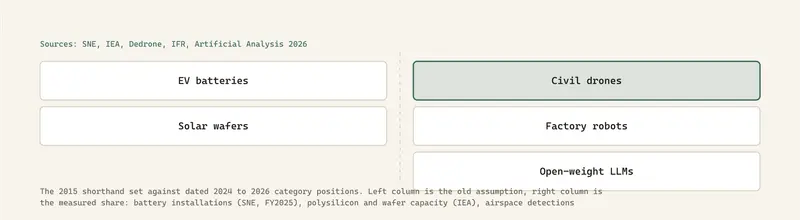
Start with batteries, because the numbers leave no room for interpretation. SNE Research published full-year 2025 figures on 4 February 2026. The global EV battery market reached 1,187 GWh, up 31.7% year on year. CATL installed 464.7 GWh for a 39.2% share. BYD installed 194.8 GWh for 16.4%. Together that is 659.5 GWh and 55.6% of every cell installed on the planet. Add CALB at 5.3%, Gotion at 4.5%, EVE at 2.6% and Svolt at 2.4%. Of the top seven suppliers, only LG Energy Solution at 9.2% and Panasonic at 3.7% are not Chinese.
Solar is more concentrated still. The IEA puts China's share of every manufacturing stage, polysilicon through finished modules, above 80%, and capacity already under construction pushes the polysilicon, ingot and wafer share toward 95%. There is no second source at scale. Anyone building a solar project anywhere is buying Chinese upstream material regardless of the badge on the module frame.
Drones look like a monopoly with paperwork. DJI holds an estimated 70% to 80% of the global civilian market depending on whose methodology you accept. Dedrone, a counter-drone detection firm that watches actual airspace rather than sales channels, found DJI airframes in 83.48% of all drone detections in 2025. Autel, the usual named alternative, registered 1.40%. Home-built airframes came in at 9.82%, up more than fourfold on 2024, which is a separate story about cheap flight controllers and open airframe designs.
Industrial robots, from the IFR World Robotics report released 25 September 2025: 542,000 units installed worldwide in 2024, of which China took 295,000. That is 54% of global installations in one country. The detail that matters more is domestic. Chinese robot makers outsold foreign suppliers inside China for the first time, taking 57% of their home market against roughly 28% a decade earlier. China's operational stock passed two million units.
Humanoids are earlier and much noisier. Unitree listed on the Shanghai STAR Market on 19 August 2026 at an issue price of 150.80 yuan, raised about 6.1 billion yuan, and the stock opened 629% higher before closing the day up 460%. Ignore the price action. The number worth keeping is the 278 million yuan of net profit Unitree reported for 2025 on shipments above 5,500 units, because profitability at this stage of a hardware category is unusual. TrendForce expects Unitree and AgiBot together to take close to 80% of humanoid shipments in 2026.
Vehicles are where the perception lag is widest. In July 2026 new energy vehicles were 60.4% of all new vehicle sales in China, the first month above 60%, on 1.561 million units. NEV exports that month hit 553,000, up 145.5% year on year. On safety, Euro NCAP rewrote its assessment protocols for the first time in more than a decade and published the first results under the 2026 scheme on 8 July 2026. Two cars scored five stars: the BMW iX3 and the Zeekr 7GT. The Zeekr scored higher on three of the four stages, 79% Safe Driving, 89% Crash Avoidance and 93% Crash Protection against the BMW's 73%, 83% and 86%.
The variance is not a national trait. It is what a very deep supplier base looks like from the outside.
The open-weight reversal took about eighteen months
The AI category moved fastest and is the least priced into anyone's assumptions. Artificial Analysis ran its Intelligence Index on 30 April 2026 and found that the top ten open-weight models were all from China-based labs. Kimi K2.6 from Moonshot AI and MiMo V2.5 Pro from Xiaomi tied at 54. DeepSeek V4 Pro scored 52. The strongest closed model, GPT-5.5 at extra-high effort, scored 60. Gemini 3.1 Pro Preview and Claude Opus 4.7 both scored 57. The gap between best open and best closed is six to eight points.
Twelve months earlier, in April 2025, the strongest open-weight model on that same index scored 22.
Distribution followed capability. Hugging Face published its State of Open Models report on 14 August 2026. Qwen recorded 2,045 million downloads across the first seven months of 2026 and now carries 151,448 derivative repositories on the Hub, roughly 2.6 times Meta's entire footprint, growing at 180 to 210 new repositories a day. That is not a benchmark result. That is the default substrate a large share of the world's fine-tuning now starts from.
What this looks like from Huaqiangbei
Huaqiangbei is a short metro ride from where I live. On any given floor of the component markets you can find the same nominal part number sitting on two counters at prices that differ by a factor of three. Both stalls will tell you it is genuine. One of them is telling the truth. The country of origin is identical. What differs is whether the reel came through a distributor with traceable lot codes or through the reclaim trade, and Shenzhen police have broken up rings that resurface reclaimed ICs, laser off the original markings and remark them as Infineon or TI parts.
That market sits about forty minutes from campuses producing the cells and airframes described above. Both facts are true on the same afternoon, in the same city, sometimes inside the same building.
The Nigerian version of this is solar. Nigeria imported 242.68 billion naira, roughly 163 million dollars, of solar panels in the first half of 2025, with 71.38% of it arriving from China, up 17.29% on the same period of 2024. Walk a market in Lagos or Aba and you will see panels from tier-one manufacturers with real warranty paper stacked beside panels carrying a laminated spec sheet and a phone number. Same origin country. Not remotely the same product. The buyers who lose money are not the ones who bought Chinese. They are the ones who bought on price without a test report.
The strongest objection: buying badly is still easy
The honest counter-argument is that variance at the low end has not gone anywhere, and that a country-level average tells you close to nothing about the specific part number in front of you. That objection is correct, and the data supports it more sharply than the optimists usually admit.
Kiwa PVEL published its 2026 PV Module Reliability Scorecard on 28 May 2026. In that round, 87% of manufacturers recorded at least one test failure. 26% of bills of materials broke during load testing. 45% of manufacturers had at least one major delamination failure. For the first time in the scorecard's twelve-year history, not a single bill of materials earned Top Performer status across every test. Forty-three manufacturers were Top Performers in at least one category. That spread, between 43 genuinely excellent product lines and an 87% failure-somewhere rate, is the real shape of the market.
Cars are not exempt. Euro NCAP crash tested an MG3 in September 2025 and found the driver's seat unlatching from its rails mid-impact and twisting. MG accepted the finding, redesigned the rail and ran a recall from November 2025. By the end of April 2026 it had inspected and fixed more than 12,000 cars, and Euro NCAP was still publicly urging owners to book the free repair in May 2026.
Two things follow. The failure was found by an independent lab, fixed by the manufacturer and verified by that lab again, which is the system doing its job rather than failing. And the PVEL numbers cover manufacturers worldwide, not Chinese ones specifically. The variance is not a national trait. It is what a very deep supplier base looks like from the outside: depth produces the best product in a category and the worst product in a category, and no country filter can separate them for you.
Buyer-side technical judgement, concretely
Replacing the country heuristic means doing actual work. In hardware, name the third-party report you will accept before you shortlist anything. Kiwa PVEL for modules. Euro NCAP or C-NCAP for vehicles. TÜV or UL for most of the rest. Then incoming inspection with X-ray and decapsulation on anything where a remarked part causes a field failure rather than a warranty claim. Ask for lot codes. Ask which fab. Ask for the test report by number, not by adjective.
For models, the equivalent is refusing to treat a leaderboard as a substitute for your own eval. Pull the weights, serve them yourself with vLLM or Ollama, run your own task set through Promptfoo, trace it with Langfuse or Arize Phoenix and red-team it with garak before anything touches a customer. Chinese labs publish to ModelScope alongside Hugging Face, and the Chinese-language model card frequently carries context-length caveats, licence conditions and known-failure notes that never reach the English README. I have watched teams deploy against the English page and get surprised by something that was written plainly in Chinese six weeks earlier.
Crash labs, reliability scorecards, detection datasets and public benchmarks are all now doing the job the label used to pretend to do. They are also why the label has become actively misleading rather than merely outdated. The evidence is published, dated and free. Continuing to price a supplier on a reputation formed in 2015 is a choice, not a constraint.
Where the pressure goes next
The interesting part of the CAAM data is not the record share. It is the split underneath it. In July 2026 domestic NEV sales inside China fell 2.8% year on year while exports rose 145.5%. Across January to July, NEV exports reached 2.909 million units, roughly double the prior year.
Domestic demand is saturating. Capacity is not shrinking. The surplus is arriving in Lagos, Jakarta, Santiago and Warsaw, at prices set by a market that has already been through its own brutal consolidation and by firms that no longer need the home market to grow.
The label was never a quality claim. Right now it is a forecast about where the price floor is heading, and most of the industries about to be repriced by it have not yet bought a single unit to test.
Tools referenced
DeepSeek, reviewed here: DeepSeek review.
MiniMax M3, reviewed here: MiniMax M3 review.
vLLM, reviewed here: vLLM review.
Ollama, reviewed here: Ollama review.
Promptfoo, reviewed here: Promptfoo review.
garak, reviewed here: garak review.
Sources
SNE Research full-year 2025 global EV battery market share, via CnEVPost, 4 February 2026: https://cnevpost.com/2026/02/04/global-ev-battery-market-share-2025/
IEA, Solar PV Global Supply Chains, executive summary: https://www.iea.org/reports/solar-pv-global-supply-chains/executive-summary
IFR World Robotics 2025 press release, 25 September 2025: https://ifr.org/ifr-press-releases/news/global-robot-demand-in-factories-doubles-over-10-years
CAAM July 2026 China NEV sales and export data, via CnEVPost, 12 August 2026: https://cnevpost.com/2026/08/12/china-nev-sales-jul-2026-caam/
Artificial Analysis, recent open weights model launches and Intelligence Index, April 2026: https://artificialanalysis.ai/articles/recent-open-weights-model-launches
Hugging Face, State of Open Models: Summer 2026, 14 August 2026: https://huggingface.co/blog/state-of-open-models-summer-2026
Kiwa PVEL 2026 PV Module Reliability Scorecard results, pv magazine, 28 May 2026: https://www.pv-magazine.com/2026/05/28/kiwa-pvels-2026-solar-module-reliability-scorecard-reveals-high-failure-rates-amid-incremental-increases-in-performance/
Euro NCAP, BMW iX3 and Zeekr 7GT secure five stars under the new 2026 tests, 8 July 2026: https://www.euroncap.com/press-media/a-new-benchmark-for-vehicle-safety-bmw-and-zeekr-secure-five-stars-under-euro-ncap-s-new-tests/
Frequently Asked Questions
Is made in China still a sign of low quality in 2026?
No, not as a general rule, and it has not been for several years in the categories where China holds manufacturing depth. SNE Research reported that CATL and BYD alone installed 55.6% of the world's EV batteries in 2025. The IEA puts China above 80% of every solar manufacturing stage. The IFR counted 295,000 industrial robots installed in China in 2024, 54% of global installations. Artificial Analysis found on 30 April 2026 that the top ten open-weight AI models by Intelligence Index all came from China-based labs. Quality variance at the low end is still real, so the correct approach is testing specific products against third-party reports rather than filtering by country.
Are Chinese electric cars safe?
The independently tested ones score at or above European rivals. Euro NCAP overhauled its assessment protocols for the first time in over a decade and published the first results under the 2026 scheme on 8 July 2026. Two cars earned five stars: the BMW iX3 and the Zeekr 7GT. The Zeekr scored higher on three of four stages, at 79% Safe Driving, 89% Crash Avoidance and 93% Crash Protection against the BMW's 73%, 83% and 86%. Safety is model-specific, not brand-specific or country-specific. Euro NCAP also found a driver's seat rail failure in the MG3 during September 2025 testing, prompting a recall that fixed over 12,000 cars by April 2026. Check the individual model's rating under the current protocol before buying.
Are Chinese open-weight AI models as good as GPT or Claude?
They are close but not equal on raw capability, and they lead every other open-weight option. On the Artificial Analysis Intelligence Index as of 30 April 2026, Kimi K2.6 from Moonshot AI and MiMo V2.5 Pro from Xiaomi tied at 54, with DeepSeek V4 Pro at 52. The leading closed models scored 60 for GPT-5.5 at extra-high effort and 57 for both Gemini 3.1 Pro Preview and Claude Opus 4.7, so the gap is six to eight points. In April 2025 the best open-weight model scored 22, which shows how quickly that gap closed. For adoption, Hugging Face reported on 14 August 2026 that Qwen had 2,045 million downloads across the first seven months of 2026 and 151,448 derivative repositories.