Shenzhen Hardware Manufacturing Is No Longer Cheap. It Is Still Four Days.
 Francis Okafor
On this page
A design change left Berlin on a Tuesday morning. The assembled prototype was sitting on a bench in Shenzhen on Friday afternoon. That four-day turn is the whole argument for Shenzhen hardware manufacturing in 2026, and it has almost nothing to do with cheap labour, which stopped being true about a decade ago.
The headline numbers are easy to find. GDP of 3.87 trillion yuan in 2025, up 5.5 percent, the fastest growth among China's first-tier cities. Strategic emerging industries at 1.67 trillion yuan of added value, 43 percent of the whole economy. Thirty-nine industrial product categories, integrated circuits and industrial robots and smartphones among them, each accounting for more than a tenth of national output. All true. All beside the point.
The point is density. Component traders, prototype shops, mould makers, PCB fabricators and final assemblers sit inside a radius you can cross in an hour if the Guangshen expressway behaves. Add a supplier culture that will quote 200 pieces and 500 pieces without hanging up on you. An iteration that takes six weeks in most of the world takes four days here, and after ten revisions that gap is the difference between shipping and not shipping.
The cheap labour story died around 2015
Shenzhen's statutory monthly minimum wage is 2,520 yuan, against 2,500 for the rest of Guangdong. Roughly 350 US dollars. On top of that sit mandatory social insurance and housing fund contributions that a foreign buyer never sees itemised on a quote but always pays for. Vietnam's 2026 minimum runs from 3,700,000 to 5,310,000 dong depending on region, somewhere around 140 to 200 dollars.
So Vietnam is half. India is less than half across most states. Anyone still pitching Shenzhen on wage arbitrage is reading from a deck written in 2009.
The recruitment boards outside the industrial parks in Bao'an tell it better than any statistic. They quote a base, an overtime rate and a signing bonus, and the bonus is the only number that actually moves. In a hard hiring week it doubles. Nobody who has stood in front of those boards reading them in Mandarin still believes this is a low-wage city.
What happened instead of relocation, for the work that stayed, was automation. China installed 295,000 industrial robots in 2024 according to the International Federation of Robotics, 54 percent of every industrial robot installed on earth that year. The city did not try to compete on wages. It took the wage out of the equation wherever the physics allowed.
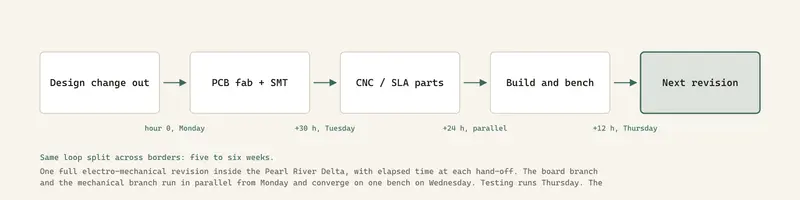
Assembly cost is not what governs iteration. Distance to the twelfth revision is.
The four-day loop that defines Shenzhen hardware manufacturing
Here is the loop with the clock running.
Monday, 9am. Gerbers and a BOM go out. Quick-turn fabs across the delta advertise 24-hour PCB production, and JLCPCB, which runs at industrial scale out of the region, publishes that roughly 90 percent of its assembly orders finish inside 24 hours and effectively all of them inside 48. Call it 30 hours from files to a populated board in your hand, and most of that is queue rather than process.
In parallel, Monday afternoon. A STEP file goes to a prototype shop in Bao'an. SLA and FDM parts for a fit check come back in 24 to 48 hours at roughly 20 to 80 dollars a part. A machined aluminium enclosure piece is a couple of hundred dollars on a similar clock. Nothing ships. Somebody rides it over.
Wednesday, the parts converge on one bench. Thursday, bench testing and thermals and a drop test at a lab two metro stops away that takes walk-ins. Friday morning, the next revision goes out and the clock restarts.
Individual steps are not much faster here than anywhere else. Money buys speed in Munich too. What collapses is the queue between steps. The mould shop is a 40-minute drive, not a customs entry. The fab engineer answers a WeChat voice note at 10pm because his DFM review is the thing standing between your board and the scrap bin. Nobody batches. There is no freight leg. The dead time between operations, which is where the six weeks actually live in every other version of this story, rounds to zero.
Sourcing a part in Huaqiangbei
Huaqiangbei reopened as a 930-metre pedestrian street on 14 January 2017, after four years shut for metro construction. SEG Plaza anchors it, 71 floors put up between 1997 and 2000 at a rate of one storey every 2.7 days, with the electronics market occupying the lower floors. Everybody photographs the outside. The transaction happens at a counter about a metre wide.
You do not arrive with a description. You arrive with a part number and a photograph of the reel label. You say the number out loud in Mandarin, digit by digit, because part of it is a date code and the woman behind the counter will ask. She has maybe forty SKUs visible behind her and access to several thousand through people she has never met in person. She does not have yours. She photographs your photograph into a WeChat group.
Three quotes came back inside six minutes the last time I did this. Two priced per thousand. One had a partial reel, 800 pieces, sitting in a warehouse in Longhua. I asked for the date code before I asked the price. Then I asked to see the physical reel rather than a photo of a reel. Then I paid, against a paper slip with the quantity written on it in pen, and the parts arrived on the back of an electric scooter inside two hours.
The risk is exactly what you think it is. Relabelled parts, remarked date codes, recovered silicon pulled off scrapped boards. That risk is the fee you pay for the speed. For anything carrying a safety, lifetime or certification consequence you buy authorised, you wait the eight weeks, and you accept that you are no longer running a four-day loop. For everything else the market beats any distributor on the planet.
The market I compare it to is Computer Village in Ikeja, which I have walked more times than I can count. The same compressed density of people and shouting and negotiation. A completely different function. Ikeja moves finished goods and repairs them at a level of skill Shenzhen would respect. It does not make them. Lagos State has been trying to move that market to a 15-hectare ICT park at Katangowa since 2017, and a High Court ruling in June 2026 revived the plan after years of stalling. Density of trade is not density of manufacture. Huaqiangbei has both, because the fabs feeding it are 40 minutes away.
What a tooling quote actually says
You send a STEP file with a material call, a finish spec and an honest annual volume. In the Chinese mould trade the median time to a first quote is about 2.2 hours, and 93.8 percent of enquiries get one back inside 24 hours. That single number explains more about why people stay than any labour comparison does.
The quote comes back roughly like this. A single-cavity prototype tool in P20 for a simple thermoplastic housing lands at 1,000 to 3,000 dollars. A production tool with four to eight cavities runs 5,000 to 15,000 and climbs from there. Complex consumer housings with sliders, lifters and cosmetic texture go well past that. Lead time is 15 to 25 days for the prototype tool and 25 to 45 days for the production tool, with undercuts or thin walls or anything needing EDM adding another 5 to 10 days.
What the quote does not contain is the part that eats your schedule. T1 samples arrive and a boss is short. The gate is in the wrong place and there is a weld line across a visible face. Texture approval takes a round trip. Steel-safe changes are cheap because removing steel is easy; putting it back is welding and a week. A tool shop 40 minutes away will run three of those rounds in the time an offshore vendor runs one.
The cultural half is harder to price. A Dongguan tool shop will quote a 500-piece production run and mean it. Most of the world's mould makers will not answer that email at all. The Chinese shop takes it because it is betting on the reorder, on the reference and on machine time already amortised across forty other customers. That willingness to quote small is the most underrated thing about the region, and it is the first thing to go if the volume leaves.
The strongest case against staying
The diversification is real and it is large. For whole product categories the Shenzhen premium no longer pays. That has to be said plainly rather than waved at.
India assembled roughly a quarter of global iPhone output by early 2026. Across the PLI scheme period from FY22 to FY26, Tata Electronics overtook Foxconn on iPhone exports, 26.3 billion dollars against 25.6 billion, on total production values of 35.5 billion and 38 billion respectively. Exports were 73.6 percent of the value. Vietnam has gone from cheap assembly to a genuine electronics base, and the tariff structure now actively pushes work there.
Tariffs push the same direction. The July 2025 US-Vietnam arrangement carries a 40 percent penalty on goods judged to have been transshipped without substantial transformation, and enforcement against China-linked plants in Vietnam has continued through 2026. Origin now has a price attached, and it goes straight into the landed cost model.
So here is the concession, without hedging. If your product is mature, high volume and labour-heavy, with a frozen bill of materials and a two-year design life, you should not be building it in Shenzhen. Cable assemblies. Simple enclosures. Commodity consumer goods. Take them to Bac Ninh or Tamil Nadu, and the tariff position will often decide it before engineering gets a vote.
Now look at what actually moved. Assembly moved. The component base did not. China shipped roughly 186 billion dollars of goods into Vietnam in 2025, around 41 percent of everything Vietnam imported. Bloomberg's read of 2025 customs data found a single Foxconn subsidiary in Vietnam exporting 8.6 billion dollars of MacBooks, iPads and motherboards while importing 7.9 billion dollars of components from China. The final assembly step crossed one border. The supply base stayed exactly where it was.
And assembly cost is not what governs iteration. Distance to the twelfth revision is. If your design is frozen, the delta's advantage is worth nothing to you and you should leave today. If you are still finding out what the product is, four days against six weeks compounds savagely. Ten revisions is forty days here and about sixty weeks there. Very few hardware companies survive sixty weeks of not knowing.
What changed as the costs went up
Two things changed, and neither is what people outside expect.
The market floors changed. A much larger share of Huaqiangbei now sells to livestream resellers, phone repair shops and consumer retail than it did ten years ago, while the serious component trade migrated into the traders' WeChat groups and onto online platforms. The counter is a front end for a network now rather than an inventory. Walk in expecting to browse your way to a part and you leave with nothing. Walk in with a part number and you leave with the part.
The work moved out and up. Low-margin assembly left Shenzhen years ago for Dongguan, Huizhou, Jiangxi and eventually Hanoi. What stayed is high-mix, low-volume, engineering-heavy hardware: drones, service robots, medical instruments, test equipment, AI devices. Rents rose in the Bao'an and Longhua industrial parks. Wages rose. The response, for the work that stayed, was robots and better process control rather than a moving truck.
The bill of materials changed too. Boards being quoted now routinely assume a model runs on the device, which means more RAM, sometimes an NPU and a conversation about ncnn or MNN in a room where the argument used to be about which MCU. Sensor-side work goes through Edge Impulse. On the line, camera inspection with something like Ultralytics YOLO26 or a platform such as Instrumental has stopped being exotic, and floor software from Tulip or Siemens Industrial Copilot turns up in factories that ran on paper travellers three years ago. The mechanical loop and the model loop are now the same loop, and the delta is one of very few places where both of them close inside a week.
The part nobody has copied
You can move a factory. Countries have done it, quickly, with money and land and tax holidays. India moved a quarter of iPhone assembly in a handful of years. That is not a small achievement and pretending otherwise is how people get blindsided.
What has not moved is the tacit layer. The mould maker who tells you the rib is too thick before you ask, because he has watched that sink mark appear on forty housings. The trader who knows which lot of that particular MCU is remarked and says so quietly rather than lose you. The line leader who has built your category forty times and stops the build to point out that the connector orientation is going to generate returns. None of that appears on a quote. None of it transfers with the tooling. It took thirty years of building other people's products badly and then well to accumulate.
Vietnam is not what worries me. Density behaves like a flywheel, and somebody has to keep putting energy into it. Every SKU that leaves for Hanoi or Chennai takes a small piece of the reason that Dongguan tool shop can afford to quote you 500 pieces at all. It survives on the aggregate, not on you. There is some volume threshold below which it stops answering that email, and I have no idea where the threshold sits. Nobody does. We will find out the way these things are always found out, which is when somebody flies in for a part and gets told to try Hanoi.
Tools referenced
Instrumental, reviewed here: Instrumental review.
Tulip, reviewed here: Tulip review.
Siemens Industrial Copilot, reviewed here: Siemens Industrial Copilot review.
Edge Impulse, reviewed here: Edge Impulse review.
ncnn, reviewed here: ncnn review.
MNN, reviewed here: MNN review.
Sources
China Daily: Shenzhen leads major cities with 5.5% GDP growth on tech edge (2025 figures): https://www.chinadaily.com.cn/a/202602/10/WS698a74dba310d6866eb38589.html
International Federation of Robotics, World Robotics 2025: global robot demand in factories: https://ifr.org/ifr-press-releases/news/global-robot-demand-in-factories-doubles-over-10-years
China Briefing: Minimum Wages in China, a Complete Guide: https://www.china-briefing.com/news/minimum-wages-china/
JLCPCB: PCB Assembly FAQs (assembly turnaround times): https://jlcpcb.com/help/article/pcb-assembly-faqs
Haizol: Online Injection Molding from China, Cost, Lead Times and Factory Data (2026): https://www.haizol.com/news/china-injection-molding-industry-report-2026
Business Standard: Tata Electronics pips Foxconn in India iPhone exports worth $26.3 billion: https://www.business-standard.com/technology/tech-news/tata-electronics-pips-foxconn-in-india-iphone-exports-worth-26-3-billion-126070201178_1.html
Bloomberg: A Winner in Early Trump Tariffs, Vietnam Thrives in Trade War 2.0: https://www.bloomberg.com/graphics/2026-vietnam-trump-tariffs-supply-chain/
Nairametrics: Court ruling revives Computer Village relocation to Katangowa: https://nairametrics.com/2026/06/28/court-ruling-revives-computer-village-relocation-to-katangowa-says-bridgeways/
Frequently Asked Questions
Is manufacturing in Shenzhen still cheaper than Vietnam or India?
Not on labour. Shenzhen's statutory monthly minimum wage is 2,520 yuan (roughly 350 US dollars) as of 2026, against a Vietnamese minimum of 3.7 to 5.31 million dong, about 140 to 200 dollars depending on region, and Chinese employers carry mandatory social insurance and housing fund contributions on top of that. India is lower still across most states. Shenzhen's remaining advantage is supply chain density and iteration speed rather than unit labour cost. For mature, labour-heavy products with a frozen design, Vietnam or India will usually win on landed cost, particularly once US tariff treatment is priced in.
How fast can you iterate a hardware design in Shenzhen?
A full electro-mechanical revision loop can close in about four days in the Pearl River Delta. Quick-turn PCB fabs in the region offer 24-hour production, and JLCPCB states that around 90 percent of its assembly orders finish within 24 hours and effectively all within 48. SLA and FDM prototype parts come back in 24 to 48 hours at roughly 20 to 80 dollars each, and a machined aluminium enclosure piece runs a couple of hundred dollars on a similar clock. Because component markets, fabs, machine shops and assemblers sit within roughly an hour of each other, there is no freight leg between steps. The same loop typically takes five to six weeks when the steps are spread across countries.
How much does injection mould tooling cost in China?
As of 2026, a single-cavity prototype mould in P20 steel for a simple thermoplastic part typically quotes at 1,000 to 3,000 US dollars, and a production tool with four to eight cavities at 5,000 to 15,000 dollars or more, rising sharply for complex consumer housings with sliders, lifters and cosmetic texture. Lead times run 15 to 25 days for prototype single-cavity tooling and 25 to 45 days for production multi-cavity tooling, with undercuts, thin walls or EDM work adding another 5 to 10 days. Median first-quote response time from Chinese mould shops is about 2.2 hours, with 93.8 percent of enquiries quoted inside 24 hours.