What Actually Moves Through the Africa China Technology Corridor
Trade numbers are the worst lens. From Shenzhen, six flows explain more: handsets and their preinstall slate, vendor certifications, open model weights, payment rails, components and people.
Trade statistics are the worst way to see the Africa China technology corridor. China's customs figures put two-way trade at roughly $348 billion in 2025, of which about $225 billion moved from China to Africa. Both numbers are true. Both are close to useless if you want to know what is happening, because a single aggregate cannot tell you which specific things move, who captures the value or what it would cost to stop.
I have spent eight years in Shenzhen. I read the Chinese-language trade press before its English summaries appear. I chair a forum that puts African and Chinese technologists in the same room, and I fly the other way often enough to notice what changes on arrival. From inside, this resolves into six flows sitting at different depths, with wildly different switching costs. Depth is the thing worth measuring. A shipping container is shallow. A certification is deep.
The handset is the distribution channel
Canalys put African smartphone shipments at 19.2 million units in the second quarter of 2025, up 7% year on year, with Transsion holding 51% of the market across its Tecno, Infinix and itel brands. That figure gets quoted as a hardware story. It is not a hardware story.
The phone is the carrier. The cargo is the default set: which wallet is preinstalled, which store, which music app, which browser opens a link. PalmPay launched with a seed round led by Transsion and ships preinstalled on Transsion handsets. Boomplay came out of a joint venture between Transsion and NetEase and has been preloaded on those phones since 2015. For a first-time smartphone owner, the preinstalled wallet is not one option among several. It is the account.
Who benefits: the manufacturer, twice. Once on hardware margin, which on a sub-$100 device is thin, then again on the distribution rent it can charge for a slot. Who carries the dependency: everyone downstream. An African fintech without a slot has to buy each user individually, in markets where average revenue per user makes paid acquisition brutal arithmetic. That is the real alternative cost, and it is why the slot is worth more than the phone.
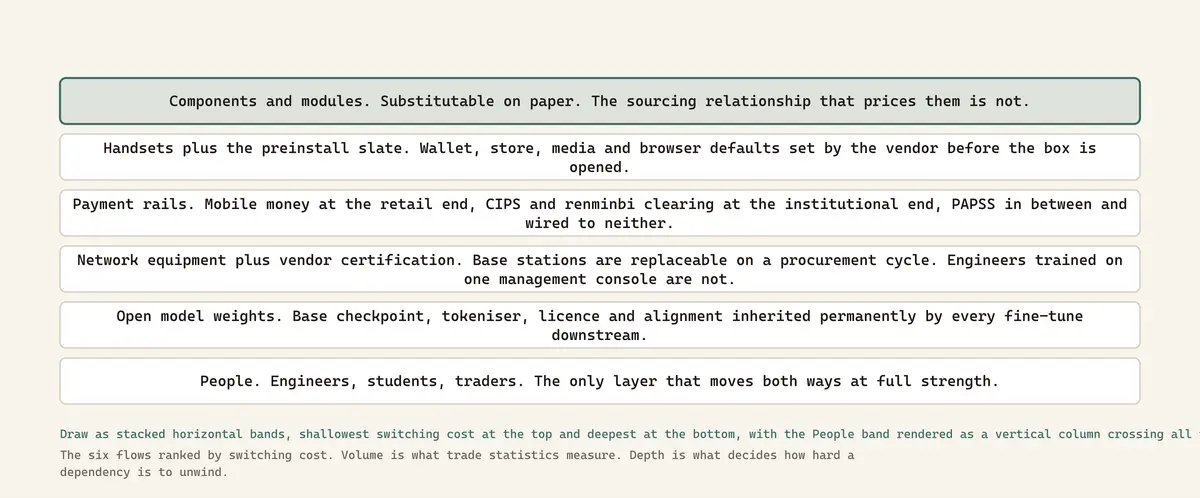
Radio equipment is replaceable on a procurement cycle. A workforce trained on one vendor's console is not.
Base stations ship with a curriculum
You will read everywhere that Huawei built 70% of Africa's 4G networks. I went looking for the source. The trail usually points at a 2021 CSIS analysis, which I read: it is about cloud and e-government contracts and it carries no such figure. I am not saying the claim is false. I am saying I could not find anyone who measured it, so I will not build an argument on it.
What is documented is the training pipeline. At a summit in Shanghai in June 2024, Huawei announced it would train a further 150,000 people in sub-Saharan Africa over three years, on top of an earlier target it says it beat by training more than 120,000 in 26 months. ICT Academies sit inside universities and technical colleges. The certification ladder runs from associate to expert grade, on one vendor's command syntax and one vendor's management console.
Radio equipment is replaceable on a procurement cycle. A workforce is not. When an operator considers a different supplier, the hardware quote is the small number. The large number is retraining, plus a hiring market where the available skill has been priced against one product line for a decade. Nobody writes that into the tender. It shows up as the reason the tender never happens.
Open weights are the heaviest cargo
This is the flow almost nobody counts, and it is the one I would watch.
Sunflower, published in October 2025, is a family of 14B and 32B models built on Qwen 3, targeting Ugandan languages rather than spreading thin across a continent with more than two thousand of them. AfriqueLLM, accepted to ACL 2026, adapts open models to 20 African languages through continued pretraining on 26 billion tokens, and its comparison of Llama 3.1, Gemma 3 and Qwen 3 as starting points is a procurement decision dressed as an ablation study.
Who benefits: African research groups that will never have the budget to pretrain a base model from scratch for languages with thin web text. Fine-tuning an existing checkpoint is the correct choice. It is also the only choice.
What arrives with it: the tokeniser, the licence, a training mixture you cannot inspect and alignment decisions taken in another jurisdiction. Tokenisation is the quiet one. If a language fragments into far more tokens than English, every inference call costs more, permanently, and that tax is set at the base model rather than in your code. The alternative would cost tens of millions of dollars and a data collection effort measured in years. So the dependency is not a mistake. It is a rational purchase whose price shows up later.
Two payment systems that do not meet
More than $2 trillion moved through mobile money globally in 2025 according to the GSMA, and $1.4 trillion of that was in sub-Saharan Africa. That is where African working capital actually sits.
At the other end of the corridor, the plumbing changed fast. Standard Bank became the first African bank on China's Cross-Border Interbank Payment System in late 2025 and pushed around $500 million through it in four months, mostly trade finance. China's central bank then authorised Standard Bank and ICBC jointly as a renminbi clearing arrangement covering 19 African countries, letting importers settle with Chinese suppliers in yuan instead of converting through dollars twice.
Both are real. They do not touch each other. The renminbi channel serves entities with corporate banking relationships and documentary trade. The wallet serves everyone else. Between them sits a bank account many small importers do not have, an FX spread and a correspondent chain nobody chose. The World Bank still records sub-Saharan Africa as the most expensive region on earth to send money to, close to 8.8% on a $200 transfer, and nine of the thirteen global corridors costing above 20% in the third quarter of 2025 originate in the region.
PAPSS exists to settle African cross-border payments in local currencies without routing through banks outside the continent. It is the piece that would matter most to the importers I meet. It is also the piece least connected to either of the other two.
Components and the relationship that prices them
Walk the electronics markets here and the visible transaction is a part. A module. A display. A board.
The invisible transaction is the relationship: who will quote a small run without a minimum order that assumes you own a factory, who holds a price when copper moves, who tells you a component is going end of life before the notice appears. None of that is in the customs data. It cannot be bought with a purchase order and it does not transfer when the buyer changes. I have watched people spend a whole afternoon at one counter over a margin that looks trivial per unit, and the margin is not what the afternoon was for.
This dependency is the softest and the most personal. It is also the easiest to replace on paper and the hardest in practice. A distributor elsewhere will sell you the same part with published lead times, a returns policy and a price that assumes you are not counting cents. For a hardware team building to an African market's actual price point, that is not a substitute. It is a different business.
The flow that runs both ways
People are the only cargo moving in both directions at full strength. Chinese engineers land for deployments. African engineers, students and traders come here and stay long enough to learn how the other end works, which is different from how either country's press describes it.
The useful conversations do not happen at trade fair level. They happen when somebody who has debugged a base station in one country and read a Chinese vendor forum in the original language explains to a founder why a quoted price is not the real price, and why the cheaper module will fail the second rainy season.
This is the only layer with agency over the others. A certified engineer can choose a different vendor. A returning researcher can choose a different base checkpoint. A trader who speaks the language negotiates a different number. Everything else in the corridor is a decision taken once and then inherited by everyone downstream.
What the Africa China technology corridor frame leaves out
Here is the strongest objection to everything above, and I think it lands.
Calling this a corridor puts two parties at the ends of a pipe and quietly makes Africa the receiving end. It centres Chinese supply and African demand, which flatters a Chinese self-image and a Western anxiety at the same time, and it writes out the thing that has actually driven African technology: African decisions.
Mobile money was not imported. It was built in East Africa and copied outward, and sub-Saharan Africa now carries the majority of the world's mobile money accounts and the bulk of its transaction value. PAPSS is African institutional design. The African Union adopted a Continental AI Strategy in July 2024 with an implementation window running to 2030. Cassava, led from the continent, is deploying GPU capacity in South Africa with expansion planned across Egypt, Kenya, Morocco and Nigeria, which is a sovereignty argument made in hardware. The research groups behind the African-language models I cited set their own agenda, chose their own languages and picked base models on measured performance rather than on geography.
The honest version is that this corridor is one input among several, and the interesting decisions are being made by people who treat it as a supplier rather than a patron. If I only describe what arrives, I have written the smaller half.
The firmware nobody votes on
The next thing to move through here is already in transit. Small models running on the device instead of in a data centre, shipped inside the same preinstall image as the wallet and the music app.
When that lands, the base checkpoint, the tokeniser, the refusal behaviour and the default language coverage all arrive on a handset that most of a country's first-time internet users will own within a few years. No tender. No regulator sign-off. No line in the customs data, because weights do not weigh anything.
A continental AI strategy governs national policy, procurement and data protection law. It has nothing to say about a firmware image on a $90 phone. That gap is where the next decade of this relationship gets settled, and at the moment nobody at either end of the corridor is looking at it.
Sources
Ecofin Agency, Africa's trade deficit with China hits $102bn in 2025 (Chinese customs data: $348.05bn total trade, $225.03bn Chinese exports): https://www.ecofinagency.com/news/2301-52207-africa-s-trade-deficit-with-china-hits-102bn-in-2025-up-64-5-yoy
TechAfrica News, Africa's Smartphone Market Surges 7% in Q2 2025 (Canalys: 19.2m units, Transsion 51%), 22 August 2025: https://techafricanews.com/2025/08/22/africas-smartphone-market-surges-7-in-q2-2025-outpacing-global-growth/
Huawei, press release: train an additional 150,000 people in Sub-Saharan Africa by 2027, 4 July 2024: https://www.prnewswire.com/news-releases/huawei-to-train-additional-150-000-people-in-sub-saharan-africa-by-2027--302189415.html
Akera et al., Sunflower: Expanding Coverage of African Languages in LLMs (Qwen 3 base, 14B and 32B, Ugandan languages), arXiv, October 2025: https://arxiv.org/abs/2510.07203
Yu et al., AfriqueLLM: Open LLMs for African Languages (20 languages, 26B-token continued pretraining, Llama 3.1 vs Gemma 3 vs Qwen 3), ACL 2026: https://arxiv.org/abs/2601.06395
GSMA, Mobile money accounted for $2 trillion in transactions in 2025 ($1.4tn in sub-Saharan Africa): https://www.gsma.com/newsroom/press-release/mobile-money-accounted-for-2-trillion-in-transactions-in-2025-doubling-since-2021-as-active-accounts-continue-to-grow/
Trade Treasury Payments, China authorises renminbi clearing network across 19 African countries (Standard Bank and ICBC, ~$500m via CIPS in four months): https://tradetreasurypayments.com/news/china-authorises-renminbi-clearing-network-across-19-african-countries-deepening-yuan-s-role-in-african-trade
World Bank, Remittance Prices Worldwide, Issue 54, September 2025 (sub-Saharan Africa the costliest receiving region): https://remittanceprices.worldbank.org/sites/default/files/2026-04/RPW_main_report_and_annex_Q325.pdf
Frequently Asked Questions
What actually moves through the Africa China technology corridor?
Six distinct things rather than one trade flow. Handsets together with the preinstalled software layer on them. Telecom equipment together with the vendor certifications that train engineers on one console. Open model weights used as bases for African-language fine-tunes. Payment rails that do not interconnect. Electronic components and the sourcing relationships that price them. And people travelling in both directions, which is the only flow with the standing to renegotiate the others.
How much of Africa's smartphone market does Transsion hold?
Canalys put Transsion at 51% of African smartphone shipments in the second quarter of 2025, across its Tecno, Infinix and itel brands, in a market of 19.2 million units that grew 7% year on year. The share matters less than what it carries. The preinstalled wallet, store and media apps become the defaults for first-time smartphone owners, and a default account is far harder to displace than a phone.
Are Chinese open-weight models being used in African AI projects?
Yes, and openly. Sunflower, published in October 2025, builds 14B and 32B models for Ugandan languages on top of Qwen 3. AfriqueLLM, accepted to ACL 2026, adapts open models to 20 African languages using continued pretraining on 26 billion tokens and compares Llama 3.1, Gemma 3 and Qwen 3 as starting points. For languages with thin web text, adapting an existing base model is the only affordable route, which means inheriting its tokeniser, licence and alignment choices.
Can African importers pay Chinese suppliers in renminbi?
Some can. Standard Bank became the first African bank to join China's Cross-Border Interbank Payment System in late 2025 and processed roughly $500 million through it within four months, mostly trade finance. China's central bank then authorised Standard Bank and ICBC jointly to clear renminbi across 19 African countries. The arrangement serves businesses with corporate banking relationships. It does not reach the mobile money wallets where most small-trader capital sits.
Did Huawei build 70% of Africa's 4G networks?
That figure circulates constantly and does not survive a check. It is commonly attributed to a 2021 CSIS analysis, which is about cloud and e-government contracts and contains no such number. What is documented is training rather than market share: Huawei announced in mid-2024 that it would train a further 150,000 people in sub-Saharan Africa over three years, having said it trained more than 120,000 in the preceding 26 months. Build arguments on the documented number, not the circulating one.
What is the strongest argument against framing this as a corridor?
That it centres two parties and casts Africa as the receiving end. Mobile money was built in East Africa and exported outward, PAPSS is African institutional design, the African Union adopted a Continental AI Strategy in July 2024, and African research groups pick base models on measured performance rather than on geography. The corridor is one input among several, and the decisions worth watching are made by people who treat it as a supplier.

About Francis Okafor
Nigerian engineer, eight years inside China's tech ecosystem, writing from Shenzhen. I build agentic AI systems that drive physical hardware, and I write about how these systems behave once they are carrying real load.