Where to Rent GPUs in Africa: What Is Actually Plugged In
For anything larger than a fine-tune, one country on the continent has rentable modern GPUs. What is actually plugged in, what is only announced and what either costs to use.

Someone in Lagos or Nairobi asks me where to rent GPUs in Africa about once a fortnight. The honest answer is short and unwelcome. For anything bigger than a fine-tune there is one country on the continent with rentable modern silicon, and unless you are willing to put your workload in Johannesburg or Cape Town, it is not yours.
I have spent eight years inside Chinese tech, most of it reading procurement terms and licence documents in the original rather than in translation. Shenzhen builds compute the way other cities build roads. Africa is building something else: a small number of real clusters, a very large number of press releases and a power problem nobody can announce their way out of.
What follows is what I could verify against primary sources as of 1 September 2026. I have kept announced capacity and operational capacity strictly apart, because almost every article on this subject does not.
South Africa has the only rentable modern GPUs on the continent
Altron switched on what it called South Africa's first operational AI factory in mid-October 2025. Not the first announced. The first operational, and the distinction was deliberate, because Dell had announced one the year before. It runs inside a Teraco facility in Johannesburg, sells access as AI-as-a-Service and launched with five customers including Lelapa AI, Dataviue and MathU. Data stays inside South African jurisdiction. That was the entire pitch.
Cassava Technologies is the larger effort and the more heavily covered one. It became Nvidia's first African cloud partner and announced in March 2025 that it would place 3,000 GPUs in South Africa by June that year, scaling to 12,000 more across the continent within three to four years, at a reported total investment near $720 million. By early May 2026 its first Cape Town deployment was in place, with Cassava saying the site would build into a fully fledged AI factory over the following four to six weeks, and a 20MW Johannesburg site had been announced. Expansion to Nigeria, Kenya, Egypt and Morocco remains a plan rather than a rack.
Cassava's GPU-as-a-Service page names H200 hardware and describes partitioning each physical GPU into up to seven isolated instances using Nvidia's MIG. On-demand billing, reserved terms of one to five years and a spot tier are all offered. What is not offered is a price. There is no rate card anywhere on the site, only a contact form.
That absence is the most useful thing on the page. Every serious global GPU provider publishes hourly rates, because developers comparison-shop and the ones who hide pricing lose them. A contact form means the product is sold to enterprises and governments with procurement departments, on negotiated terms, in volume. If you are two engineers with a card, you are not the customer they built it for.
Nvidia will sell anyone GPUs. Nobody will sell Kenya a gigawatt.
The hyperscalers' African regions ship almost no GPUs
This is the part people get wrong most often, because it seems implausible on its face. Google Cloud runs africa-south1 out of Johannesburg. Open the official GPU regions and zones table and Africa does not appear in it at all. Not with A100s, not with H100s, not with anything. The continent is simply absent from the list.
AWS has operated af-south-1 in Cape Town since 2020 and offers roughly 478 of its 1,354 instance types there. The only accelerated family available is g4dn, starting at $0.698 an hour for a g4dn.xlarge and running to $10.381 for g4dn.metal. A g4dn carries an Nvidia T4: 16GB of memory on a Turing-generation core with no bfloat16 support. It is a competent inference card from 2018. P4d, P5 and even the G5 generation are not there.
Azure's South Africa North lists NV-series sizes, which are visualisation and remote-desktop parts built on A10 and older silicon. No NC series, no ND series, which means no A100 and no H100.
The summary for hyperscalers is blunt. You can serve a small vision model or run transcoding in Cape Town today. You cannot train anything current in any African region of AWS, Google or Microsoft, because the hardware has not been installed for you to rent.
Kenya and Nigeria have AI-ready racks, not AI clusters
Nairobi has the strongest facility story outside South Africa. IXAfrica's NBOX1 is operational and serving customers, with 4.5MW of IT capacity across 780 racks in three halls, engineered to take up to 50kW per rack. Rack density is what separates an AI-ready hall from an ordinary one, and most African colocation cannot do it. A second campus, NBOX2, is announced at 53MW with racks up to 90kW and an on-chip liquid cooling option.
Inside NBOX1, Atlancis Technologies announced on 10 November 2025 that it had deployed what it described as East and Central Africa's first GPU-powered AI factory, sold through its Servernah cloud brand with Everse Technology handling adoption support. The announcement says delivered and deployed. It does not say how many GPUs, which model or what an hour costs. I could not find any of those three figures published anywhere, and I looked.
Nigeria's picture is thinner and more honest about it. Udutech launched an Africa GPU Hub in Lagos in August 2025 offering rentals from under a dollar an hour, structured as a marketplace pooling regional capacity rather than a single owned cluster. Its founder Alex Tsado is a former Nvidia product manager who worked on the company's cloud AI business, which is worth knowing when you are judging whether a thing is real. Kasi Cloud commissioned its Lekki campus in May 2026, with a 5.5MW first operational phase on a site designed to scale towards 100MW. Airtel's 38MW Nxtra site at Eko Atlantic broke ground in 2024 and was targeted to go live in the first quarter of 2026. Nationally, Nigeria has somewhere between 65MW and 86MW of operational data centre capacity across about 17 live sites, with at least nine more facilities under construction or in advanced planning.
Then there is the project that did not happen. Microsoft and G42 announced a $1 billion geothermal-powered data centre at Olkaria in May 2024, targeting May 2026 and promising tens of thousands of GPUs and CPUs. It needed around a gigawatt. Kenya's total installed capacity is roughly 3,000MW. President Ruto described the arithmetic himself: to switch on that one data centre, the country would have needed to shut off power for half of Kenya. The Treasury did not approve the funding, the deadline passed and the project is not proceeding.
Egress costs more in Africa than latency does
Take latency first, because it is usually the wrong question. WonderNetwork's public ping statistics put Lagos to London at about 104ms, Lagos to Amsterdam at about 112ms and Lagos to Frankfurt at about 121ms. Nairobi to Amsterdam sits near 134ms and Nairobi to London near 165ms. These are averaged pings between specific measurement hosts, not traces from your office to your GPU, so treat them as the right order of magnitude rather than as a service level you can plan against.
For a training run none of it matters. You upload a dataset once, you pull checkpoints occasionally and the job runs for hours or days. A hundred milliseconds of round trip is invisible against a twelve-hour epoch. Latency becomes a genuine constraint only when you are serving interactive inference to users on the same continent, and even then 104ms to London is workable for a chat interface.
The number that actually moves money is egress. AWS charges $0.154 per GB to move data out of Cape Town to the internet, against $0.09 per GB from US and European regions. Move 2TB of artefacts out in a month and Cape Town costs roughly $300 where Frankfurt costs roughly $175. Renting on the continent does not reduce your data transfer bill. It raises it by about seventy percent.
One latency figure is worth staring at before you plan anything. Lagos to Johannesburg measures around 73ms. Lagos to Cape Town measures around 240ms. Johannesburg and Cape Town are about 1,300km apart in the same country. A gap that wide from a single origin is the signature of traffic leaving the continent and coming back, which is what happens when a path has no direct peering. I have not run that traceroute myself and I am not going to pretend otherwise. The lesson stands regardless: measure your own paths from your own network before you assume geographically closer means faster.
A $100 monthly card limit decides more than any benchmark
The constraint that stops most African teams renting compute anywhere is not bandwidth and it is not hardware. It is the payment rail.
As of August 2026 the Nigerian picture varies enormously by institution. GTBank raised its naira card international spending limit to $20,000 a quarter and then doubled that to $40,000. Stanbic IBTC's naira debit card limit sits at $100 a month, applied across point of sale, web and ATM. UBA was quoting N1,378 to the dollar for international card transactions on 3 August 2026, with rates refreshed daily.
Read those two limits next to each other. An engineer banking at one institution can put $40,000 a quarter through a card. An engineer at another gets $100 a month, which at the competitive on-demand floor of about $2.10 an hour buys you just under two days on a single H100. Same country, same city, same job title, entirely different access to the world's compute.
This is why teams pool personal cards, incorporate abroad or route spend through an employer's foreign entity, and every one of those workarounds is a tax paid in time and legal risk. A provider that bills in naira, shillings or rand removes the problem outright. That is a real reason to rent locally and it has nothing whatever to do with GPUs.
The strongest argument is to rent in Frankfurt and forget the continent
Here is the case against everything above, and it is strong enough that I lead with it when people ask me privately.
H100 rentals now run between roughly $1.49 and $6.98 an hour across more than fifteen tracked global providers, with the competitive on-demand floor near $2.10. Prices have fallen 60 to 75 percent from their 2024 peak. Those rates are published, directly comparable and available to anyone with a working card and an email address. Spot and interruptible tiers cut them further again.
Against that, no African provider I could find publishes an hourly rate for training-class hardware. You email sales, you wait, you negotiate and you have no external benchmark for the quote you get back. You are also buying into a much smaller pool, which means less headroom on the weekend you suddenly need eight GPUs instead of one, and a thinner ecosystem of tooling, images and community answers when something breaks at 2am.
For a two-person team fine-tuning an open-weights model with no regulatory constraint on where the data sits, Frankfurt or Virginia is almost always the correct answer. Current silicon, published pricing, real quota, documented APIs and an egress rate about 40 percent below Cape Town's. Anyone telling you to rent locally on cost grounds has not run the numbers. The local case is not a cost case and it weakens itself every time somebody pretends it is.
Where to rent GPUs in Africa comes down to four situations
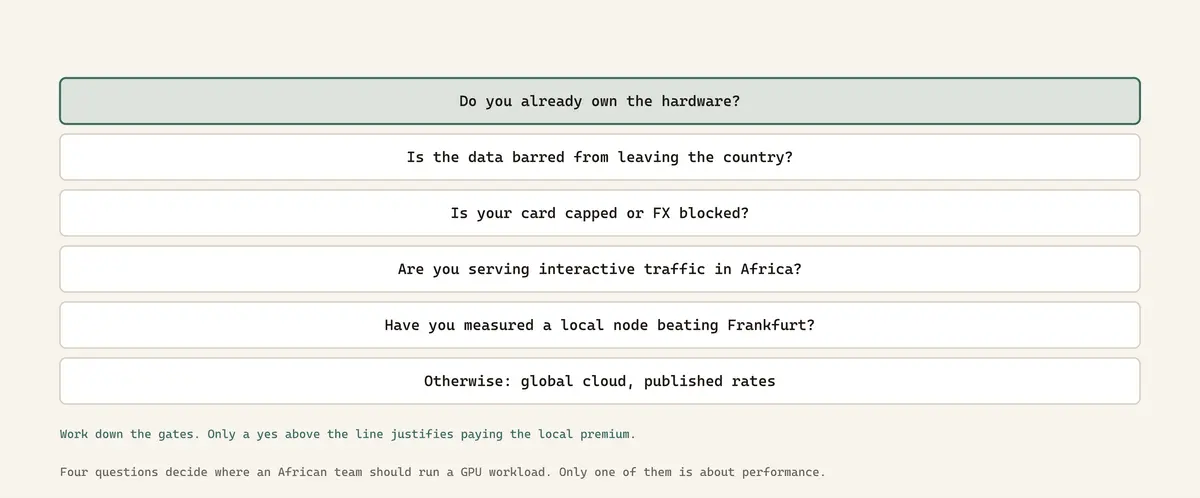
Local rental wins in four specific circumstances. Outside them it loses, and knowing which one you are in is most of the decision.
First, when the data cannot leave. South Africa's POPIA, Kenya's Data Protection Act and Nigeria's NDPA all regulate cross-border transfer, and in practice a regulator, a bank or a hospital group will often refuse offshore processing outright rather than argue about adequacy. Altron built its entire launch on South African jurisdiction and signed five customers on it. That argument survives contact with a cost spreadsheet, because there is no cheaper compliant alternative to compare against.
Second, when your card is capped. Paying a premium on the hourly rate is trivially worth it if the alternative is not being able to pay at all.
Third, when you are serving inference to users on the continent and you have measured that a local node genuinely helps. Measured, not assumed. The Lagos to Cape Town figure above is exactly the trap.
Fourth, when you already own hardware and need somewhere to put it. This is the least discussed case and possibly the strongest. Teraco is an Nvidia DGX-Ready colocation site in Johannesburg with 50MW available at JB1. IXAfrica takes 50kW racks in Nairobi today and is building for 90kW. If you have bought GPUs, colocating them on the continent is a solved problem in a way that renting them is not.
The bottleneck is a gigawatt, not a GPU
The geography of African compute is not explained by talent, demand or capital. All three exist in Lagos and Nairobi in quantity. It is explained by electricity, and the numbers are not close.
Nigeria's grid rarely delivered above 5,500MW at peak through 2025, available capacity fell to around 4,089MW by March 2026, and the federal government is targeting 6,000MW of wheeling capacity by December 2026 as an achievement. Kenya has roughly 3,000MW installed and could not underwrite a gigawatt for one building. South Africa has the exact opposite problem. Eskom chairperson Mteto Nyati says the utility is sitting on three to six gigawatts of unsold cold reserve and has been in conversation with Amazon, Microsoft and Google about who might take it. His phrasing was that Eskom has power it cannot sell. The country's entire installed data centre capacity is about 400MW, roughly a tenth of the low end of that surplus.
That is why the clusters are in Johannesburg and Cape Town rather than Lagos, and it will stay that way until somebody solves generation rather than procurement. Nvidia will sell anyone GPUs. Nobody will sell Kenya a gigawatt.
Sources
Cassava AI: GPU as a Service (H200, on-demand, reserved and spot tiers, no published pricing): https://www.cassava.ai/ai-compute/gpu-as-a-service/
Altron: launch of South Africa's first operational AI Factory, 27 October 2025: https://www.altron.com/press-releases/altron-launches-south-africas-first-operational-ai-factory-delivering-enterprise-grade-ai-infrastructure-platform-and-services
Google Cloud: GPU regions and zones (Africa absent from the table): https://docs.cloud.google.com/compute/docs/gpus/gpu-regions-zones
AWS af-south-1 instance and pricing listing (g4dn only, from $0.698/hr): https://aws-pricing.com/af-south-1.html
Semafor: energy shortfall scuppers Kenya's $1bn Microsoft and G42 data centre, 6 May 2026: https://www.semafor.com/article/05/06/2026/energy-shortfall-problem-scuppers-kenyas-1b-microsoft-data-center
iXAfrica: Atlancis, Everse and iXAfrica unveil GPU-powered AI infrastructure at NBOX1, Nairobi: https://ixafrica.co.ke/atlancis-technologies-everse-technology-and-ixafrica-unveil-africas-first-gpu-powered-ai-infrastructure/
W.Media: Eskom looks to hyperscalers to absorb South Africa's 6GW power surplus: https://w.media/eskom-looks-to-hyperscalers-to-soak-up-south-africas-6-gw-power-surplus/
WonderNetwork global ping statistics, Lagos origin: https://wondernetwork.com/pings/Lagos
Frequently Asked Questions
Where can I actually rent an H100 or H200 GPU in Africa today?
In practice, South Africa. Cassava Technologies sells H200 capacity as GPU-as-a-Service from its South African deployments, and Altron has run an operational AI factory inside a Teraco facility in Johannesburg since 27 October 2025. Neither publishes an hourly rate card, so you contact sales and negotiate. Atlancis sells GPU capacity through its Servernah cloud at IXAfrica's NBOX1 in Nairobi, announced as deployed in November 2025, but it has not published GPU models, counts or prices. No AWS, Google Cloud or Azure region in Africa offers H100 or H200 instances.
Is it cheaper to rent GPUs in Africa than in Europe?
No. Global H100 rentals run roughly $1.49 to $6.98 an hour with a competitive on-demand floor near $2.10, down 60 to 75 percent from the 2024 peak, and those rates are published and comparable. No African provider publishes training-class rates at all. Egress runs the wrong way too: AWS charges $0.154 per GB out of Cape Town against $0.09 per GB from US and European regions, about 71 percent more. The case for renting locally is data residency and payment access, not price.
Do AWS, Google Cloud or Azure offer GPUs in their African regions?
Barely. Google Cloud's africa-south1 in Johannesburg appears nowhere in the official GPU regions and zones table, meaning no GPU machine types at all. AWS af-south-1 in Cape Town offers only the g4dn family, built on the Nvidia T4, a 16GB Turing card from 2018 with no bfloat16 support, from $0.698 an hour. Azure's South Africa North lists only NV-series visualisation sizes, with no NC or ND series and therefore no A100 or H100.
What is the latency from Lagos or Nairobi to a European GPU cloud?
WonderNetwork's averaged public ping data puts Lagos to London at about 104ms, Lagos to Amsterdam at about 112ms and Lagos to Frankfurt at about 121ms. Nairobi to Amsterdam sits near 134ms and Nairobi to London near 165ms. For training workloads this is irrelevant, since you upload data once and the job runs for hours. It only matters for interactive inference, and even then 104ms is usable for chat. Measure your own network path rather than trusting third-party averages.
Can I pay for GPU rental with a Nigerian naira card?
It depends entirely on your bank. As of August 2026 GTBank had raised its naira card international spending limit to $20,000 a quarter and then doubled it to $40,000, while Stanbic IBTC's naira debit card limit was $100 a month across point of sale, web and ATM. A $100 monthly ceiling does not cover two days of a single on-demand H100 at global rates. This is the single strongest practical argument for using a provider that bills in local currency.
What happened to the Microsoft and G42 data centre in Kenya?
It stalled. Announced in May 2024 as a $1 billion geothermal-powered facility at Olkaria targeting May 2026, it required around one gigawatt against Kenya's total installed capacity of roughly 3,000MW. Kenya's National Treasury did not approve the required funding in 2025 and the government declined to underwrite the load through long-term power purchase agreements. President Ruto said publicly that switching on the data centre would have meant shutting off power for half the country. The deadline passed without construction.

About Francis Okafor
Nigerian engineer, eight years inside China's tech ecosystem, writing from Shenzhen. I build agentic AI systems that drive physical hardware, and I write about how these systems behave once they are carrying real load.