Seven China technology milestones that mattered and what each one cost
 Francis Okafor
On this page
- 2008: the country learns to build very large things very quickly
- 2014: payments skipped the card entirely
- From assembly to design, which is where the margin lives
- Electric vehicles and batteries, winning and bleeding at once
- Drones: the first Chinese industry to hit a ceiling that is not technical
- Silicon and open weights, two answers to the same constraint
- The strongest case against calling these China technology milestones at all
- Where the pattern runs out
- Tools referenced
- Sources
Three years ago today, on 29 August 2023, Huawei put a phone on sale in mainland China with no launch event and no spec sheet. Buyers took it apart. TechInsights found a Kirin 9000S inside, built on SMIC's N+2 7nm process, a 107 square millimetre die produced without a single EUV machine. That quiet product drop sits on every list of China technology milestones written since. It is also the clearest case of how badly those lists get read.
The reading usually goes one of two ways. Either the achievement is total and everyone else should pack up, or it is subsidised imitation that collapses the moment the credit stops. Eight years in Shenzhen has left me unable to hold either position. I read the Chinese trade press before anyone translates it, and I have shipped enough production software here to know how much of what gets announced is real. The useful question about a milestone is not whether it counts. It is what the thing revealed about how decisions get made, and who paid.
Seven of them.
2008: the country learns to build very large things very quickly
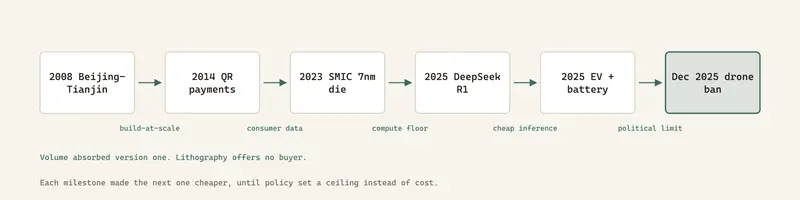
The Beijing to Tianjin intercity line opened in 2008, designed for 350 km/h. On 26 December 2025 a Fuxing train left Yan'an for Xi'an and pushed the national network past 50,000 kilometres of operating high-speed track. Twelve thousand of those kilometres went in between 2021 and 2025. High-speed service now reaches 97 percent of Chinese cities above half a million people.
What the buildout revealed is that this system can compress land acquisition, technical standard-setting, financing and procurement into one decision loop and then hold that loop steady for seventeen years. The capability is the real output. It shows up again in the grid, in port automation and in the battery plants that came later.
The cost was not abstract. On 23 July 2011 two trains collided near Wenzhou and 40 people died, from signalling design faults and a badly run emergency response. Liu Zhijun, the railways minister who drove the programme, received a suspended death sentence in July 2013 after taking 64.6 million yuan in bribes. China State Railway Group still carries debt above 6 trillion yuan. Most lines outside the eastern corridors will never cover their capital costs.
I take the 29-minute train from Shenzhen North to Guangzhou South often enough that I stopped thinking of Guangzhou as a separate city. That reframing is what the debt bought. Whether it was worth six trillion yuan depends on how you price an option that pays out over forty years, and nobody can answer that honestly today.
Subsidy explains why capital was destroyed. It does not make a die yield.
2014: payments skipped the card entirely
On 13 March 2014 the People's Bank of China sent Alipay a notice suspending QR code payments and virtual credit cards, two days after China CITIC Bank announced it would issue them with Alipay and Tencent. Caixin reported the order at the time. The stated concern was that no standards existed. Then the regulator let the thing run anyway.
That sequence is the single most useful thing I know about how technology policy works here. There is a tolerance window. New categories are not pre-licensed. They are allowed to scale until they are big enough to matter, and then rules arrive shaped around what already exists. Ride-hailing went through the window. Short video went through it. Large language models went through it in 2023.
The scale it produced is hard to convey. In the second quarter of 2025 alone, banks processed 149.789 billion non-cash payment transactions worth 1,365.36 trillion yuan, per the PBOC's own quarterly report. An OECD background note from June 2025 put Alipay at roughly 54 percent of the mobile payments market and WeChat Pay at about 42 percent.
The cost is a duopoly the state now cannot dislodge. The digital yuan has been in pilot since 2019 and had accumulated 3.48 billion transactions worth 16.7 trillion yuan by the end of November 2025. That is the cumulative total, against a bank payment system that moves roughly the same amount in a single day. I have watched vendors politely refuse cash outside Shenzhen North. A woman selling baozi held up a laminated QR code and looked genuinely stuck when I offered a fifty. Habit beat the central bank.
From assembly to design, which is where the margin lives
The cliché is that China moved from making things to designing them. The mechanism was less tidy than that. Huaqiangbei's clone-phone economy in the late 2000s produced thousands of small teams who could take a MediaTek reference design, cut it, source a shell and ship in six weeks. Most of those firms died. A few of them worked out that the board was never the hard part.
Transsion was founded in Shenzhen in 2006 and went after markets nobody in Shanghai wanted. In 2025 its three brands, Tecno, Infinix and itel, took about 48 percent of African smartphone shipments, over 40 million units. I grew up around Tecno handsets in Nigeria and assumed without checking that they came from somewhere generic. Finding out the company was headquartered a forty-minute drive from my flat reorganised how I think about this whole subject. The phones were built around dual-SIM habits, around skin tones that other cameras kept getting wrong and around the actual voltage on a Lagos street. That is not cheap manufacturing. That is product work done by people who went and looked.
Shenzhen spent 223.66 billion yuan on R&D in 2024, 6.46 percent of municipal GDP, a ratio above what most national governments manage. The city filed 19,660 PCT international patent applications in 2025 and has led China on that measure for 22 consecutive years.
What it revealed is that design follows the supply chain rather than the reverse. When your prototype shop is downstairs, you iterate weekly instead of quarterly, and the compounding on that is brutal. The cost landed on the clone economy that fed it, cleared out by IP enforcement and platform consolidation, and on the ODMs still assembling other people's brands at low single-digit margins.
Electric vehicles and batteries, winning and bleeding at once
China sold 16.49 million new energy vehicles in 2025 according to CAAM, up 28.2 percent, and exported 2.62 million of them, exactly double the 2024 figure. Total vehicle exports came to 7.098 million on CAAM's count, first in the world for a third year running. Customs data puts it higher at 8.324 million because it counts different things, which is worth knowing before quoting either number.
The battery figures are starker. SNE Research had CATL at 39.2 percent of global EV battery installations for 2025, 464.7 GWh. CATL and BYD together took 55.6 percent of a 1,187 GWh market.
Now the other column. More than 100 EV startups registered in China over the past decade. Hozon, which built the Neta brand, entered bankruptcy review in 2025 carrying around 9.8 billion yuan of debt after a 4 to 4.5 billion yuan funding round fell apart in February. WM Motor has been in reorganisation for years and still struggles to support cars it already sold. In July 2025 the Central Commission for Financial and Economic Affairs elevated an anti-involution campaign aimed squarely at price wars in EVs, batteries and solar. Polysilicon capacity utilisation ran below 40 percent through 2025, with panels moving under variable cost.
The system funds the entire branch of the tree and lets most of it die. That is not a defect in the model. It is the model. Forty companies grinding each other to zero margin is what pushed the cell price low enough for those export numbers to exist at all. The bill arrives as stranded capital, unpaid suppliers and a county with an empty plant on its books.
Drones: the first Chinese industry to hit a ceiling that is not technical
DJI came out of a Hong Kong University of Science and Technology postgraduate project and set up in Shenzhen in 2006. Industry estimates put it around 70 percent of the global civilian drone market, with some detection-based surveys running higher. No Western competitor has matched it on price and flight software at the same time.
Then the ceiling. DJI went onto the US Entity List in December 2020. Section 1709 of the FY2025 NDAA required a designated national security agency to audit DJI and Autel by 23 December 2025 and specified that absent an audit, the equipment would be added to the FCC Covered List automatically. No agency began one. DJI wrote to DHS, the FBI, the NSA and ODNI on 1 December 2025 asking somebody to please conduct the review. Nobody did. From 22 December 2025 all foreign-produced uncrewed aircraft systems and their critical components sit on the Covered List.
This is the milestone I think about most, because the failure mode has nothing to do with engineering. A company can win a global market on merit and then lose one of its largest markets to a clause with a deadline that no official had to act on. Inaction was the mechanism. Every hardware firm I know here read that outcome correctly and started designing for a world with two of everything.
Silicon and open weights, two answers to the same constraint
Back to the phone. SMIC reached roughly 7nm density using deep ultraviolet immersion scanners and aggressive multipatterning, printing each layer several times instead of once with EUV. It works. It also costs more per wafer, yields worse and burns more power than the TSMC equivalent.
That is where honest accounting starts. Made in China 2025 set 70 percent self-sufficiency in core components by 2025. On chips the country reached roughly 30 percent domestic sourcing by the end of that year, forty points short. Equipment did better, going from about 25 percent of the domestic market in 2024 to 35 percent in 2025, past its own 30 percent target. Huawei brought out the Ascend 950PR in the first quarter of 2026 with in-house HBM and showed the Atlas 350 card on 20 March 2026. There is still no domestic EUV source in production, and the software around Ascend, MindSpore and CANN included, remains the part engineers complain about privately.
Export controls set a floor, not a ceiling. They guaranteed somebody would finally fund the unglamorous work of lithography, deposition, etch and metrology that no rational Chinese firm would have paid for while ASML would still sell to them. They did not stop the 7nm part. What they bought was time, at a price nobody has fully counted on either side.
The second answer arrived on 20 January 2025, when DeepSeek published R1 under an open licence with reasoning performance in the same band as OpenAI's o1. Seven days later Nvidia lost 589 billion dollars of market value in one session, the largest single-day loss in US market history.
The cost claims got mangled and deserve stating properly. DeepSeek's Nature paper in September 2025 gave 294,000 dollars for R1's reinforcement learning stage. That excludes the V3 base model underneath it, about 2.79 million H800 GPU hours, roughly 5.58 million dollars of compute. Neither figure includes the cluster itself, the salaries or the failed runs. The real number is a few million dollars of marginal compute sitting on a large fixed investment. Still remarkable. Not the headline.
The release mattered less than the wave behind it. Hugging Face's Summer 2026 report counts about 2,045 million downloads for Qwen across 2026, against roughly 418 million for Google's models and 227 million for Meta's. There are 151,448 Qwen-derived repositories on the Hub, 4.7 times the Llama count, growing by 180 to 210 a day. Moonshot's Kimi line and MiniMax shipped alongside. Chinese labs put out the largest open models of the year while most US open releases stayed under 130 billion parameters.
In the fortnight after R1 I watched engineering groups here swap API endpoints the way you change a package mirror. Nobody called a meeting about it. When a model within reach of the frontier costs a fraction as much per token and you can run the weights on your own hardware, the decision makes itself. Open weights are what you do when you cannot win on compute: you commoditise the layer above it and compete where you still hold the supply chain. Serving stacks like vLLM, LMDeploy and llama.cpp turned that from a procurement cycle into an afternoon.
The strongest case against calling these China technology milestones at all
The best version of the counter-argument is not the lazy one about copying. It runs like this. Nearly every item here was funded by soft credit, most of it destroyed capital, and the outputs are dumped into markets that will eventually close. High-speed rail loses money outside a few corridors. Solar and EV makers are locked in a price war their own government is now trying to stop. Chip self-sufficiency missed by forty points. DJI's share is an accident of slow Western response rather than a durable position. Open weights devalue a competitor's product and are not themselves a business. On this reading the milestones are accounting artefacts.
Most of those individual claims are true and I would not argue with any of them. What they cannot explain is why the artefacts work.
Subsidy explains why capital was destroyed. It does not make a die yield, and it does not hand 48 percent of a foreign market to a firm nobody in Beijing was protecting. The question worth asking is what fraction of the burnt capital converted into capability that outlives the write-off. On batteries the answer is most of it, because the process knowledge lives in people and equipment that survived the shakeout, which is why cell prices kept falling after the money got tight. On chips the fraction is lower and the timeline much longer. On solar it may be close to zero, since there was nothing left to learn by the fortieth polysilicon line. Averaging those three into a single verdict is how both the triumphalists and the dismissers end up wrong.
Where the pattern runs out
Six of the seven share one mechanism: a domestic market large enough to absorb the first bad version. The 2008 trains were rough. Early Tecno phones were rough. Neta's cars were rough and then Neta was gone. Volume paid for the iteration, and the iteration is the entire trick.
The two frontiers that matter now offer nothing of the kind. Lithography has no forgiving home market. An EUV source either produces usable photons at production throughput or it does not, and no customer will buy version one at a discount. A drone export ban does not care how good your gimbal is. Both constraints are indifferent to the thing this country has been best at, which is grinding a cost curve down through sheer parallel attempts.
So there is a contradiction I have not resolved after eight years of watching from a desk here. The same instinct that funds forty companies to find two is why batteries got cheap and why polysilicon lines now idle below 40 percent. The anti-involution campaign is the first serious attempt to keep the first result and cancel the second. If it succeeds it removes the mechanism that produced most of this list. Nobody I have asked in Shenzhen believes it will work, and nobody wants to say so with their name attached.
Tools referenced
DeepSeek, reviewed here: DeepSeek review.
MiniMax M3, reviewed here: MiniMax M3 review.
vLLM, reviewed here: vLLM review.
LMDeploy, reviewed here: LMDeploy review.
llama.cpp, reviewed here: llama.cpp review.
MindSpore, reviewed here: MindSpore review.
Sources
Xinhua: China's high-speed rail mileage tops 50,000 km (26 December 2025): https://english.news.cn/20251226/558786c99de5428b98a84c3ff93300e3/c.html
People's Bank of China, Payment System Report Q2 2025: https://www.pbc.gov.cn/en/3688241/3688663/3688681/5638391/2026010416002691916/2026010416000672818.pdf
Caixin: Decoding the PBOC's move against QR code mobile payments (17 March 2014): https://www.caixinglobal.com/2014-03-17/closer-look-decoding-pbocs-move-against-qr-code-mobile-payments-101013489.html
TechInsights finds SMIC 7nm (N+2) in the Huawei Mate 60 Pro: https://www.techinsights.com/blog/techinsights-finds-smic-7nm-n2-huawei-mate-60-pro
CnEVPost: Global EV battery market share in 2025, SNE Research data (4 February 2026): https://cnevpost.com/2026/02/04/global-ev-battery-market-share-2025/
CnEVPost: China 2025 full-year NEV sales, CAAM data (14 January 2026): https://cnevpost.com/2026/01/14/china-nev-sales-1-71-million-dec-2025-caam/
Wiley: FCC adds all foreign-produced UAS and critical components to the Covered List: https://www.wiley.law/alert-In-Unexpected-First-of-Its-Kind-Action-FCC-Adds-All-Foreign-Produced-Uncrewed-Aircraft-Systems-and-UAS-Critical-Components-to-Covered-List
Hugging Face: State of Open Models, Summer 2026: https://huggingface.co/blog/state-of-open-models-summer-2026
Frequently Asked Questions
What are China's most important technology milestones?
Seven stand up to scrutiny with dated evidence. The Beijing-Tianjin high-speed line in 2008, which grew into a network passing 50,000 kilometres of operating track on 26 December 2025. The 2014 shift to QR mobile payments, which by Q2 2025 had banks processing 149.789 billion non-cash transactions worth 1,365.36 trillion yuan. The move from contract assembly to product design, visible in Transsion taking about 48 percent of African smartphone shipments in 2025. Electric vehicles and batteries, with 16.49 million NEVs sold in China in 2025 and CATL at 39.2 percent of global battery installations. Consumer drones, where DJI holds roughly 70 percent of the civilian market. SMIC's 7nm Kirin 9000S, found in the Huawei Mate 60 Pro on sale from 29 August 2023. And DeepSeek R1's open-weight release on 20 January 2025.
Did DeepSeek really train R1 for $5.6 million?
No, and the two figures in circulation measure different things. DeepSeek's Nature paper in September 2025 reported 294,000 dollars for R1's reinforcement learning stage specifically. That number excludes the V3 base model R1 was built on, which took roughly 2.79 million H800 GPU hours at an estimated 5.58 million dollars of compute. Neither figure includes the GPU cluster itself, researcher salaries or failed training runs. The honest description is a few million dollars of marginal compute on top of a large fixed capital base, which is still a striking result but is not a total training cost.
Why is China's chip self-sufficiency below its 2025 target?
Made in China 2025 called for 70 percent self-sufficiency in core components by 2025. On semiconductors the country reached roughly 30 percent domestic sourcing by the end of that year. The binding constraint is lithography. SMIC produces about 7nm density using deep ultraviolet immersion scanners with multipatterning, printing each layer several times rather than once with EUV, which works but yields worse and consumes more power than the TSMC equivalent. There is no domestic EUV source in production. Semiconductor equipment localisation did better than the chips themselves, rising from about 25 percent of the domestic market in 2024 to 35 percent in 2025, beating its own 30 percent target.