Chinese Open Source AI Models Are a Business Plan, Not a Gift
 Francis Okafor
On this page
On 26 August 2026, Alibaba's Qwen team pushed Qwen3.8-Flash-Next to Hugging Face at eleven at night, Beijing time. Moonshot AI open-sourced Kimi K3 at the same hour a month earlier. Eleven at night in Shenzhen is eight in the morning in San Francisco.
I have stopped reading that as coincidence. It is the first thing you notice about Chinese open source AI models when you live in the timezone they are built in: the release clock is set to the American news cycle, not the domestic one.
The second thing takes Mandarin.
I read the Chinese announcement and the English announcement of the same release, usually within an hour of each other. They are not translations of each other. They are two different arguments. The English version talks about the global developer community and the digital divide. The Chinese version, in the financial press that Chinese founders actually read, talks about 定价权. Pricing power. Neither one is false. They are written for people who will never compare notes.
Two press releases for one set of weights
Take the week of 14 August 2026. Hugging Face published a report showing Alibaba's models had been downloaded roughly 3 billion times in six months, against 418 million for Google and 227 million for Meta. The Global Times covered it in English the next day. The framing was moral. Liu Gang of the Chinese Institute of New Generation AI Development Strategies described Chinese models as helping narrow the digital divide and infusing global AI development with, in the paper's own translation, more of the genes of openness, sharing and mutual benefit. The examples were agriculture, education and healthcare in the Global South.
That register did not appear from nowhere. On 16 July 2026, officials from 29 countries signed the agreement establishing the World Artificial Intelligence Cooperation Organisation, headquartered in Shanghai. Xi Jinping told the World AI Conference in Shanghai that AI development should not be a solo performance by a single country but a symphony of international cooperation and warned against creating new historical injustices in access to AI capacity. Open weights sit inside that speech as evidence of good faith.
Now read the Chinese coverage of Kimi K3 from five days later. Sina Finance ran it under a headline about Chinese open models firing the opening shot in a breakout battle for pricing power, 定价权突围战. Huang Zhenxin, who runs Moonshot's enterprise business, told reporters that open-source models and Chinese large models should not be stuck with a cheap label, and that a company shipping frontier-class work can price accordingly. In June he had put the ambition more plainly: 掰手腕 with the three overseas labs. Arm wrestling.
Domestic tech coverage of these same companies runs on vocabulary the English press almost never carries. 生态护城河, ecosystem moat. 入口争夺, the fight over the entry point. Nobody writing in Chinese is describing a donation.
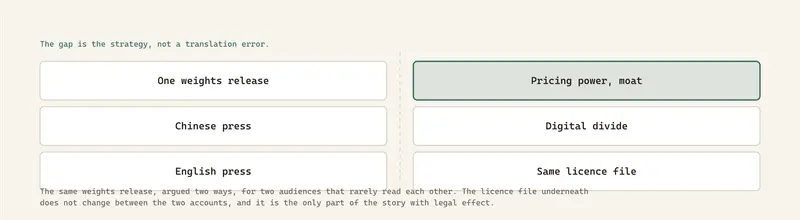
The Chinese text argues about pricing power. The English text argues about the digital divide. Same weights, same day, two audiences that never audit each other.
What the licence says once you read past the word open
Until this summer the honest short answer about Chinese labs was that their terms were often more permissive than Meta's. DeepSeek still is. DeepSeek-V4-Pro, a 1.6 trillion parameter mixture-of-experts model with 49 billion active parameters, went generally available in August 2026 under plain MIT. No thresholds, no riders.
The flagships stopped doing that.
Kimi K3 landed on 27 July 2026 at 2.8 trillion parameters, about 1.56TB of weights, released not under the modified MIT that Moonshot used for K2 but under a bespoke document the company calls the Kimi K3 License. Two clauses matter. Cross 100 million monthly active users or 20 million US dollars in monthly revenue and you must display "Kimi K3" in your interface. Run what the licence calls a Model as a Service business (giving third parties inference or fine-tuning access with meaningful control over inputs, parameters or training data) and let revenue across you and your affiliates pass 20 million US dollars over any consecutive twelve months, and you must sign a separate agreement with Moonshot before any commercial use at all. Reuters has reported Moonshot seeking as much as 30% of revenue in hosting talks with Microsoft, Amazon and Google.
Qwen3.8-Max followed on 12 August 2026 at roughly 2.4 trillion parameters, and this is the part I did not expect. Every open-weight Qwen before it shipped under Apache 2.0. This one carries a custom Qwen3.8-Max License built on the same skeleton: attribution above 100 million monthly active users or 20 million dollars monthly revenue, plus a separate paid licence for model-as-a-service or AI work assistant businesses above 50 million dollars in trailing twelve month aggregate revenue. Its smaller sibling, Qwen3.8-27B, stayed on Apache 2.0.
Then there is territory. MiniMax H3, the open-weight video model released in early August 2026, defines its Applicable Territory as worldwide excluding the European Union, the United Kingdom, the Republic of Korea and the United States of America. Local deployment of the weights in those four places needs separate written authorisation from MiniMax. The hosted API stays available everywhere, including in the excluded territories. Tencent's Hunyuan community licences have carried a comparable EU, UK and South Korea carve-out for over a year.
An open model you are not licensed to run in Berlin, Seoul or San Francisco is a very particular kind of open.
Openness is what the fast follower does
None of this is hypocrisy. It is strategy, and the strategy reads cleanly once you put it in the right order.
If you are behind at the frontier, the weights are not the asset. The standard is. Alibaba's models now anchor the largest model ecosystem on Hugging Face, with over 100,000 derivatives, and by one 2026 count roughly 40% of new LLM derivatives on the platform trace back to Qwen. Every serving stack tuned to your attention layout, every quantisation recipe, every eval harness, every fine-tune somebody already shipped to production is a switching cost you did not have to pay for. That is commoditising your complement, and it works precisely because the complement in question is somebody else's revenue line.
The US-China Economic and Security Review Commission published a paper in March 2026 called Two Loops that reaches the same reading from the opposite direction. Its argument: a digital loop of open models and community iteration feeding a physical loop of deployment across manufacturing, logistics and robotics, where the deployment generates the operating data that improves the next model. I work adjacent to that second loop. The paper is not wrong about the shape of it.
Here is what gets left out of both the English coverage and the Chinese coverage. Kimi K3 is 1.56TB of weights. DeepSeek-V4-Pro is 893GB. Free means free of a licence fee. It does not mean free of a rack. Walk the memory stalls in Huaqiangbei and you can price what it takes to serve one of these at full precision inside twenty minutes, and the number is not a startup number. Which produces a tidy coincidence. The organisations with the hardware to actually exercise the open-weight grant on a flagship model are almost exactly the organisations the revenue clauses were drafted to bill. The licence and the hardware requirement point at the same short list. Everyone else was always going to end up on an API.
The strongest case against all of this
The best counter-argument is not that I have the motives wrong. It is that motives do not matter.
A weight file, once downloaded, cannot be recalled. DeepSeek-V4-Pro is MIT today and stays MIT forever, whatever DeepSeek does in its next release. Qwen3.8-27B is Apache 2.0. Chinese open models went from close to zero to roughly 30% of usage on OpenRouter inside about a year, and the beneficiary of that shift is anyone who wanted an alternative to per-token pricing from three American companies. Treating a genuine transfer of capability as suspect because the donor has a plan is a way of talking yourself out of a windfall. The closed labs are not more honest. They are just less generous, and their marketing does not get graded on a stricter curve because it happens in English.
Most of that is right, and I would not argue with the second half at all.
What it misses is that the terms are versioned and the version history runs one way. Thirteen months ago every open-weight Qwen was Apache 2.0. Today the flagship is not and the 27B is, which tells you which tier the company has decided is strategic. Reporting on the Qwen3.8-Max release also indicates the downloadable checkpoint is not feature-identical to the paid API version. Same name, thinner product.
And the thresholds are not aimed at you. They are aimed at hyperscalers. Which sounds like good news for a small team. It is. It also describes your position in the arrangement with some precision. You are not the customer being protected. You are the distribution being built.
What Chinese open source AI models buy you in Lagos and Kampala
The distribution argument does not make the benefit fake. It makes it specific.
Ernest Mwebaze's team in Uganda built Sunflower, a language model covering 31 Ugandan languages, on top of Qwen 3. A coffee farmer in Mityana District uses it for crop and farm management information. By one 2026 tally Nigeria, South Africa and Kenya account for about 63% of the companies in Africa's AI startup sector, and mid-2026 reporting puts DeepSeek usage across the continent at two to four times the rate seen elsewhere. Chinese firms have pushed this along with free compute credits, training programmes and cloud bundles, and Alibaba distributes Qwen through ModelScope and its cloud footprint in Southeast Asia and Africa in a way no American lab has bothered to match.
One African developer quoted in Chinese state media described the difference as renting versus owning a house. That is the right analogy, and it did not originate as a talking point.
When I talk to engineers building for Nigerian languages, the blocker is almost never model quality. It is foreign exchange. Paying per-token in dollars against a naira revenue line is a business that degrades every time the currency moves, and no amount of prompt engineering repairs it. A weight file you serve on hardware you already own converts a variable dollar cost into a fixed one you have finished paying. That arithmetic holds regardless of who drafted the licence or why. Nobody in Lagos is crossing 50 million dollars of trailing twelve month model-as-a-service revenue this year, and the licence was written knowing that.
The line that moves
So I keep two tabs open, and I would suggest anyone making a real procurement decision on these models do the same, in translation if necessary. Not because one side is lying. Because each side is describing a different component of the same machine to an audience that will never check the other description.
The number worth tracking is not 100 million users. That threshold catches four or five companies on earth and costs the labs nothing to publish. It is the twenty million and fifty million dollar service-revenue lines, because those are ordinary company numbers and because thirteen months ago they did not exist anywhere in a Qwen licence.
Watch the gap between what the flagship licence demands and what the small model licence demands. In thirteen months it has gone from nothing to fifty million dollars. Nothing in the drafting suggests it has finished moving.
Sources
Kimi K3 License, Moonshot AI (Hugging Face): https://huggingface.co/moonshotai/Kimi-K3/raw/main/LICENSE
MiniMax H3 Community License Agreement (Hugging Face): https://huggingface.co/MiniMaxAI/MiniMax-H3/raw/main/LICENSE
Simon Willison, moonshotai/Kimi-K3, 27 July 2026: https://simonwillison.net/2026/Jul/27/kimi-k3/
Reuters via Yahoo Finance: Alibaba plans revenue sharing for next open-source Qwen model: https://finance.yahoo.com/technology/ai/articles/alibaba-plans-revenue-sharing-next-131417995.html
Fortune: Alibaba AI models hit 3 billion downloads, passing Meta and Google, 15 August 2026: https://fortune.com/2026/08/15/alibaba-qwen-open-ai-models-3-billion-downloads-meta-google/
Global Times: Alibaba's Qwen overtakes Meta and Google to claim top spot globally: https://www.globaltimes.cn/page/202608/1368313.shtml
Sina Finance: Kimi K3 and the battle for pricing power, 21 July 2026 (Chinese): https://finance.sina.com.cn/jjxw/2026-07-21/doc-iniiqquy8142888.shtml
USCC: Two Loops, How China's Open AI Strategy Reinforces Its Industrial Dominance, March 2026: https://www.uscc.gov/research/two-loops-how-chinas-open-ai-strategy-reinforces-its-industrial-dominance
Frequently Asked Questions
Are Chinese open source AI models actually open source?
In the strict sense, mostly no. Almost all are open weight rather than open source: the trained parameters can be downloaded and run, but training data and full training code are not published, which fails the Open Source Initiative's Open Source AI Definition. Terms also vary sharply by model. DeepSeek-V4-Pro ships under plain MIT with no thresholds and Qwen3.8-27B under Apache 2.0, while Kimi K3 and Qwen3.8-Max both carry custom licences with revenue-triggered clauses, and MiniMax H3's community licence excludes local deployment in the United States, European Union, United Kingdom and South Korea.
Why do Chinese AI companies release open weights for free?
The commercial logic is standard-setting and commoditising a competitor's revenue line. A heavily downloaded open model accumulates fine-tunes, serving stacks, quantisation recipes and tooling built around its architecture, and all of that becomes a switching cost the publisher never paid for. It also squeezes closed labs that depend on API margin. Alibaba's models were downloaded roughly 3 billion times in the six months to August 2026, against 418 million for Google and 227 million for Meta, and Chinese labs began attaching revenue-share clauses in 2026 to capture value from the large cloud providers hosting those weights.
Can you use Chinese open source AI models commercially?
Usually yes at small and mid scale, with obligations that begin at defined revenue thresholds. The Kimi K3 licence requires a separate agreement with Moonshot AI once a model-as-a-service business exceeds 20 million US dollars in aggregate revenue over any consecutive twelve months, and requires 'Kimi K3' displayed in the product interface above 100 million monthly active users or 20 million dollars monthly revenue. The Qwen3.8-Max licence uses the same structure with a 50 million dollar trailing-twelve-month gate for model-as-a-service. Read the specific licence file for each checkpoint, since terms differ per model and changed materially during 2026.