Digital Transformation in Manufacturing Is Three Different Projects
 Francis Okafor
On this page
- Digital transformation in manufacturing is the third stage, not the first
- The tablet that replaced the clipboard
- Bad semantics cost more than bad sensors
- The seam between MES and ERP
- The shape of the pyramid
- Plenty of profitable plants run on spreadsheets
- Four checks that place a plant on the ladder
- The definition of the summit keeps moving
- Sources
Three words get used as if they meant the same thing. Digitisation. Digitalisation. Digital transformation. They describe three different amounts of work, three different budgets and three completely different risks. Most of the disappointment around digital transformation in manufacturing comes from a plant buying the first one while the board deck claims the third.
I work on manufacturing systems and Industry 4.0. Walk a floor for an hour and you can usually place a plant on that ladder, and the answer has very little to do with how much equipment is instrumented. It has to do with whether any decision changes without a human retyping something.
Digital transformation in manufacturing is the third stage, not the first
Gartner's glossary is unusually precise about the first word. Digitization is the move from analogue to digital form, and its definition carries a clause that does all the work: no different-in-kind change to the process itself. A torque value written on a sheet becomes a torque value in a table. Retrieval gets faster. Nothing else moves.
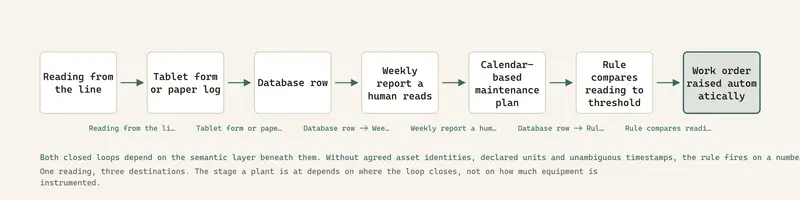
Digitalisation is when the process changes shape because the data now exists. The maintenance interval stops being a calendar entry and starts responding to a vibration trend. The planner's job changes. The spares policy changes. Somebody's authority changes, which is why this stage is political and the first one is not.
Digital transformation changes what the business sells. A compressor maker that stops selling compressors and starts selling compressed air by volume, with availability guaranteed, has moved the sensor stream from a diagnostic aid to a billing basis. Different contracts, different balance sheet, different failure modes.
Gartner's own entry for digitalization points at business models rather than processes, which collapses my second and third stages into one. The vocabulary is genuinely contested and arguing about it is a waste of a morning. The three-stage split earns its keep for a practical reason: each stage has a different owner. IT can deliver the first alone. Operations has to own the second. Only the chief executive can authorise the third. Programmes fail when the owner is wrong for the stage being attempted.
A plant with clean semantics and mediocre sensors will outperform a plant with excellent sensors and no agreed vocabulary, every time.
The tablet that replaced the clipboard
Pharmaceutical manufacturing has a name for the most common failure and the rest of industry should borrow it. Paper on glass. A digital form with no enforcement, no validation and no structured handling of exceptions. The batch record moved onto a screen. It can still be completed at the end of shift from memory, with copy-pasted notes and overrides that nobody reviews.
The tell is simple. If the record can be filled in after the fact, it is a record of what somebody remembers rather than a record of what happened. Timestamps generated by the moment of entry instead of the physical event are worthless downstream, and every analytics project built on top of them will quietly produce nonsense that looks like insight.
Paper on glass survives because it is genuinely useful and genuinely cheap. Retrieval improves. Audits go faster. Filing cabinets disappear. The tablet is not the harm. The harm is the slide that reports it upward as transformation, because that slide closes the budget line that would have funded the next stage.
Bad semantics cost more than bad sensors
In 1999 NIST commissioned a study of interoperability costs across the US automotive supply chain. The estimate came to at least one billion dollars a year, and the single largest component was people repairing or re-entering data files that downstream systems could not use. Twenty-seven years later the failure mode is unchanged. It has only changed file format, from CAD geometry to time-series tags.
Interoperability breaks at three levels: technical, syntactic and semantic. Plants solve the first two and then stop. Every machine is on the network. Everything publishes well-formed messages. And the plant still cannot answer how many good parts line 3 made last Tuesday, because good is defined one way in quality and another in production, and line 3 covers a different set of assets in the maintenance system than in the scheduler.
The unglamorous list is where projects actually die. Tag naming conventions that grew by accretion over fifteen years. Units implied rather than declared. Timestamps in local time with no zone. Downtime reason codes with a catch-all that operators select because it is the fastest button on the screen. A plant with clean semantics and mediocre sensors will outperform a plant with excellent sensors and no agreed vocabulary, every time.
The seam between MES and ERP
ISA-95, published internationally as IEC 62264, exists for this exact problem. It defines a hierarchy running from the physical process up to business planning, four operational domains covering production, quality, maintenance and inventory, plus the specific objects that have to cross between the enterprise layer and the shop floor. B2MML carries those objects as XML. OPC UA carries the real-time side. The first part of the standard was reissued in 2025, which tells you nobody considers the problem closed.
ERP thinks in orders, costs and materials over a horizon of days. Control thinks in tags and milliseconds. MES is the translator, and that seam is where the maturity question gets settled. If the translation is a nightly CSV export, the plant is digitised regardless of whose logo is on the screen. If the schedule reacts inside the shift, something is genuinely digitalised.
Integration projects rarely fail on protocols. They fail because nobody wrote down what a work order is, or when a batch counts as complete, or which system is authoritative when the two disagree. Standards like ISA-95 are worth the effort mainly because they force that argument to happen on paper, months before it happens at two in the morning on a running line.
The shape of the pyramid
China runs the most systematic industrial digitalisation programme anywhere and grades its own results in public. MIIT sorts recognised plants into four tiers: basic, advanced, excellence and a flagship tier above those. In February 2025 the ministry reported more than 30,000 plants at basic level, 1,200 at advanced and 230 at excellence, spread across all 31 provincial regions.
Read the ratio rather than the totals. The top of that pyramid sits at well under one percent of the recognised base, and the recognised base is itself self-selected, made up of plants that applied to a government scheme and passed an assessment. Every unrecognised factory in the country sits below the bottom rung. That is the most flattering sample available and it still looks like a pyramid.
Set that against survey headlines. Eurostat found 42.3 percent of EU small and medium enterprises at very low digital intensity in 2023, with a further 33.8 percent at low. The US Census Bureau's Business Trends and Outlook Survey put AI use across all firms near 19.8 percent between December 2025 and May 2026, with the smallest firms below that. Consultancy figures run far warmer. BCG, a firm that sells transformation programmes, found that 30 percent of transformations met or exceeded their target value while 26 percent produced almost nothing. Read the optimistic numbers as measures of intent rather than measures of installed capability.
Plenty of profitable plants run on spreadsheets
The strongest argument against everything above is that it is frequently not worth doing. A working MES, a historian, an integration layer and the people needed to keep the semantic model honest represent a large capital cost and a permanent operating cost that nobody enjoys renewing. The benefit scales with variability, mix complexity, volume and regulatory burden. Take those away and the case thins out fast.
A plant running three products across two lines with a stable crew and a foreman who knows every machine by sound has already solved the coordination problem. He solved it with memory and proximity. Digitalisation is in large part a substitute for institutional memory, and if the memory is intact and not about to retire, you are buying an asset you already own.
There is a worse case than wasted money. Digitalised systems decay. Tags get renamed during a rebuild. A line gets reconfigured, and the model keeps reporting confidently against a reality that has moved underneath it. Paper never claims authority it does not have. A stale digital system does, and people act on it. I have watched that failure mode produce worse decisions than the clipboard it replaced.
The honest test is one question, asked in the plant manager's language rather than the vendor's. Name a decision you currently make late, make wrong or fail to make at all because the data is not there. One concrete example, with a cost attached. No example, no project.
Four checks that place a plant on the ladder
These take an afternoon and require no vendor involvement.
First, try to complete a record after the fact. If the system allows it, and it usually does, the record is a memory exercise and the plant is at digitisation whatever the screens suggest.
Second, find one setpoint, schedule or work order anywhere in the plant that changes automatically because of a reading, with no human retyping a value between two systems. If there is none, there is no digitalisation on site.
Third, ask maintenance and production for the same availability number, same line, same week. If the two disagree, the semantic layer is unresolved and every dashboard built above it is decoration.
Fourth, ask what breaks if the data stops for a week. Digitisation loses convenience. Digitalisation loses output inside a shift. Transformation loses revenue, because the data is the thing being sold.
The definition of the summit keeps moving
China's grading scheme has begun folding AI capability into the criteria for its upper tiers. The bar for excellence rises every year while the bottom of the pyramid is still arguing about downtime codes and time zones. Plants that never finished digitisation are now being sold models.
Which produces the quiet failure I expect to spend the next several years cleaning up. A model trained on a downtime field where other is the fastest button will learn, accurately and permanently, that most stoppages have no cause.
Sources
Gartner IT Glossary: Digitization: https://www.gartner.com/en/information-technology/glossary/digitization
Gartner IT Glossary: Digitalization: https://www.gartner.com/en/information-technology/glossary/digitalization
Brunnermeier and Martin, Interoperability Cost Analysis of the U.S. Automotive Supply Chain (NIST, 1999): https://www.rti.org/sites/default/files/resources/US_Automotive.pdf
ISA-95 / IEC 62264 Enterprise-Control System Integration standard: https://www.isa.org/standards-and-publications/isa-standards/isa-95-standard
State Council of China: MIIT reports smart factory tier figures, February 2025: https://english.www.gov.cn/news/202502/12/content_WS67ac9475c6d0868f4e8ef978.html
Eurostat: How digitalised have the EU's enterprises become? (2024): https://ec.europa.eu/eurostat/web/products-eurostat-news/w/ddn-20240829-1
US Census Bureau: AI use by businesses, Business Trends and Outlook Survey (2026): https://www.census.gov/library/stories/2026/05/ai-use-businesses.html
BCG: Flipping the Odds of Digital Transformation Success (2020): https://www.bcg.com/publications/2020/increasing-odds-of-success-in-digital-transformation
Frequently Asked Questions
What is the difference between digitisation, digitalisation and digital transformation in manufacturing?
Digitisation converts an analogue record into a digital one without changing the process, so a paper torque log becomes a database row and nothing else moves. Digitalisation changes the process so it consumes that data, for example a maintenance schedule that responds to a vibration reading instead of a calendar date. Digital transformation changes what the business sells, such as billing customers for guaranteed compressed air rather than selling them a compressor. Each stage has a different owner: IT can deliver the first alone, operations must own the second and only the chief executive can authorise the third.
What does paper on glass mean in manufacturing?
Paper on glass is a digital form that replaces a paper record without adding enforcement, validation or structured exception handling. The clipboard becomes a tablet and everything else stays the same. The reliable test is whether an operator can still complete the record at the end of shift from memory. If they can, the timestamps reflect the moment of data entry rather than the physical event, and any analytics built on top of that record will produce confident nonsense.
How can I tell whether my plant is genuinely digitalised?
Find one setpoint, schedule or work order that changes automatically because of a reading, with no human retyping a value between two systems. If there is none anywhere in the plant, there is no digitalisation on site regardless of what is installed. A second check: ask maintenance and production for the same availability number for the same line and the same week. If they disagree, the semantic layer is unresolved and every dashboard above it is decoration.
Is smart manufacturing always worth the investment?
No. A working MES, a historian, an integration layer and the staff to keep the semantic model current are a large capital cost and a permanent operating cost, and the benefit scales with variability, mix complexity, volume and regulatory burden. A small plant running a few products with a stable crew has often already solved the coordination problem using memory and proximity. Digitalised systems also decay when tags get renamed or lines are rebuilt, and a stale digital system claims an authority that paper never does.
Why is ISA-95 relevant to MES and ERP integration?
ISA-95, published internationally as IEC 62264, defines the hierarchy from physical process up to business planning, four operational domains covering production, quality, maintenance and inventory, and the specific data objects that must cross between enterprise systems and the shop floor. B2MML carries those objects as XML and OPC UA handles the real-time side. Its practical value is that it forces a plant to agree on paper what a work order or a completed batch actually means, before that disagreement surfaces on a running line.