How 3 billion yuan of bubble tea manufactured AI adoption in China
 Francis Okafor
On this page
- Three weeks between the demo and the money
- Why AI adoption in China ran through payment rails
- Tencent went at it from the other end
- Moonshot refused to buy anyone
- The bill, in the filings
- The strongest argument against everything above
- Mobile money is not a super-app
- What 25.7 percent tells you
- Tools referenced
- Sources
On 15 January 2026, in a Hangzhou conference hall, an Alibaba vice-president named Wu Jia picked up a phone and asked it to order forty cups of bubble tea. The app found a nearby chain outlet, applied the available discounts, paid inside the chat window through Taobao Instant Commerce and had the drinks delivered to the venue before the event ended. Good demo. Also the least consequential thing that happened that day, because AI adoption in China is not settled by demos. It gets settled three weeks later, when the subsidy budget clears.
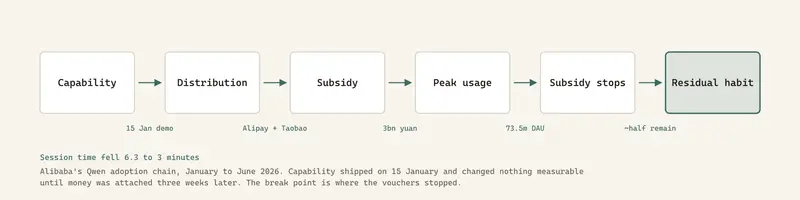
That same launch wired Qwen into Taobao, Alipay, Fliggy and Amap. Capability first. Then, on 6 February, Alibaba opened a 3 billion yuan campaign, roughly 430 million US dollars, handing every user who updated the app or invited a friend a 25 yuan voucher redeemable at more than 300,000 beverage shops nationwide. A cup of tea for 0.01 yuan. One fen.
Inside three hours, over a million orders. Inside five, five million. Inside nine, more than ten million orders worth about 250 million yuan, and the app fell over. That is not a product launch. That is a distribution system being pointed at a population.
Three weeks between the demo and the money
The sequencing is the whole argument. On 15 January the capability shipped. On 6 February the money moved. Between those two dates, nothing about the underlying model changed in any way a user could feel.
What changed was price. Qwen climbed from tenth on China's Apple App Store to first, overtaking Tencent's Yuanbao inside a day. WeChat blocked the campaign's share links on 6 February, citing ecosystem disruption. Alibaba's Hong Kong shares closed down 2.88 percent at HK$155 the same afternoon. Tencent put a billion yuan behind Yuanbao for the same Spring Festival window; Baidu put up 500 million.
The physical world absorbed the load. Sixth Tone interviewed milk tea shop workers during the campaign. One, an eighteen-year-old working at a Chagee outlet in Guangdong, described stacks of waiting cups taller than an adult, a full shift of heating drinks and sealing lids without a break and deliberately drinking less water so she would not need the bathroom. She quit after three days. Riders stood in the shops asking when orders would appear. That is what a software abstraction looks like when it lands on a counter staffed by two people.
Nobody in that line had decided to adopt an AI assistant. They had decided that tea for one fen was worth twenty minutes.
Why AI adoption in China ran through payment rails
I live in Shenzhen. On the second day of that campaign I stood in a queue in Futian behind maybe thirty people, none of whom were talking about artificial intelligence. They were comparing screenshots of voucher codes. The counter had two ordering tablets and a receipt printer that had been running long enough that the paper came out warm. Nobody in that line had decided to adopt an AI assistant. They had decided that tea for one fen was worth twenty minutes.
I have spent most of my working life shipping production software, a good stretch of it on systems that move money, and the thing I keep saying to people who read that campaign as an AI story is that the model was the cheapest component in it. Parsing "order me a milk tea" is close to solved. What is not solved, and what almost nobody outside payments respects, is holding order idempotency, inventory truth and refund state together when volume rises by an order of magnitude in ninety minutes across three hundred thousand physical locations. Alibaba's app failed that day. The settlement rails did not.
Alipay reported more than 120 million AI Pay transactions in the week of 5 to 11 February, the first agentic payment service anywhere to report at that scale. AI Pay had launched quietly in 2025. In January 2026 Alipay published an Agentic Commerce Trust Protocol with partners, and the Qwen app was the first platform to adopt it, connecting through to Taobao Instant Commerce.
Read that sequence backwards and the strategy is plain. Settlement first. Merchant acceptance second. Model last.
Western adoption ran the other direction entirely. It went through developers with API keys, then through knowledge workers pasting documents into a chat box, then upward into procurement. Slow, voluntary and nearly impossible to accelerate with money, because the companies holding the models did not own the checkout, the couriers or the merchant contracts. You cannot subsidise a habit you cannot transact.
Tencent went at it from the other end
Tencent spent a billion yuan on Yuanbao over Spring Festival and got the cheapest acquisition of the three majors, around 69 yuan per daily active user by DataEye's estimate, against roughly 85 to 113 for ByteDance's Doubao and about 144 for Qwen. Yuanbao reached 109 million monthly actives by February. Tencent's Hunyuan model, meanwhile, sat 68th on a widely cited leaderboard in December.
That gap is the interesting part. Tencent's model was not competitive and it barely mattered, because Tencent's asset was never the model.
In March it showed what the asset was. On 9 March Tencent began internal testing of QClaw, an agent built on OpenClaw that installs into WeChat and QQ. On 18 March it shipped as a native WeChat mini-program, taking voice messages and images as instructions, with scheduled tasks promised in later builds. WeChat carries more than 1.4 billion accounts. No download, no new icon, no acquisition cost.
There is a bill that does not appear in any marketing budget. By February, SecurityScorecard's research team counted over 135,000 publicly exposed OpenClaw instances, some 15,000 of them vulnerable to remote code execution, and Chinese authorities had already warned state enterprises and financial institutions about deployment. Putting an agent framework behind 1.4 billion accounts multiplies whatever is wrong with that framework by 1.4 billion.
Moonshot refused to buy anyone
Moonshot AI is the control group. After DeepSeek reset price expectations in 2025, Moonshot stopped its expensive user acquisition spending and moved the money into the models themselves. Kimi K2.5 arrived on 27 January 2026 with open weights, native multimodal input and agentic tool use, and it was measured against frontier closed models rather than against other Chinese consumer apps.
Moonshot did not show up in the Spring Festival subsidy war at all. Between September and November 2025 its paying users, domestic and overseas, grew by more than 170 percent month on month on average, and overseas API revenue grew fourfold after K2 Thinking shipped.
That is the Western adoption shape running inside China: capability, developers, paying users, in that order. It works. It also produces user numbers one or two orders of magnitude below Qwen's, at margins that are almost certainly better. Two strategies, two definitions of winning and no clean way to compare them without first deciding what adoption is for.
The bill, in the filings
Alibaba's own disclosures settle the cost question. For the quarter ended 30 June 2026, its AI Labs and Applications segment posted an adjusted EBITA loss of RMB 13,861 million, about 2,043 million US dollars, against a loss of RMB 3,224 million in the same quarter a year earlier. The stated cause was increased AI investment and higher inference cost related to the Qwen app. Two billion dollars of quarterly loss in a single segment.
Against that, the retention. Qwen's daily actives ran around 7 million before the campaign and peaked at 73.52 million during it. When the subsidies stopped, that number nearly halved. Average session time moved the wrong way, from 6.3 minutes before the campaign to roughly 3 minutes at the trough, because the behaviour being purchased was coupon redemption, and coupon redemption is fast. DataEye put Alibaba's full Spring Festival spend nearer 6 billion yuan once everything was counted, at about 144 yuan per daily active user acquired, the most expensive of the three and the least durable.
By June 2026 QuestMobile had Qwen at 167 million monthly actives, 17.4 sessions and 22.9 minutes per user per month. Alibaba then began selling Qwen Office subscriptions at 78 and 158 yuan a month. Selling productivity software to people who turned up for free tea.
The strongest argument against everything above
Here is the case I find hardest to dismiss. Engineered adoption is just adoption. Every payment network in history was bought. WeChat Pay took its user base from Alipay with a red packet campaign at Spring Festival 2014; Alipay itself was seeded with escrow guarantees and merchant incentives; Visa and Mastercard bought acceptance for decades; Uber subsidised both sides of its market for years. Subsidy is how you pay to cross a two-sided coordination gap. No shopper uses agentic checkout until merchants accept it, no merchant wires it up until shoppers use it, and somebody has to fund the first move. On that reading, calling Chinese AI adoption artificial is squeamishness about seeing the invoice.
The residual is real too. Half of 73.52 million is still around 36 million people. Alibaba's June filing states that 250 million users have now had a first AI-driven shopping experience through the Qwen app's agentic features. You cannot un-have that.
The objection holds, but only partly, and where it fails is specific. What matters is whether the subsidy leaves standing infrastructure behind on both sides. WeChat's red packets worked because once the packet was spent the user still had a funded wallet and the shop still had a QR sticker taped to its counter. The money created a persistent state at both ends. A redeemed bubble tea voucher creates nothing on the user side except an app icon.
So the asset from February is not the DAU figure. It is Alipay's AI Pay volume, the trust protocol and the several hundred thousand merchants who did the integration work. Those persist. The users largely did not, and the shortening session times tell you exactly what they came for.
Mobile money is not a super-app
For African markets the platform layer already exists, and it is not shaped like this one. GSMA's State of the Industry Report on Mobile Money 2026 puts 2025 global mobile money transaction value above 2 trillion dollars, of which 1.4 trillion moved in sub-Saharan Africa, about 66 percent of the world total. Registered accounts reached 2.3 billion globally, up by a record 268 million. Africa holds roughly 1.2 billion of those and 347 million of the world's 593 million thirty-day active accounts, close to 60 percent. Sub-Saharan Africa ran 173 live services in 2025.
Those are payment rails at Chinese intensity. What is missing is the layer above them. M-Pesa moves value; it does not own the product catalogue, the merchant inventory feed or the delivery fleet. In China a single firm held the model, the checkout, the merchant network and the riders, which is the only reason a voice command could become a delivered cup. In Lagos or Nairobi those four sit inside four different companies, often under four different regulators, and the coordination cost falls on whoever tries to assemble them.
The Chinese play therefore does not port. The lesson underneath it does: adoption follows whoever controls the moment of payment, not whoever has the better model. Anyone wiring an agent into a mobile money API and a merchant aggregator at the same time is running Alibaba's strategy on borrowed rails. That is commercial and regulatory work, not research work. A small open model behind a competent tool layer clears the bar for "order this and pay for it" without anyone training anything.
What 25.7 percent tells you
The most instructive number in the GSMA report has nothing to do with AI. Of 2.3 billion registered mobile money accounts, 25.7 percent were active in a given month. More than seven in ten sit idle. That is the outcome after twenty years of the most successful financial inclusion effort anywhere, with real agent networks, real regulation and real daily utility, and three quarters of the accounts still do nothing in a given month.
It is the same curve as Qwen's, stretched over two decades instead of two months. Registration is cheap in every market on earth. Activity is not, and nobody has yet demonstrated that money can purchase the second one.
Alibaba is currently spending around two billion dollars a quarter to find out. The result will not generalise, because a market where one company owns the model, the checkout, the merchant network and the couriers cannot tell you what happens in a market where nobody owns all four. Everyone outside China is watching an experiment they are not able to run.
Tools referenced
Tencent Yuanbao, reviewed here: Tencent Yuanbao review.
OpenClaw, reviewed here: OpenClaw review.
DeepSeek, reviewed here: DeepSeek review.
Sources
South China Morning Post: Alibaba's bubble tea giveaway pushes Qwen past Tencent's Yuanbao to top of China App Store: https://www.scmp.com/tech/article/3342702/alibabas-bubble-tea-giveaway-pushes-qwen-past-tencents-yuanbao-top-china-app-store
Caixin Global: Alibaba AI App Crashes After 3 Billion Yuan Giveaway Sparks Frenzy: https://www.caixinglobal.com/2026-02-07/alibaba-ai-app-crashes-after-3-billion-yuan-giveaway-sparks-frenzy-102412500.html
Sixth Tone: 'So Tired I Want to Cry': China's AI Subsidy War Swamps Shops: https://www.sixthtone.com/news/1018191
Business Wire: Alipay AI Payment Exceeds 120 Million Transactions in One Week: https://www.businesswire.com/news/home/20260213770962/en/Alipay-AI-Payment-Exceeds-120-Million-Transactions-in-One-Week-as-Agentic-Commerce-Accelerates-in-China
Alibaba Group Announces June Quarter 2026 Results (AI Labs and Applications segment): https://investingnews.com/alibaba-group-announces-june-quarter-2026-results/
36Kr: Can Doubao Successfully Implement Paid Feature Monetization After Qwen App Explores This Model?: https://eu.36kr.com/en/p/3929052257467777
KrASIA: Alibaba's latest Qwen subsidies are a bet on agentic commerce: https://kr-asia.com/alibabas-latest-qwen-subsidies-are-a-bet-on-agentic-commerce
GSMA: The State of the Industry Report on Mobile Money 2026: https://www.gsma.com/solutions-and-impact/connectivity-for-good/mobile-for-development/gsma_resources/the-state-of-the-industry-report-on-mobile-money-2026/
Frequently Asked Questions
Why did Alibaba give away free bubble tea for its Qwen AI app?
On 6 February 2026 Alibaba opened a 3 billion yuan campaign, roughly 430 million US dollars, giving anyone who updated the Qwen app or invited a friend a 25 yuan voucher redeemable at more than 300,000 beverage shops, which brought a cup of bubble tea down to 0.01 yuan. The goal was not to sell tea. It was to make people complete an agent-mediated purchase end to end, through Taobao Instant Commerce and Alipay AI Pay, so that agentic checkout became a familiar action rather than a demo. More than a million orders landed in under three hours and over ten million within nine hours, which crashed the app and pushed Qwen to the top of China's Apple App Store.
Did Qwen keep its users after the bubble tea subsidy ended?
Only partly. Qwen's daily active users ran around 7 million before the campaign and peaked at 73.52 million during it, then nearly halved once the subsidies stopped. Average session length fell from 6.3 minutes before the campaign to roughly 3 minutes at the trough, which indicates the acquired behaviour was coupon redemption rather than sustained assistant use. By June 2026 QuestMobile put Qwen at 167 million monthly active users averaging 17.4 sessions and 22.9 minutes per month, and Alibaba began selling Qwen Office subscriptions at 78 and 158 yuan a month to convert some of that base into paying customers.
How is AI adoption in China different from the West?
In China adoption was pushed down from platforms that already owned payments, delivery and a super-app, so a company could turn an AI capability into a mass habit within weeks by attaching a subsidy to it. Alipay processed more than 120 million AI Pay transactions in the single week of 5 to 11 February 2026. In the United States and Europe, adoption climbed upward instead, starting with developers holding API keys, then knowledge workers, then enterprise procurement, because the firms with the strongest models did not control checkout, couriers or merchant contracts and therefore could not buy a transaction habit even if they wanted to.