Why a digital twin in manufacturing stalls at level two
A digital twin is only useful when live telemetry feeds it and a decision comes back out. A 3D model that never updates is a rendering, and the data feed was always the expensive part.

A digital twin in manufacturing is not a viewer, and the international standard says so. ISO 23247 defines it as a fit for purpose digital representation of an observable manufacturing element with synchronisation between the element and its representation. Synchronisation is doing all the work in that sentence. Take it out and you have a rendering. Renderings have been sold as twins for most of a decade.
The pattern repeats everywhere. The 3D model arrives first because it is the part that photographs well, and it ends up on a wall display in the visitor corridor. Two years later the line has been re-laid twice, a conveyor has been swapped for a shorter one, and the model still shows the original layout. Nobody owned it. Nobody was funded to own it.
The useful version of this technology does two things. It simulates what you cannot safely try on a running line. And it predicts something specific enough to change a maintenance schedule, a setpoint or a changeover sequence. Everything else is decoration with a licence fee.
The four levels of a digital twin in manufacturing
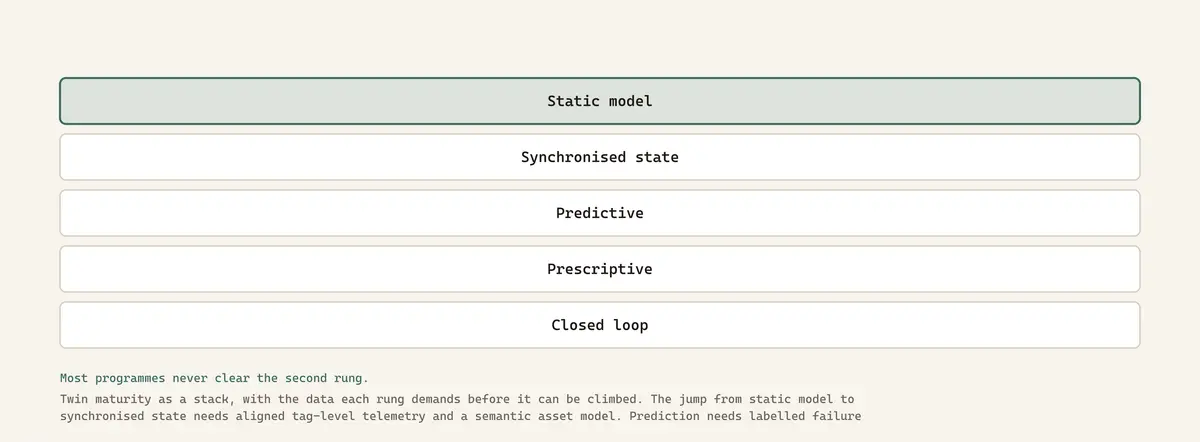
Level one is the static model. CAD geometry, an asset register, maybe a layout in OpenUSD. The data requirement is a one-time export and a person who updates it after every physical change. That second part is where level one quietly dies.
Level two is synchronised state. The model reflects what the physical thing is doing right now. The data requirement jumps hard here: tag-level telemetry from PLCs and sensors, timestamps that are genuinely aligned across sources and a semantic model that maps tag AI_0347 to the specific motor it belongs to. In brownfield plants the common shape is OPC UA at the machine, an edge gateway translating to MQTT Sparkplug B and a broker holding a unified namespace. OPC UA PubSub has been in the specification for years and still has thin production adoption next to the MQTT ecosystem, which tells you how these decisions actually get made.
Level three is predictive. Now you need history, and not merely history of the signals. You need labelled outcomes. To predict a bearing failure you need bearings that failed, correctly attributed, with the hours and load profile that preceded each one. Well-maintained lines produce very few of these. That is the central irony of predictive maintenance: the better your plant already runs, the less data you have to build the model that would improve it.
Level four is prescriptive with a closed loop. The twin no longer reports that the oven will drift. It moves the setpoint, or it files the work order. The data requirement adds three things people consistently underestimate. An explicit action space. A safety envelope that bounds every action it can take. And write access to a control system whose owner will personally answer for what it does at 3am.
Every predictive model trained on that field was learning the shape of a user interface, not the shape of a machine.
Level two is a plateau, not a step
Almost everything stops there, and the reasons are boring rather than technical.
The most useful hour I have spent on a twin project involved no code at all. I stood at a line with a maintenance supervisor and went through his paper log in Mandarin, turning handwritten shorthand for stoppage causes into a code list. He distinguished about forty causes. The MES dropdown offered three, because it had been specified in another country years earlier and never revised. Operators picked whichever of the three was least wrong. Every predictive model trained on that field was learning the shape of a user interface, not the shape of a machine. No amount of simulation fidelity upstream repairs that, and no vendor demo will ever show it to you.
Then there is trust. A level three model that raises an alarm and sends a technician to a healthy asset costs one inspection and a small amount of credibility. Do it often enough and the eleventh alert gets ignored, which is the one that was real. People who run condition monitoring programmes keep landing on the same rough threshold: if inspections find nothing eight times out of ten, the programme is over regardless of what precision looks like on a validation set.
The last reason is structural. Moving from level two to level three changes what a maintenance planner does on a Monday morning. That planner does not report to whoever bought the twin. Level two needs a budget. Level three needs someone else's process to change, which is a much harder purchase.
Physics and learned models answer different questions
Full physics gives you accuracy and a runtime measured in hours. CFD on a thermal process, FEA on a fixture, multibody dynamics on a gantry. None of it runs at line rate, so it gets compressed. Proper orthogonal decomposition and other reduced order methods turn an expensive solve into something that answers in milliseconds, at the cost of staying valid only inside the region you sampled.
Learned models cover what the physics never encoded. Wear. Contamination. The operator who always runs slightly hot. The specific machine in bay four that has been out of true since it was moved.
The division of labour is cleaner than the marketing suggests. Physics extrapolates. It stays approximately right at an operating point you have never run, because conservation laws do not care about your training set. Machine learning interpolates, and it is far better than physics at capturing the residual you could not be bothered to model. Introduce a new SKU next quarter and the learned model has nothing while the physics still holds. Run that SKU for a year and the learned model beats the physics on the last two percent.
Ansys 2026 R1, released on 11 March 2026 under Synopsys after the 35 billion dollar acquisition closed on 17 July 2025, is a fair commercial marker for where this now sits. It shipped a reduced order model wizard for building real-time twins and added Temporal Fusion Transformer and Neural ODE methods to its hybrid analytics. The vocabulary of the simulation vendors and the vocabulary of the machine learning people has finally converged, roughly fifteen years late.
What the 2026 tooling does and does not touch
NVIDIA made the Omniverse DSX Blueprint generally available on build.nvidia.com on 16 March 2026, alongside the Vera Rubin DSX reference design, with Cadence, Dassault Systèmes, Eaton, Jacobs, PTC, Schneider Electric, Siemens and Vertiv among the named contributors. Read the target carefully. DSX is a blueprint for twinning AI factories, meaning data centres. The most heavily funded factory twin work of 2026 is aimed at the buildings that hold GPUs.
The discrete manufacturing story at GTC on 26 March 2026 was virtual commissioning. ABB, FANUC, KUKA and Yaskawa, with a combined installed base above two million robots, are putting Omniverse and Isaac frameworks into their commissioning environments and Jetson modules into their controllers. This is the honest use case. You test a control program against a simulated cell before you let it swing three hundred kilos of steel near a person. Simulation of something you genuinely cannot try safely, which is exactly half the argument for doing any of this.
Siemens announced Digital Twin Composer at CES on 6 January 2026, built on Omniverse libraries, in early access with selected customers and slated for the Xcelerator Marketplace mid-year. ISO published parts 5 and 6 of 23247 during 2026, covering the digital thread and twin composition, the latter naming three composition patterns: integrated, unified and federated.
None of this solves your tag naming. That is not a criticism of the tools. It is a statement about where the work actually lives. Every one of these platforms assumes a clean, semantically described stream arriving from the plant floor. Producing that stream is the majority of the project cost and it appears in none of the keynotes.
Reading the case studies with one hand over the numbers
Unilever and Accenture published the most specific manufacturing twin disclosure of 2026 on 16 June. Named sites, named products, named ranges. At Raeford, North Carolina, a twin on a deodorant line predicts 95% of process flow restrictions and is credited with 20% less waste and 10% more capacity. Poznan, Poland: minor stoppages down by up to 20% and waste down by nearly 30%. Gandhidham, India: 30% fewer quality defects over four years. Cu Chi, Vietnam: 1 to 2% saved on premium ingredients. Forty more twins are planned inside eighteen months.
Siemens quotes PepsiCo at a 20% throughput increase on initial deployment, up to 90% of potential issues caught before physical modification and 10 to 15% lower capital expenditure. Foxconn has said it expects more than 30% annual reduction in kilowatt-hours at facilities designed this way. Note the tense on that last one. It is a projection quoted in the same register as a result, and the distinction vanishes in every secondary write-up.
Four things are missing from all of them. There is no denominator, so you never learn how many lines were attempted and produced nothing. There is no counterfactual, and a line that receives four months of concentrated senior engineering attention improves whether or not a twin is involved. The four-year window at Gandhidham covers a period in which a great many things changed. And 95% of restrictions predicted is a model metric rather than a business metric, which makes it the one number a data scientist can move without anything on the floor moving at all.
A 2025 analysis coded 358 published definitions of the term against a 26-dimension framework and found that roughly a third failed to capture the necessary elements. That is the peer-reviewed literature. Marketing copy is not more disciplined than the peer-reviewed literature.
The strongest case for stopping at level two
The best argument against everything above is that level two is already enough, and the people making it are not fools.
Synchronised state plus honest alerting plus statistical process control produces real gains at a fraction of the risk. Level four means handing write access to a process that can injure someone and scrap a shift. In regulated production every setpoint change is a change-control event with a paper trail attached. A predictive model that is wrong twenty percent of the time is worse than an experienced technician who is wrong five percent of the time and can explain his reasoning. And a good deal of what gets branded closed-loop control is PID with a new label, which plants have run since the 1970s without anyone calling it a twin.
Most of that is correct. The response is not to argue for level four across a plant. It is to stop measuring maturity at plant scale at all. The question worth asking is not what level your twin has reached. It is which single decision you are trying to change, and whether a loop can close on that one decision. Setpoint on one oven. Replacement interval for one class of bearing. Changeover sequence on one line. A loop with three possible actions, bounded by a physical interlock, has almost nothing in common with autonomous plant control, and it is where the returns actually sit.
The PID point cuts the other way too. Plants already trust closed loops. What they refuse is an opaque one. That is a legibility problem, solvable with hard constraint bounds, logged rationale and an operator override that genuinely works. Framing level two as failure is itself a vendor position, because the vendor sells the levels above it.
What a national tier list does to the incentive
Living in Shenzhen changes how you read all of this. China has built roughly 35,000 basic-tier smart factories, more than 8,200 advanced-tier and more than 500 excellence-tier, with 15 enterprises named to the leading-tier cultivation list, according to Guangming Daily on 18 June 2026. On 17 July 2026, six bodies including MIIT, the NDRC and the National Data Bureau launched the 2026 gradient cultivation programme to push more plants up those rungs.
That is a maturity model with public money attached, which is a different animal from a consultancy slide. Tiers require submission, audit and evidence. Whatever you think of the criteria, they generate more verifiable disclosure than any vendor case study I have read.
The trouble is that a subsidised tier is a target, and targets get worked. A plant can procure just enough twin to clear a rung without ever closing a loop, and the incentive to do exactly that grows with the size of the grant. I have read the criteria documents in the original and they are more serious than sceptics assume. They are also, unavoidably, a specification for how to look compliant.
The test that survives all of it takes one sentence and no framework. Ask what the twin changed last Tuesday. Not what it displayed. What it changed. If the answer is a screen, you have bought a rendering with a data feed, and the data feed was the expensive part.
Tools referenced
NVIDIA Isaac Sim, reviewed here: NVIDIA Isaac Sim review.
MuJoCo, reviewed here: MuJoCo review.
Genesis World, reviewed here: Genesis World review.
SpatialLM, reviewed here: SpatialLM review.
Siemens Industrial Copilot, reviewed here: Siemens Industrial Copilot review.
Instrumental, reviewed here: Instrumental review.
Sources
Accenture newsroom: Unilever scales digital twins across global manufacturing network (16 June 2026): https://newsroom.accenture.com/news/2026/unilever-scales-digital-twins-across-global-manufacturing-network-with-accenture
Siemens: Digital Twin Composer unveiled at CES 2026 (6 January 2026): https://news.siemens.com/en-us/digital-twin-composer-ces-2026/
NVIDIA Investor Relations: Vera Rubin DSX reference design and Omniverse DSX Blueprint general availability (16 March 2026): https://investor.nvidia.com/news/press-release-details/2026/NVIDIA-Releases-Vera-Rubin-DSX-AI-Factory-Reference-Design-and-Omniverse-DSX-Digital-Twin-Blueprint-With-Broad-Industry-Support/default.aspx
NVIDIA blog: Into the Omniverse, GTC 2026 virtual worlds and physical AI (26 March 2026): https://blogs.nvidia.com/blog/gtc-2026-virtual-worlds-physical-ai/
Synopsys: Ansys 2026 R1 launch with TwinAI and ROM tooling (11 March 2026): https://news.synopsys.com/2026-03-11-Synopsys-Launches-Ansys-2026-R1-to-Re-Engineer-Engineering-with-Joint-Solutions-and-AI-Powered-Products
ISO 23247-6:2026, digital twin framework for manufacturing, part 6 composition: https://www.iso.org/standard/87426.html
Guangming Daily: China's smart factory tier counts (18 June 2026): https://news.gmw.cn/2026-06/18/content_38834565.htm
Conceptualising the digital twin: an analysis of 358 definitions: https://www.tandfonline.com/doi/full/10.1080/27525783.2025.2600763
Frequently Asked Questions
What is the difference between a digital twin and a 3D model?
Synchronisation. ISO 23247 defines a manufacturing digital twin as a fit for purpose digital representation of an observable manufacturing element with synchronisation between the element and its representation. A CAD model or a rendered factory walkthrough that does not update from live plant data fails that test. It is a visualisation, however photorealistic. The distinguishing feature is a running connection to telemetry from PLCs, sensors and control systems, and a semantic model that maps each tag to the physical thing it describes.
Why do digital twin projects fail to scale past a pilot?
They usually reach synchronised state and stop. Getting past that point needs labelled failure outcomes, not just signal history, and well-maintained lines produce very few failures to learn from. Stoppage-cause fields in MES systems are often collapsed into a handful of options that operators pick almost at random, so models learn the interface rather than the machine. False positives then destroy operator trust: once inspections find nothing eight times out of ten, alerts get ignored. Finally, moving to prediction changes what maintenance planners do, and they usually report to a different budget than the one that bought the twin.
Should a digital twin use physics simulation or machine learning?
Both, doing different jobs. Physics-based models extrapolate, staying approximately right at operating points you have never run, but full CFD or FEA solves take hours and must be compressed into reduced order models to run at line rate. Machine learning interpolates well inside its training distribution and captures the residual physics never encoded: wear, contamination, operator variation. The practical split is physics for structure and novel conditions, learned models for the last few percent once a process has run long enough to generate data. Ansys 2026 R1, released 11 March 2026, ships reduced order model tooling alongside Temporal Fusion Transformer and Neural ODE methods for exactly this combination.

About Francis Okafor
Nigerian engineer, eight years inside China's tech ecosystem, writing from Shenzhen. I build agentic AI systems that drive physical hardware, and I write about how these systems behave once they are carrying real load.