China's University Major Cuts Are AI Policy, and Nigeria Should Read the Fine Print
 Francis Okafor
On this page
- What the Ministry of Education actually published on 28 April 2026
- Nine universities, thirty seats each
- 1.7 million graduates, and roughly three million formal jobs across a continent
- Treating the mismatch as policy instead of as a punchline
- The counter-argument: 1952
- Why this round is not 1952, and where it could still go wrong
- The ten-year lag nobody can shorten
- Tools referenced
- Sources
The most consequential AI governance decision of 2026 was not made by a technology regulator. It was published on 28 April by China's Ministry of Education and it took the form of a degree catalogue. The China university major cuts described in the coverage that followed were real. Almost everything written about them in English was wrong, and the accurate version is more interesting than the headline.
Regulators write rules about models. Education ministries write the supply curve for the people who build them. Only one of those decisions takes ten years to reverse.
That is the whole argument. What a country teaches in 2026 sets a ceiling on what it can build in 2036, and no amount of downstream rulemaking raises that ceiling. Which makes the ministry of education, in Beijing and in Abuja alike, an AI policy body that does not describe itself as one.
What the Ministry of Education actually published on 28 April 2026
The primary text is short. During the 14th Five-Year Plan period, 2021 to 2025, Chinese universities added 10,200 undergraduate programme points and revoked or suspended enrolment in 12,200. In the original: 全国高校新增本科专业布点1.02万个、撤销或停招1.22万个. Cumulative adjustment passed 30 per cent of all programmes, and in 2026 alone the national adjustment ratio crossed 10 per cent for the first time.
The load-bearing word is 布点, programme point. A programme point is one major offered at one institution. Peking University closing a public administration intake removes one point. It does not delete public administration from China. English coverage rendered 12,200 as "degrees" and "degree programmes", which invites the reader to imagine 12,200 subjects erased. Nothing like that happened.
The second misreading is worse. At least one widely syndicated headline announced that China had launched 10,200 AI courses. The 10,200 figure is the count of new programme points across every discipline, agriculture and medicine and marine science included. It is not a count of AI anything.
The catalogue itself grew. The 2025 edition listed 845 majors. The 2026 edition lists 883, across 92 major classes and 13 categories. Thirty-eight net additions. You can check the arithmetic yourself: 845 plus 38. A system that cut 12,200 things and expanded its own taxonomy at the same time is doing something more specific than pruning.
The annual mechanics are published too, which is the part worth stealing. For the 2024 cycle, released on 22 April 2025, the ministry recorded 1,839 new programme points, 157 adjusted for degree category or study duration, 2,220 suspended from enrolment and 1,428 revoked outright. The State Council's own interpretation notes plainly that revocations and suspensions substantially exceeded additions. Nobody had to leak that. It is a table on a government website.
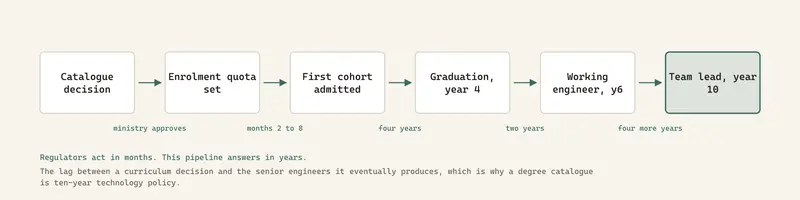
Regulators write rules about models. Education ministries write the supply curve for the people who build them.
Nine universities, thirty seats each
The 2026 catalogue put undergraduate majors into the interdisciplinary category for the first time. Eleven existing majors moved across, and four new ones were added, among them 具身智能 (embodied intelligence) and brain-computer science and technology.
Nine universities were approved to enrol embodied intelligence students in 2026: Beijing University of Posts and Telecommunications, Northeastern, Shanghai Jiao Tong, Zhejiang, Xi'an Jiaotong, Beihang, Beijing Institute of Technology, Harbin Institute of Technology and Nanjing University of Aeronautics and Astronautics. Six of them take 30 students each, nationally. Beijing Institute of Technology takes 120. Northeastern takes 60. The entire first cohort of China's flagship humanoid robotics degree is a few hundred people.
That is not a talent surge. It is a calibrated bet, and the placement is deliberate. Harbin Institute of Technology runs its intake as a Greater Bay Area class from the Shenzhen campus, which sits roughly an hour from the Dongguan and Songshan Lake corridor where the actuators, harmonic drives and controllers are actually manufactured. I have spent eight years in Shenzhen and the thing that still surprises visiting engineers is compression: in Huaqiangbei you can buy a servo, a driver board and an IMU across three floors in an afternoon, take them to a bench and have a limb twitching before dinner. A curriculum written 1,900 kilometres from that is a different curriculum.
One caution. The figures circulating alongside this story, a shortage of one million embodied intelligence workers and a median recruitment salary above 330,000 yuan, come from a 36kr report that cites no underlying source. Treat them as industry mood, not measurement.
1.7 million graduates, and roughly three million formal jobs across a continent
Now the other side. About 1.7 million graduates leave Nigerian universities and polytechnics every year, according to the State of the Nigerian Youth Report 2025 from Plan International Nigeria and ActionAid Nigeria. The same report counts nearly 80 million unemployed young Nigerians, around 53 per cent of the youth population, on a broad definition. Nigeria's National Bureau of Statistics puts headline unemployment at 4.9 per cent under its revised methodology. Both numbers are honestly derived. They measure different things, and quoting either without the other is how this conversation stays useless.
The continental frame is starker and better sourced. In February 2026 the World Bank launched an $972 million programme across seven countries in Eastern and Southern Africa, citing about 8 million young people entering the labour market each year in that region alone against fewer than 1 million securing waged employment. Two and a quarter million Nigerians, 2,243,816 to be exact, registered for the 2026 UTME. They chose their courses from whatever their preferred universities happened to be accredited to teach.
Nigeria is not curriculum-illiterate. The National Universities Commission replaced the old minimum standards with the Core Curriculum and Minimum Academic Standards from September 2023, which for the first time separated Software Engineering, Cybersecurity, Data Science, Information Systems and ICT into distinct degrees rather than annexes of Computer Science. Sixty units of core content, universities free to build the remaining sixty toward the 120 required to graduate. That is a real reform and it was done.
What is missing is the second half of the instrument. There is no annual published table of which programmes were opened, which were suspended and which were closed, at which institution, with what enrolment. China's advantage is not that officials are wiser. It is that they wrote the closures down.
Treating the mismatch as policy instead of as a punchline
The Nigerian graduate-with-no-job is a stock character in Nigerian comedy. As policy input he is worth more than that. Five things would move.
Publish the closures. An annual machine-readable table of programme approvals, suspensions and revocations by institution, with graduate destination data attached, is a cheap document and the entire mechanism. You cannot manage a portfolio you have never listed.
Tie enrolment quotas to laboratory capacity rather than lecture theatre capacity. A data science degree with no compute is a statistics degree with weaker mathematics. This is more tractable than it sounds. A quantised 7B model runs offline on a mid-range laptop through llama.cpp or Ollama, which means a teaching lab that survives a power cut and a bandwidth cap. Robotics can be taught in simulation first through MuJoCo or NVIDIA Isaac Sim, at zero marginal cost per student, before anyone buys an arm.
Give every new programme a sunset clause. Five years, then a published review against employment outcomes. Renewal should require evidence, not inertia.
Wire the industrial plan into the catalogue. Nigeria published a National Artificial Intelligence Strategy in September 2025 with a 2025 to 2029 window and a target of AI skills for 70 per cent of the 16 to 35 workforce. The 3MTT programme began in December 2023 with 30,000 fellows and Nigerian tech media report well over 100,000 trained since. None of that is connected to what the NUC accredits. Two ministries are building the same pipeline and neither reads the other's output.
Finally, count the exits. A significant share of the best-trained Nigerian engineers work for firms outside Nigeria within three years of graduating. That is not automatically a loss. It is only a loss if nobody measures it and nobody builds a path back.
The counter-argument: 1952
Central planning of curricula has a poor record, and the sharpest case against Beijing is Beijing.
In the 1952 院系调整, China reorganised its universities on a Soviet model and dismantled the disciplines judged useless to industrial construction. Sociology, political science, law and psychology were abolished as academic fields. Sociology was not restored until 1979. Twenty-seven years. When it returned there was almost nobody left who had been trained to teach it, because a discipline is not a syllabus but a chain of supervisors, and when you break one link you lose the next three cohorts as well as your own.
That is the real cost of restructuring, and it is asymmetric. Opening a programme takes a year. Rebuilding one takes a generation.
Apply it to the present. The 12,200 withdrawn points fell heavily on arts, humanities, foreign languages and management. Suppose the forecast is wrong, which is the ordinary outcome for any ten-year technology forecast. Suppose embodied intelligence turns out to be capital-intensive rather than labour-intensive, or consolidates into five firms with 2,000 engineers between them. The 30-seat cohorts will be fine. The hollowed-out language and area studies departments will not repair themselves in a budget cycle, and translation, comparative law and regional expertise are precisely the capabilities a country needs when it is exporting robots into sixty legal jurisdictions.
Why this round is not 1952, and where it could still go wrong
Three differences matter. In 1952 disciplines were abolished nationally. Between 2021 and 2025 instances were withdrawn at institutions while the national catalogue grew from 845 majors to 883. Nothing was banned. Enrolment was withdrawn. Second, the cycle is annual and the paperwork runs both ways: a university can register a programme point back. Third, the process is partly bottom-up, with institutions applying and the ministry approving or filing.
Where it could still fail is the incentive gradient. It points one way. No provincial official is promoted for defending a French department. Note that in the 2024 cycle suspensions, 2,220, outnumbered outright revocations, 1,428, and suspension is the quieter death: the programme technically exists, the staff leave first, and by the time anyone wants it back the supervisors are gone. Note also that a 10 per cent annual adjustment rate compounds. Sustain it and you replace the entire structure inside a decade, which is faster than you can retrain the faculty who staff it.
The African version of this failure is the mirror image. Nothing closes. Programmes accumulate, accreditation renews on precedent, and a department that has not been reviewed since 2009 keeps admitting 200 students a year. That is also central planning failure. It is just the passive kind, and it does not make headlines because nothing visibly happens.
The ten-year lag nobody can shorten
The thirty students admitted to Shanghai Jiao Tong's embodied intelligence programme in September 2026 will finish in 2030 and be senior enough to lead teams around 2034. Whatever any parliament legislates about AI between now and then, those people have already been selected. The list is closed.
Nigeria's list for 2034 is also closed. It was assembled from 2.24 million JAMB course preferences filtered through whatever each university happened to be accredited to offer, with no industrial plan anywhere in the loop and no published record of what was opened or shut.
Two education ministries, both writing ten-year technology policy. One of them knows that is what it is doing. The uncomfortable part is that knowing has never been the same as being right, and the proof sits in the same archive as the 2026 catalogue, filed under 1952.
Tools referenced
NVIDIA Isaac Sim, reviewed here: NVIDIA Isaac Sim review.
MuJoCo, reviewed here: MuJoCo review.
Genesis World, reviewed here: Genesis World review.
DeepSeek, reviewed here: DeepSeek review.
Ollama, reviewed here: Ollama review.
llama.cpp, reviewed here: llama.cpp review.
Sources
Ministry of Education, PRC: release of the Undergraduate Programme Catalogue (2026), 28 April 2026: http://www.moe.gov.cn/jyb_xwfb/gzdt_gzdt/s5987/202604/t20260428_1435016.html
Xinhua: 《普通高等学校本科专业目录(2026年)》发布, 28 April 2026: https://education.news.cn/20260428/fbaf09cb35484123a0861639845bcc27/c.html
State Council of the PRC: MOE Department of Higher Education Q&A on the 2024 programme registration results and the 2025 catalogue, 22 April 2025: https://www.gov.cn/zhengce/202504/content_7020385.htm
South China Morning Post: China's universities cut 12,000 'obsolete' degrees, June 2026: https://www.scmp.com/economy/china-economy/article/3356913/chinas-universities-cut-12000-obsolete-degrees-amid-race-embrace-ai-era
36Kr: the nine universities enrolling for the embodied intelligence major in 2026, 22 June 2026: https://eu.36kr.com/en/p/3864187082505094
World Bank: SET4Jobs programme for Eastern and Southern Africa, 26 February 2026: https://www.worldbank.org/en/news/press-release/2026/02/26/new-program-to-equip-18-million-youth-and-enable-jobs-in-eastern-and-southern-africa
Premium Times: State of the Nigerian Youth Report 2025 coverage, September 2025: https://www.premiumtimesng.com/news/top-news/818817-80m-nigerian-youth-unemployed-report.html
National Universities Commission: CCMAS for the Computing discipline, Nigeria: https://nuc-ccmas.ng/computing/
Frequently Asked Questions
How many university degree programmes did China cut between 2021 and 2025?
China's Ministry of Education reported that during the 14th Five-Year Plan period, 2021 to 2025, universities nationwide revoked or suspended enrolment in 12,200 undergraduate programme points and added 10,200 new ones. A programme point means one major offered at one institution, not a distinct degree subject. Over the same period the national catalogue of subjects grew rather than shrank, reaching 883 majors across 92 major classes and 13 categories in the 2026 edition published on 28 April 2026.
Did China scrap 12,000 arts and humanities degrees and launch 10,200 AI courses?
No. Both claims misread the Ministry of Education figures. The 12,200 revoked or suspended programme points span every discipline, although arts, humanities, foreign languages and management absorbed a large share of the reductions. The 10,200 figure counts newly registered undergraduate programme points across all fields, including agriculture, medicine, marine science and engineering. It is not a count of AI courses, and no primary Chinese source describes it that way.
How many graduates does Nigeria produce each year, and how many jobs are available?
About 1.7 million graduates leave Nigerian universities and polytechnics annually, according to the State of the Nigerian Youth Report 2025 published by Plan International Nigeria with ActionAid Nigeria in September 2025. For continental scale, the World Bank reported in February 2026 that roughly 8 million young people enter the labour market each year in Eastern and Southern Africa while fewer than 1 million secure waged employment. Nigeria registered 2,243,816 candidates for the 2026 UTME university entrance examination.