Robot Safety Standards Are Written Before Any Law Arrives
 Francis Okafor
On this page
- What robot safety standards actually constrain
- Pain thresholds, measured by an insurance institute
- Thirty-three countries decide what a robot may do
- Liability is the forcing function, not the statute
- Parliament waited for the committee
- Slow and technical, for defensible reasons
- What arrives in Lagos has already been decided
- Sources
Long before any parliament debates a robot bill, the decision has been made. Robot safety standards fix what a machine is allowed to do to a human body, and they are drafted by technical committees, funded in part by accident insurers and enforced through purchase orders. By the time a legislature votes, it is usually ratifying arithmetic that was settled years earlier in a room in Stockholm or Berlin.
I have watched this from Shenzhen for eight years. Engineers here do not open the AI Act to find out what they are permitted to build. They open ISO 10218 and the client's tender document. That is not cynicism. That is the order of operations.
Three mechanisms do the actual governing: the standards themselves, which set what is buildable; liability law, which makes non-compliance expensive before any regulator shows up; and procurement, which turns a voluntary document into a contractual requirement. Legislation is the fourth thing, and it is downstream of the other three.
What robot safety standards actually constrain
ISO/TC 299, the robotics committee, published third and second editions of ISO 10218 in February 2025, replacing the 2011 editions that had governed industrial robots for fourteen years. Part 1 covers the robot as partly completed machinery. Part 2 covers the application, the cell and the integration. Most of the collaborative-operation content that had lived in ISO/TS 15066:2016 was folded into Part 2, and ISO/TS 15066 is now flagged for revision, to be superseded by a new ISO/AWI 15066-1 on biomechanical thresholds and contact data.
Those documents recognise four collaborative operation modes: safety-rated monitored stop, hand guiding, speed and separation monitoring and power and force limiting. Two of them decide the physical shape of a factory.
Speed and separation monitoring means the control system recomputes a protective separation distance continuously. Inputs are the robot's current speed and direction, an assumed human approach speed, the reaction time of the whole sensing and control chain, the stopping distance at that speed and uncertainty terms for position measurement. Cross the line and the robot stops. The companion document ISO 13855:2024 supplies the approach-speed figures used when positioning safeguards. The practical consequence is blunt: a fast robot needs either a large exclusion zone or a lot of sensing, and slowing it down shrinks the cell. Floor space and cycle time both fall out of a safety equation nobody in the plant negotiated.
Power and force limiting is the other branch. Contact with a person is permitted, but the force and pressure at the point of contact must stay under a limit specific to the body part struck. A forearm is not a skull. Design follows: mass budget, maximum joint speed, surface curvature, padding and gripper geometry are all constrained by a table.
Underneath both sits ISO 13849-1:2023, now in its fourth edition, which allocates safety functions to one of five performance levels. The required performance level determines redundancy, diagnostic coverage and component selection. This is where an international standard reaches directly into a bill of materials.
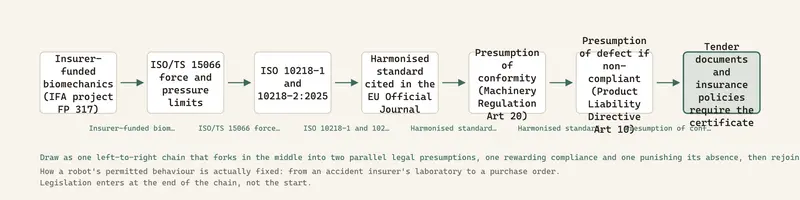
The limit values governing collaborative robots sold anywhere in the world were produced by the organisation that pays out when a German worker is injured.
Pain thresholds, measured by an insurance institute
The force and pressure numbers had to come from somewhere. They came from the IFA, the research institute of the DGUV, the German Social Accident Insurance, in a project it catalogues as FP 317.
IFA's own description of the work is specific. Roughly 100 test subjects. Twenty-nine body points across fifteen discrete body regions. Around 9,000 analysable pain-threshold measurements. A plunger pressed into tissue with the rate of pressure rise held between 2 and 5 newtons per second, while the subject pressed a button to mark the onset of pain. IFA states that the resulting quasi-static force and pressure limits were incorporated into ISO/TS 15066 and into a DGUV informative publication on collaborative robots.
Read that chain of custody again. The limit values governing collaborative robots sold anywhere in the world came out of a project funded by the organisation that pays out when a German worker is injured, measured in a university laboratory it commissioned. The insurer funded the biomechanics. The committee codified it. The manufacturer now designs to it. No legislature appears anywhere in that sequence.
Thirty-three countries decide what a robot may do
ISO/TC 299 was created in 2015. Its secretariat is held by SIS, the Swedish Institute for Standards, its chair serves until the end of 2029 and it currently lists 35 published standards and 22 under development across sixteen working groups. Membership is 33 participating national bodies and 10 observing ones. ISO/TC 199, safety of machinery, which supplies the framework standards the robot documents lean on, has a German secretariat at DIN, 28 participating members and 25 observing.
Participation is where the shift is visible. Across ISO as a whole, China's SAC now participates in 790 technical committees and holds 99 secretariats, against DIN's 730 and 132. China sits at more ISO tables than Germany, while Germany still runs more of them. Nobody arrives at a committee empty-handed, and the domestic groundwork happens first: on 28 February 2026 a Ministry of Industry and Information Technology technical committee released China's first national standard system for humanoid robots and embodied intelligence in Beijing, reported by Global Times the following day and built across six pillars, with Xinhua putting the input at more than 120 institutions and firms.
The frontier is genuinely unwritten. ISO/CD 25785-1, covering safety requirements for dynamically stable industrial mobile robots that walk, roll or otherwise locomote, is still a committee draft. The revision of ISO 13482, which retitles it from personal care robots to service robots, sits at final draft stage. A committee draft on humanoid robot datasets is in circulation. Humanoids are being demonstrated, financed and in some cases sold while the safety standard for their locomotion class is still an argument among delegations.
Whoever wins that argument sets the physics envelope for the next twenty years of the category.
Liability is the forcing function, not the statute
The revised EU Product Liability Directive, Directive (EU) 2024/2853 of 23 October 2024, applies to products placed on the market after 9 December 2026 and treats software and AI systems as products. Article 9 obliges a defendant to disclose relevant evidence once a claimant has made a plausible case. Article 10 keeps the burden on the claimant but presumes defectiveness in three situations, one of which is that the product does not comply with mandatory product safety requirements intended to protect against the harm suffered.
Non-compliance stops being a paperwork problem at that point. It hands the claimant a presumption.
The compliance side is the mirror image. The EU Machinery Regulation, Regulation (EU) 2023/1230, applies from 20 January 2027. Its Article 20 states that a product conforming to a harmonised standard whose reference has been published in the Official Journal is presumed to conform to the essential health and safety requirements covered by that standard. Meet the committee's document and you are presumed legal. Miss it and you may be presumed defective. Two presumptions pointing the same way, neither of them written by a legislator.
The proposed AI Liability Directive, which would have added fault-based rules on top, was listed for withdrawal in the Commission Work Programme 2025 presented on 11 February 2025. Product liability plus standards is what actually remains.
The United States gets to the same place by a different road. OSHA has no robot-specific standard. It uses machine guarding at 29 CFR 1910.212, lockout/tagout at 1910.147 and the General Duty Clause, while its Technical Manual chapter on industrial robot systems points inspectors at ANSI/RIA R15.06 and ISO 10218. On 21 August 2025, Parts 1 and 2 of ANSI/A3 R15.06-2025 were approved as the US national adoption of ISO 10218-1:2025 and ISO 10218-2:2025, retiring the 2012 edition. Under the National Technology Transfer and Advancement Act and OMB Circular A-119, federal agencies are directed to rely on voluntary consensus standards in regulation and procurement, a policy NIST administers. The government does not need to write the rule. It buys against it.
Parliament waited for the committee
This year produced the cleanest available proof. Regulation (EU) 2026/1744, the Digital Omnibus on AI, was adopted on 8 July 2026 and published in the Official Journal on 24 July 2026. It amends three instruments at once: the AI Act, the civil aviation regulation and the Machinery Regulation.
Its main effect was to move the AI Act's high-risk obligations. Systems classified as high-risk under Annex III now apply from 2 December 2027. Products under Annex I, which is where machinery and robots sit, move to 2 August 2028. Recital 40 gives the reason in the legislature's own words: the "delayed availability of standards", common specifications and alternative guidance, together with the slow establishment of national competent authorities.
The AI Act had already made harmonised standards the route to presumed conformity, in the same architecture as the Machinery Regulation. Parliament wrote the frame. CEN, CENELEC and ISO write the content. When the content ran late, the frame moved. That is not a scandal and it is not a secret. It is simply the wrong way round from how most people describe technology regulation.
Slow and technical, for defensible reasons
The strongest objection to everything above is that this arrangement is correct, and that the alternative is worse.
Standards work is agonisingly slow. A3 described the ISO 10218 revision as nearly eight years of work. ISO 10218 went fourteen years between editions. ISO/TS 15066 has been marked for revision while the robots it governs became ordinary. For a field moving at the pace of embodied AI, that is a real failure, and integrators have spent years working from documents that predate the hardware in front of them.
But look at what the slowness buys. The pain thresholds are not opinions. They are a measurement protocol with about 100 subjects and roughly 9,000 data points, published, criticised and revised. No parliament can generate that, and a parliament legislating in the weeks after a widely televised industrial accident would generate something considerably worse: a blanket speed cap, a mandatory cage, a ban on a form factor because it looked frightening on video. Consensus among 33 national delegations plus manufacturers, integrators, insurers and labour inspectorates is slow precisely because no single one of them can write its own product into the requirement.
So the honest position is split. The process is broadly legitimate on technical merit and indefensible on representation. Those are two different complaints, and treating them as one produces the worst answer available, which is to hand the technical questions back to politics because the committee's guest list is unfair.
What arrives in Lagos has already been decided
Neither ISO/TC 299 nor ISO/TC 199 has a single African national standards body among its members, participating or observing. Not one, in either committee. The participation lists are public on ISO's own site.
That absence is not a capacity story, or not only one. South Africa's SABS holds 11 ISO secretariats and participates in 257 technical committees. Nigeria's SON participates in 110. ARSO, the African Organisation for Standardisation, covers 44 African member states plus an observer. The people and the institutional standing exist. They are allocated to food safety, textiles, construction materials, the things that cross borders and earn foreign exchange this year.
In the short run that allocation is rational. The IFR's World Robotics 2025 report, released on 25 September 2025, counted 542,000 industrial robots installed worldwide in 2024, with Asia taking 74 percent of new deployments, Europe 16 percent and the Americas 9 percent. Ninety-nine percent between them. Africa shares what is left with everywhere else. Why staff a committee for machines almost nobody in your market is buying.
Because standards are written when a technology is young and cheap to shape, and enforced when it is old and everywhere. The African Union's Continental AI Strategy was endorsed by the Executive Council in Accra in July 2024. Strategy documents are cheap. A working-group seat costs travel budget and one competent engineer's sustained attention for several years, which is a harder thing to find than a communiqué.
Here is the part that cannot be retrofitted. When a factory in Ogun State buys a collaborative robot in 2031, the protective separation distance formula, the force limit for a forearm and the required performance level are already compiled into the controller and printed on the declaration of conformity. There is no regional variant. No manufacturer will build one for a market that was not in the room when the numbers were set. What arrives is a certificate, in English, tracing back to a body model built from about 100 volunteers in a German laboratory.
The committee draft for legged robots is open right now, argued over by participating delegations that include Kazakhstan and Iran, watched by observers including Honduras, and with not one African country in either list. It will close. And what closes with it is not a rule anyone can appeal later. It is the shape of the machines that will show up.
Sources
ISO 10218-1:2025, Robotics safety requirements for industrial robots (ISO catalogue entry, ISO/TC 299): https://www.iso.org/standard/73933.html
ISO/TC 299 Robotics, committee participation list (33 participating and 10 observing members): https://www.iso.org/committee/5915511.html?view=participation
IFA / DGUV, pain threshold catalogue from project FP 317 (about 100 subjects, 29 body points, 9,000 measurements): https://www.dguv.de/ifa/fachinfos/kollaborierende-roboter/schmerzschwellenkataster/index-2.jsp
Regulation (EU) 2023/1230 on machinery, Article 20 presumption of conformity, applies from: https://eur-lex.europa.eu/eli/reg/2023/1230/oj/eng
Directive (EU) 2024/2853 on liability for defective products, Articles 9 and 10: https://eur-lex.europa.eu/eli/dir/2024/2853/oj/eng
Regulation (EU) 2026/1744, Digital Omnibus on AI, recital 40 on delayed availability of standards: https://eur-lex.europa.eu/eli/reg/2026/1744/oj/eng
IFR World Robotics 2025, 542,000 industrial robots installed in 2024 and regional shares: https://ifr.org/ifr-press-releases/news/global-robot-demand-in-factories-doubles-over-10-years
OSHA Technical Manual, Section IV Chapter 4, Industrial Robots and Robot System Safety: https://www.osha.gov/otm/section-4-safety-hazards/chapter-4
Frequently Asked Questions
Which ISO standards govern industrial robot safety?
ISO 10218-1:2025 covers the robot itself as partly completed machinery and ISO 10218-2:2025 covers the application, cell and integration. Both were published in February 2025 by ISO/TC 299 and replace the 2011 editions. ISO/TS 15066:2016 supplied the collaborative-robot biomechanical limits and most of its requirements have now been absorbed into ISO 10218-2:2025. ISO 13849-1:2023 sets the performance levels the safety functions must reach, and ISO 13855:2024 supplies approach-speed data for positioning safeguards.
What is the difference between speed and separation monitoring and power and force limiting?
Speed and separation monitoring keeps robot and human apart. The controller continuously computes a protective separation distance from robot speed, assumed human approach speed, system reaction time, stopping distance and uncertainty terms, and stops the robot if that distance is breached. Power and force limiting allows contact but caps the force and pressure at the point of contact, with different limits for different body parts, derived from measured pain-onset thresholds.
Does the EU AI Act regulate robots directly?
Indirectly. An AI system that is a safety component of a product covered by Annex I harmonisation legislation, which includes the Machinery Regulation, is classified as high-risk. Compliance runs through harmonised standards, which give a presumption of conformity. Regulation (EU) 2026/1744, the Digital Omnibus on AI adopted on 8 July 2026, pushed the Annex I high-risk obligations to 2 August 2028, citing the delayed availability of those standards.
Why does it matter that no African standards body sits on ISO/TC 299?
Because the numbers agreed there are compiled into robot controllers and printed on declarations of conformity before any machine ships. There is no regional variant. A buyer in a market that had no delegation at the table inherits force limits, separation formulas and performance levels set elsewhere, arriving as a finished certificate rather than a negotiable requirement. South Africa's SABS participates in 257 ISO committees and Nigeria's SON in 110, so the institutional capacity exists; it is simply pointed elsewhere.