Wheel-Legged Robots: Buying Two Locomotion Modes, Paying for Three
 Francis Okafor
On this page
- The terrain argument for wheel-legged robots, stated precisely
- The actuator bill, including the lines nobody reads
- Balancing while rolling, and the mode switch where the bugs live
- Where these platforms actually earn their keep
- Shenzhen, where the iteration loop is the product
- The counter-argument, which usually wins the bid
- What the argument is quietly turning into
- Sources
A wheel-legged robot is a bet on the shape of the ground. The bet says the world is mostly flat, punctuated by discontinuities that flatness cannot absorb. A kerb. A cable tray. A 200 mm lip at the door of a switchgear room. Roll across the flat, step over the lip, roll on. Two locomotion modes, one chassis, one battery.
Wheel-legged robots keep getting built because that bet is genuinely correct about a lot of real sites. ETH Zurich bolted wheels onto ANYmal. A student team in Zurich built a two-wheeled jumper and turned it into a security company. Unitree ships a W variant of its industrial quadruped. DEEP Robotics ships the Lynx. Somebody in a lab you have never heard of is soldering one together this quarter.
Here is the part that does not make it into the demo video. The terrain argument is right. The bill is bigger than the argument admits, and almost none of it lands where the pitch deck says it will.
The terrain argument for wheel-legged robots, stated precisely
Wheels are cheap per metre because a rolling contact never has to be re-established. No swing phase. No touchdown impulse to absorb. No cyclic vertical excursion of the centre of mass to pay for on every stride. Marko Bjelonic and colleagues at ETH measured this directly on ANYmal fitted with non-steerable wheels: driving reached 4 m/s and cut cost of transport by 83 percent against the legged version of the same hardware. A 2026 survey in Frontiers in Robotics and AI collects a decade of comparable results, including Endo and Hirose's Roller-Walker at roughly eightfold better than a crawl gait.
That is not a marginal improvement. That is the difference between a two-hour patrol and a forty-minute one, on the same cells.
Then you meet a step.
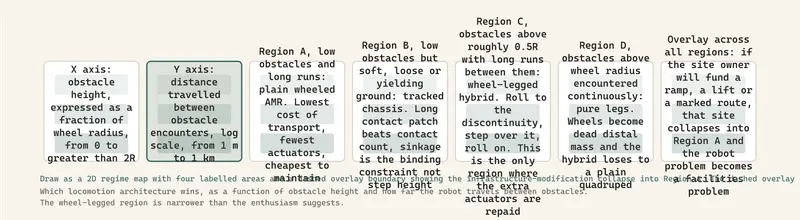
A rigid wheel climbing a step is a statics problem before it is a control problem. The contact normal sits at the step edge, and as the step height approaches the wheel radius the tractive force required to rotate the wheel over that edge runs away toward infinity. Practical limits land well below the radius, and lower still once you account for a surface that is wet, dusty or loose. This is why every wheeled robot spec sheet quotes obstacle height in centimetres and why that number is always a fraction of the wheel.
Legs do not have this problem. A leg selects a foothold above the discontinuity and puts a foot there. The cost is that it does this on every stride, everywhere, including the 200 metres of flat concrete where nothing needed selecting. The hybrid says: only pay for foothold selection when the terrain actually demands it.
Every hour I have spent on a wheel-legged control stack, roughly forty minutes of it went to deciding whether a wheel was really touching the ground.
The actuator bill, including the lines nobody reads
Count the joints. A wheeled quadruped in the common configuration is a legged quadruped plus four more actuators, four more encoders, four more drivers, four more thermal paths and four more sealing interfaces. That is the line item everyone quotes, and it is the least interesting one.
Distal mass is worse. The wheel drive sits at the far end of the leg, which is the single worst place on the machine to add rotating inertia. Leg inertia rises, swing bandwidth falls, and the touchdown impulse that a light foot used to absorb now arrives at a rotor and a reduction stage. You can move the drive proximal and run a belt or a shaft down the shank, and now you have a transmission that stretches, wears and adds backlash exactly where your contact estimator needs precision.
Holding torque is worse again. A legged robot parked on a slope holds position through joint torque and friction. Give it wheels and it will roll, so you either fit mechanical brakes on four hubs or you hold position with continuous motor current. The version of this I would not ship again is the second one. It works on the bench. It also converts every unplanned stop on a ramp into a slow creep, and by the end of a shift the thermal derate has quietly changed how much authority the balance controller actually has, which is not a condition anyone tuned for.
Then the boring stuff that decides fleet economics. Tyres are a consumable. Hub seals in dust are a consumable. A rolling contact constrains foot placement in a way a point foot does not, so terrain compliance drops and the machine is fussier about where it puts weight. And the failure surface is multiplicative, not additive: sixteen actuators in series-of-dependency means mean time between failures for the platform is far shorter than for any one actuator.
Balancing while rolling, and the mode switch where the bugs live
Two-wheeled configurations, the Ascento shape, are wheeled inverted pendulums. Open loop unstable, underactuated and non-minimum phase: to accelerate forward the controller must first drive the wheels backward to pitch the body into the move. That inverse response eats control authority and it is the reason these machines look twitchy under load. Klemm and colleagues published the design and controllers for Ascento at ICRA 2019, and the honest read of that paper is that the mechanism is the easy half.
Four-wheeled configurations dodge the balance problem and inherit a different one. Non-steerable wheels impose rolling constraints, so the system is nonholonomic. Lateral motion needs body reorientation or an actual step. You have traded an unstable equilibrium for a planning restriction.
The real difficulty is that neither mode is the system. The system is hybrid. When a leg lifts, the contact set changes, the constraint set in your whole-body quadratic program changes dimension, and the dynamics you linearised around are no longer the dynamics you have. Controllers written per mode need a switching law. The switching law is where the bugs live: discontinuous torque commands at the boundary, transients that the per-mode tuning never saw, gain schedules that were validated at each end and nowhere in between.
Bjelonic's group answered this with whole-body model predictive control over a horizon long enough to contain the switch, with the contact sequence generated online rather than hand-scheduled. The learning camp answers it with a single reinforcement learning policy trained across both regimes, so the transition is interpolated instead of scheduled. Both approaches work in papers. Both share one weakness.
The failure mode I keep meeting is not in the controller. It is in contact state estimation. These machines fuse IMU, leg kinematics and wheel odometry, and wheel odometry is only valid under a rolling-without-slip assumption. Lift a wheel, or slip it on a painted floor, and the estimator keeps integrating a velocity that is not happening. On a four-wheeled platform that produces drift. On a two-wheeled balancer that produces a controller acting confidently on a false velocity, which is the short path to a machine on its back. Every hour I have spent on a wheel-legged control stack, roughly forty minutes of it went to deciding whether a wheel was really touching the ground.
Where these platforms actually earn their keep
Perimeter security on mixed campuses is the clearest fit. Long flat runs between buildings, kerbs and short stair flights at the boundaries, no infrastructure change permitted because the site owner is a tenant. Ascento built a business on exactly that geometry.
Last-mile parcel delivery is the second, and it produced the strongest market signal the category has. RIVR, the ETH Robotic Systems Lab spinout formerly called Swiss-Mile, built a wheeled quadruped whose co-founder describes it as a dog on roller skates. Amazon, which had already invested through its Industrial Innovation Fund in the 22.2 million dollar seed round, acquired the company outright in March 2026. Read what that purchase is for. Amazon did not buy legs for the warehouse. It bought legs for the last five metres, where the ground belongs to the customer and there are three steps up to the door.
Industrial inspection is the third: substation corridors, tunnels, pipe racks. DEEP Robotics markets the Lynx M20 at precisely this, publishing 33 kg mass, 15 kg payload, IP66, 25 cm continuous stair height and a 5 m/s lab speed against a 2 m/s safe operating speed. Note that last pair. The honest spec sheets separate the number the machine can hit from the number you are allowed to run.
And one deployment that predates the current wave: the ExoMars Rosalind Franklin rover carries a wheel-walking mode, independently pivoting each wheel to dig and sweep its way out of soft regolith. Instructive, because it is a hybrid used as a rescue mode rather than a speed mode. Wheel-legged as insurance against sinkage, not as a performance claim.
Still research: sustained speed over natural broken terrain, wheeled loco-manipulation with a real arm on top, and multi-day autonomy without an operator within driving distance.
Shenzhen, where the iteration loop is the product
I live in this ecosystem, so let me be precise about what it is and is not.
What it is: an actuator supply base built for electric vehicles and drones, sitting inside a two-hour logistics radius, which makes a wheel end a bolt-on rather than a programme. That is why Chinese wheel-legged platforms arrive as suffixes on existing product lines. Unitree's B2-W and Go2-W are the wheeled variants of shipping quadrupeds. LimX Dynamics in Shenzhen sells TRON 1 with interchangeable limb ends, point foot, sole and wheel, which converts the entire mode question into a line on a purchase order. The IFR's World Robotics 2025 report puts 295,000 industrial robot installations in China in 2024, 54 percent of the global total, with domestic makers taking a 57 percent share of their home market for the first time. Those are arms, not legs, but they are why the component base exists at all.
What it is not: a lead in control theory. The published foundation for wheeled-legged whole-body control still leans heavily on ETH and a handful of other labs, and a good deal of what ships here is a well-executed variant of ideas from that literature. The advantage is cadence. A Western lab quoting a first revision is competing with a fourth revision that already has field hours on it, and in a category where the hard problems are contact estimation and hub sealing, field hours are worth more than a cleaner derivation.
One warning, since this is where the category is most dishonest. I could not obtain a manufacturer specification sheet for the Unitree B2-W. The official shop page lists a price and no numbers at all. Everything circulating is reseller copy, and that copy contains figures that contradict each other on both top speed and payload. This is normal here. Treat any single-number spec claim as untested until you see the test conditions, the payload it was carried under and whether the number is a lab peak or a rated continuous.
The counter-argument, which usually wins the bid
A plain wheeled robot with better path planning solves most real deployments for less money and less failure surface, and I think that is correct for the median site.
The evidence is not subtle. Amazon crossed one million deployed mobile robots in July 2025, the largest such fleet on earth. Essentially none of them have legs. The winning move was never a better robot. It was changing the building: flat floors, fiducial markers, controlled routes and a facilities budget that treats the floor as part of the machine. Where you own the ground, wheels win and it is not close.
Tracked platforms take the next slice. A track spreads load over a long contact patch, which handles soft and yielding ground where a wheel sinks, and it climbs stairs without any balance controller at all. Two drive motors and a flipper pair against sixteen actuators. When the requirement is stated as climbs stairs occasionally, in dust, unattended, the tracked chassis wins on failure surface before anyone opens a control textbook.
And a great many legs requirements dissolve under measurement. Walk the site, count the actual discontinuities, and it is often three: one has an alternative route, one gets a ramp for the price of a week of robot downtime, and one turns out to be a door somebody props open anyway.
Boston Dynamics is the honest witness here. They built Handle, the most famous wheel-legged machine ever filmed, and then shipped Stretch with a plain omnidirectional wheeled base. The company with the deepest legged locomotion bench in the industry looked at the warehouse and did not take the legs.
What the argument is quietly turning into
The hybrid's economics come down to a question about property, not locomotion. If you control the floor, flatten it. If you do not, and the route is long and the discontinuity is not negotiable, you buy the extra actuators. That is the whole decision, and stating it that way removes most of the enthusiasm from the room.
What interests me is where the objection is migrating. Reinforcement learning is steadily driving down the control cost of these machines, and a unified policy across rolling and stepping is no longer exotic. So the argument against wheel-legged designs is shifting from we cannot control it to we cannot maintain it. Nobody publishes on that side. Vendors publish top speed. Papers publish cost of transport. I have yet to see anyone publish actuator replacements per thousand kilometres, hub seal life in a cement plant or mean time to recover a machine that failed on its side at the top of a stair flight.
That is the number that decides whether the design comes back a seventh time or finally stays away. It is the one number the field has agreed not to collect.
Sources
Bjelonic et al., Keep Rollin': Whole-Body Motion Control and Planning for Wheeled Quadrupedal Robots (arXiv 1809.03557, 2019): https://arxiv.org/abs/1809.03557
Passive wheels on legged robots: a survey, Frontiers in Robotics and AI, 17 June 2026: https://www.frontiersin.org/journals/robotics-and-ai/articles/10.3389/frobt.2026.1857985/full
Klemm et al., Ascento: A Two-Wheeled Jumping Robot, ICRA 2019 (arXiv 2005.11435): https://arxiv.org/abs/2005.11435
DEEP Robotics LYNX M20 official product specifications: https://www.deeprobotics.us/products/lynx-m20/
TechCrunch: Amazon acquires Rivr, maker of a stair-climbing delivery robot, 19 March 2026: https://techcrunch.com/2026/03/19/amazon-acquires-rivr-maker-of-a-stair-climbing-delivery-robot/
IFR World Robotics 2025: global robot demand in factories doubles over 10 years: https://ifr.org/ifr-press-releases/news/global-robot-demand-in-factories-doubles-over-10-years
Amazon: one millionth robot deployed and DeepFleet foundation model, July 2025: https://www.aboutamazon.com/news/operations/amazon-million-robots-ai-foundation-model
ESA: Moving on Mars, ExoMars Rosalind Franklin wheel-walking locomotion: https://www.esa.int/Science_Exploration/Human_and_Robotic_Exploration/Exploration/ExoMars/Moving_on_Mars
Frequently Asked Questions
What is a wheel-legged robot?
A wheel-legged robot is a mobile platform with actuated legs that end in driven wheels, so it can roll efficiently across flat ground and switch to stepping when it meets a discontinuity such as a kerb or a stair. Common configurations are four-legged with four wheels, like Unitree's B2-W or the DEEP Robotics Lynx M20, and two-legged with two wheels, like Ascento, which balances as a wheeled inverted pendulum.
Are wheel-legged robots more energy efficient than legged robots?
On flat ground, substantially so. Bjelonic and colleagues at ETH Zurich measured an 83 percent reduction in cost of transport for a wheeled ANYmal compared with the legged version of the same hardware, reaching 4 m/s. The efficiency comes from a rolling contact that never has to be re-established: no swing phase, no touchdown impulse and no cyclic vertical motion of the centre of mass. That advantage disappears the moment the machine has to step, and the added wheel hardware is dead mass while it does.
Why is balance harder on a two-wheeled legged robot than a four-wheeled one?
A two-wheeled legged robot is a wheeled inverted pendulum: open loop unstable, underactuated and non-minimum phase, meaning the controller must drive the wheels backward to pitch the body before it can accelerate forward. A four-wheeled configuration is statically stable and avoids that entirely, but its non-steerable wheels impose rolling constraints, so it is nonholonomic and cannot move sideways without reorienting the body or taking an actual step.
When is a tracked robot a better choice than a wheel-legged robot?
When the requirement is climbing stairs occasionally, in dust, unattended. A tracked chassis spreads load over a long contact patch, handles soft ground where wheels sink, and climbs stairs with no balance controller and typically two to four actuators against sixteen on a wheel-legged quadruped. Failure surface scales with actuator count, so the tracked platform usually wins on fleet reliability and cost unless the site demands speed over long flat runs between obstacles.
Which wheel-legged robots are actually deployed rather than research platforms?
Ascento's two-wheeled platform runs perimeter security on industrial campuses. RIVR, the ETH Zurich spinout formerly called Swiss-Mile, ran last-mile parcel and food delivery pilots and was acquired by Amazon in March 2026 for doorstep delivery work. DEEP Robotics markets the Lynx M20 for substation and tunnel inspection. Sustained high-speed travel over natural broken terrain and wheeled loco-manipulation with an arm remain research.