Sensor Fusion in Sports Tracking and What 500Hz Is Actually For
 Francis Okafor
On this page
- Four sensors and four unrelated ways to be wrong
- 500Hz is a decision about time and not about resolution
- Why sensor fusion in sports tracking beats picking one sensor
- Time synchronisation is the part that actually breaks
- From raw signal to a number the coach sees
- The strongest objection is that nobody can act on this
- Precision pays where the decision is binary
- Sources
The match ball at a World Cup carries an inertial measurement unit that reports 500 times a second, and FIFA publishes that number rather than burying it in a datasheet. It is the cleanest available way into sensor fusion in sports tracking, because for once you can work backwards from a published sampling rate to the single decision it exists to serve.
It was not chosen to measure the kick. A 500Hz accelerometer cannot resolve the mechanics of foot on ball in any serious sense. It was chosen to timestamp the kick.
I do not work in football. I build measurement and control systems in manufacturing, where sensors cost less, vibration is worse and a bad timestamp turns into scrap rather than a bad substitution. The mathematics does not change when you carry it outdoors. Neither do the failure modes.
Four sensors and four unrelated ways to be wrong
An IMU sits in the body frame. It gives you angular rate and specific force at high rate with no dependence on anything external, which is exactly why it cannot tell you where a player is. Integrate the gyroscope and heading drifts. Double integrate the accelerometer and position error grows with the square of elapsed time. On a hard collision the accelerometer clips against its full scale range, and clipping destroys information rather than degrading it. No filter recovers a clipped sample.
GNSS gives you absolute position that does not drift, at the 10Hz or 18Hz that team units actually run. Between fixes you are blind for 100 milliseconds. Stadium bowls are hostile: signal reflects off stands and roofs, and multipath error does not announce itself, it moves your player two metres sideways and keeps going. Worth knowing that receiver velocity computed from Doppler shift is roughly an order of magnitude better than velocity from differentiating successive positions, centimetres per second against metres per second. A good unit reports the speed the receiver solved for, not the speed your pipeline derived.
Optical tracking works in the world frame with no player-worn hardware at all. Published validation of a multi-camera system running at 25Hz reported positional RMSE of 0.08 m and instantaneous speed RMSE of 0.08 m per second against motion capture, with total distance bias of 0.27%. Those are good numbers. Its failure mode is occlusion: a corner, eight bodies in the six-yard box, and the tracker either loses identities or swaps them. Optical error is not Gaussian. It arrives in bursts.
Local positioning using ultra-wideband anchors around the pitch trades installation cost for immunity to satellite geometry, and fails instead on anchor placement and reflection.
The argument for fusion is contained in that list. Nothing correlates. Gyro drift is slow and monotonic. Multipath is fast and venue-specific. Occlusion is event-driven. Four estimators wrong in four unrelated ways is a solvable problem. One estimator wrong in one way is not.
The residual is the only part of the filter capable of telling you it is lying.
500Hz is a decision about time and not about resolution
Start with the arithmetic. 500Hz is one sample every 2 milliseconds. FIFA's semi-automated offside system tracks up to 29 points on each player 50 times a second from 12 stadium cameras, which is one limb pose every 20 milliseconds. A player running at 8 metres per second covers 160 millimetres in 20 milliseconds and 16 millimetres in 2. Offside is adjudicated in centimetres. The ball sensor exists to collapse a 160 mm ambiguity about when contact happened into a 16 mm one. That is the whole job.
Now look at what 500Hz is not. If you want impact mechanics, the reference is SAE J211-1, which specifies head acceleration for injury criterion calculation sampled above 10 kHz and filtered at channel frequency class 1000, a corner near 1650 Hz. Instrumented mouthguards in the concussion literature sample at 3.2 kHz. Published work on optimal cutoffs for those signals landed at 175 Hz for linear acceleration and 250 Hz for angular velocity across a mixed impact set, rising to 275 Hz for angular velocity on rigid impacts alone. A 500Hz stream cannot represent 275 Hz content without aliasing it. 500Hz is two orders of magnitude away from crash instrumentation. Anyone selling it as impact measurement is selling a bigger number, not a better one.
Sampling rate is not cosmetic because it changes the answer and you cannot undo it afterwards. A 2024 study put 100Hz and 1000Hz accelerometers on the same rugby league tackles and reported mean acceleration of 1.00 g at 100Hz against 1.44 g at 1000Hz. Same tackles. Forty-four percent apart. Whatever threshold your load model uses was calibrated at one of those rates and means nothing at the other.
More is not automatically better either. A 2025 study of orientation estimation swept sampling from 10Hz to 1600Hz and found 100Hz sufficient for walking, 200Hz for running and 400Hz for high speed cyclic movement, while also finding accelerometer error increasing above 100Hz, because extra orientation updates computed from distorted accelerations inject more error than they remove. Gyroscope rate mattered throughout. Accelerometer rate above 100Hz actively hurt.
The rule that falls out is uncomfortable. The correct sampling rate is a property of the specific quantity you intend to compute, not of the sensor, and a badly designed anti-alias filter costs you more than halving the rate would.
Why sensor fusion in sports tracking beats picking one sensor
The classic result is one line. The gyroscope is right in the short term and wrong in the long term, the accelerometer is the reverse, and gravity is a free absolute reference for as long as the sensor is not accelerating hard. A complementary filter is the cheapest expression of that idea. High-pass the integrated gyro, low-pass the accelerometer tilt estimate, pick a crossover frequency. One knob, no matrix algebra.
A Kalman filter is the same trade with the crossover derived from covariance instead of chosen by hand. In exchange you owe it a process noise matrix Q and a measurement noise matrix R. Here is the tradeoff nobody puts in the README: those matrices are almost never derived from sensor physics. They get tuned until the output looks plausible on a test set. Which means the filter's confidence estimate is a fiction you wrote.
That fiction has a specific failure mode and it is the one I keep meeting. When a real outage arrives, a player crossing into stand shadow, an anchor going quiet, the filter does not get noisy. It gets smooth. It propagates the prediction, finds no measurement to argue with and produces a beautifully continuous track of a player who was not observed. Smooth output reads as correct output to everyone downstream. The version of this I would not ship again is one where the innovation sequence was computed and then discarded rather than logged and alarmed on. The residual is the only part of the filter capable of telling you it is lying.
Madgwick and Mahony filters sit between the two, replacing the covariance update with gradient descent toward the gravity and magnetic reference. Cheap enough for a battery-powered tag, which matters more than elegance when the thing has to survive 90 minutes inside a vest.
Magnetometers are the other trap. Yaw is unobservable from accelerometer and gyroscope alone, so orientation filters reach for the magnetic field to fix heading. A stadium is steel: floodlight rigs, under-soil heating, reinforced concrete, and the local field is not the field the filter assumes. Heading that behaved on the training ground goes wrong under a roof, slowly enough that nobody attributes it to the venue.
Time synchronisation is the part that actually breaks
Sampling rate is what gets specified. Synchronisation is what gets forgotten.
Take a cheap crystal oscillator at 20 parts per million. Across one 45 minute half that is 20e-6 multiplied by 2700 seconds, roughly 54 milliseconds of accumulated drift between two devices that started aligned. At 500Hz that is 27 samples. Your ball and your camera array now disagree about when the kick happened by more than the entire resolution advantage the 500Hz sensor was bought to deliver.
The number governing your system is not the sampling interval. It is the larger of the sampling interval and the synchronisation error. A 500Hz stream aligned to its neighbours within 20 milliseconds is a 50Hz stream that costs ten times as much to store.
The industrial answer is IEEE 1588 Precision Time Protocol with hardware timestamping, which buys sub-microsecond alignment on a wired network. NTP gets you milliseconds to tens of milliseconds, fine for logs and useless for kick point detection. Wireless breaks the symmetry assumption PTP relies on, so wearable systems fall back to periodic resynchronisation, receiver-side timestamping with modelled latency, or cross-correlating a shared physical event across streams after the fact.
The failure mode I keep meeting is not that engineers get sync wrong. It is that nobody owns it. Sampling rate has an owner because it appears on a spec sheet. Sync error has no line item, so it survives as a constant offset that somebody eventually tries to remove by retuning the fusion filter. That is a month spent teaching a well-behaved estimator to absorb a bug one timestamp correction would have deleted.
From raw signal to a number the coach sees
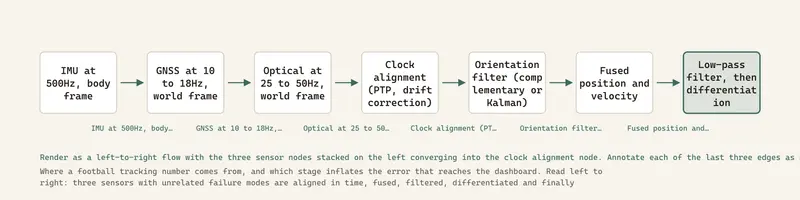
The chain is longer than most diagrams admit. Raw counts, then calibration for bias, scale factor and temperature. Clock alignment. Orientation estimation. Rotation from body frame into pitch frame. Fusion with absolute position. Low-pass filtering. Differentiation for velocity and again for acceleration. Threshold comparison. Binning into speed zones. Summation across a session. One number on a dashboard.
Errors do not add along that chain. They compound, and three stages do most of the damage.
Differentiation. Every derivative multiplies the spectrum by frequency, so noise invisible in position is loud in velocity and dominant in acceleration. Acceleration and deceleration counts are simultaneously the least reliable outputs in the system and the ones most often used to justify a training decision.
Filter cutoff. The cutoff is not a neutral cleaning step, it sets the peak value you report. The mouthguard work found the optimal cutoff differed by impact type, 100 Hz for padded impacts against 175 Hz for rigid ones on the same channel. Choose one cutoff for all events and you overstate one class and understate the other, systematically, forever.
Thresholds. A 0.08 m per second velocity error is nothing mid-zone and decisive at a boundary. Distance covered above a speed threshold is an integral over a thresholded signal, so a small persistent bias near the edge produces a large error in the reported total. That is precisely why FIFA's EPTS performance reports break accuracy down by velocity bracket instead of quoting one headline figure, and why comparing high speed running totals across two certified systems is not the like-for-like comparison it looks like.
The coach sees a scalar. Nothing in the pipeline attaches an uncertainty to it.
The strongest objection is that nobody can act on this
Here is the case against everything above, and it is a good one.
The dominant framework for turning tracking data into a training decision has been the acute to chronic workload ratio, and it has been dismantled in the literature. Impellizzeri and colleagues set out the conceptual and statistical problems in 2020: the ratio's own statistical properties generate artefacts, the acute and chronic windows have no principled derivation, and manipulating the ratio to change injury risk assumes a causal effect nobody has estimated properly. Work has shown randomised chronic loads performing about as well as real ones. If the model consuming the data is that weak, resolution upstream is decoration.
The resolution argument has direct evidence against it too. Validity work on commercial GNSS units at 10Hz and 18Hz found small bias, under 5%, for distance and peak speed at both rates, with trivial differences between them. If your outputs are total distance and peak speed, doubling the sampling rate buys nothing you can detect.
I accept both. The bottleneck at most clubs is not measurement. It is that the decision at the end of the pipeline, rest him or play him, is made by a person weighing things the sensors cannot see. Fixture congestion. What the player says on Tuesday. A contract situation. Adding a decimal place to high speed running distance does not touch that.
The conclusion I draw is narrower than the objection implies. Precision is worth paying for only where something discrete hangs on it.
Precision pays where the decision is binary
That split explains why the ball sensor is defensible while the same rate strapped to a player's back frequently is not.
Offside is binary and adjudicated in centimetres. A 2 millisecond timestamp converts into positional certainty at the moment of contact by arithmetic, not by modelling. Nothing is being inferred. Load management is continuous, the decision is fuzzy, the model consuming the data is contested, and there is no mechanism by which extra temporal resolution reaches the outcome.
The awkward part is that the industry sells one instrument into both markets. The adjudication case justifies the specification. The performance case pays for the volume.
And notice what FIFA still calls the system. Semi-automated. Twelve cameras, 29 tracked points per player, 50 poses a second, a 500Hz ball, and the final call still goes to a human who confirms or overrules the proposed line. That is not caution about the sensors. The sensors are fine. It is an admission that the hard problem was never measuring the moment of contact. It was agreeing what the measurement means, and no sampling rate fixes that.
Sources
FIFA, Semi-automated offside technology (12 cameras, 29 data points per player, 50 times per second, 500Hz ball IMU): https://inside.fifa.com/en/technical/football-technology/football-technologies-and-innovations-at-the-fifa-world-cup-2022/semi-automated-offside-technology
FIFA Quality Programme for Electronic Performance and Tracking Systems (EPTS): https://inside.fifa.com/innovation/standards/epts
Fan et al., Influence of Sampling Rate on Wearable IMU Orientation Estimation Accuracy, Sensors 25(7):1976, 2025: https://pmc.ncbi.nlm.nih.gov/articles/PMC11991382/
Fernandez-Valdes et al., Accelerometry at 100 vs 1000 Hz During Cumulative Tackles in Rugby League, Sensors 24(24):7910, 2024: https://pmc.ncbi.nlm.nih.gov/articles/PMC11679588/
Gellner, Begonia and Rowson, Optimal Cutoff Frequencies for Instrumented Mouthguard Head Impact Signals, Annals of Biomedical Engineering, 2024: https://pmc.ncbi.nlm.nih.gov/articles/PMC10995032/
Football-specific validity of TRACAB optical video tracking systems (25 Hz, 0.08 m positional RMSE), PLOS ONE, 2020: https://journals.plos.org/plosone/article?id=10.1371%2Fjournal.pone.0230179
Validity and Between-Unit Variability of GNSS Units at 10 Hz and 18 Hz for Distance and Peak Speed, Frontiers in Physiology, 2018: https://pmc.ncbi.nlm.nih.gov/articles/PMC6161633/
Impellizzeri et al., Acute:Chronic Workload Ratio: Conceptual Issues and Fundamental Pitfalls, IJSPP 15(6), 2020: https://journals.humankinetics.com/view/journals/ijspp/15/6/article-p907.xml
Frequently Asked Questions
Why does a football at the World Cup sample at 500Hz?
The 500Hz inertial measurement unit inside the match ball is a timestamping instrument, not a force-measuring one. FIFA's semi-automated offside system tracks up to 29 points per player 50 times a second, which is one pose every 20 milliseconds. A player at 8 metres per second travels 160 millimetres in that window and only 16 millimetres in the 2 millisecond interval a 500Hz sensor provides. Offside is judged in centimetres, so the ball sensor exists to pin the instant of contact tightly enough that the camera-derived player positions can be interpolated to it.
Is 500Hz enough to measure impacts in sport?
No, not in the crash-instrumentation sense. SAE J211-1 specifies head acceleration used for injury criterion calculation be sampled above 10 kHz and filtered at channel frequency class 1000, a corner near 1650 Hz. Instrumented mouthguards used in concussion research sample at 3.2 kHz, and published optimal filter cutoffs for those signals reach 275 Hz for angular velocity on rigid impacts. A 500Hz stream cannot represent that content without aliasing it. 500Hz is appropriate for event timing and for gross body kinematics, not for impact mechanics.
What is the difference between a complementary filter and a Kalman filter for IMU orientation?
Both exploit the same fact: the gyroscope is accurate in the short term but drifts, while the accelerometer is noisy but drift-free because gravity provides an absolute reference. A complementary filter high-passes the integrated gyroscope and low-passes the accelerometer estimate at a crossover frequency you choose by hand. A Kalman filter derives that crossover from process and measurement noise covariances instead. The catch is that those covariance matrices are usually tuned until the output looks plausible rather than derived from sensor physics, so the filter's stated confidence is only as trustworthy as that tuning.
Why fuse IMU, GNSS and optical tracking instead of using the most accurate one?
Because their failure modes are uncorrelated rather than merely different in size. Gyroscope drift is slow and monotonic, GNSS multipath is fast and specific to the stadium geometry, and optical occlusion is event-driven and arrives in bursts during set pieces. A single estimator has one way to be wrong and nothing to check it against. Multiple estimators wrong in unrelated ways can be reconciled, which is the entire mathematical argument for fusion over selection.
How much does clock drift matter when fusing data from multiple sports sensors?
Enough to erase the benefit of a high sampling rate. Two devices with 20 parts per million oscillators drift roughly 54 milliseconds apart across a 45 minute half, which is 27 samples at 500Hz. The temporal resolution of a fused system is the larger of the sampling interval and the synchronisation error, so a 500Hz stream aligned to within 20 milliseconds behaves like a 50Hz stream. IEEE 1588 Precision Time Protocol with hardware timestamping reaches sub-microsecond alignment on wired networks, while NTP only reaches milliseconds to tens of milliseconds.
Does a higher IMU sampling rate always produce better data?
No. A 2025 study sweeping orientation estimation from 10Hz to 1600Hz found 100Hz sufficient for walking, 200Hz for running and 400Hz for high speed cyclic movement, but also found accelerometer-driven error increasing above 100Hz, because additional orientation updates computed from distorted accelerations added more error than they removed. Gyroscope rate mattered at every speed. The right rate is a property of the quantity you intend to compute, and poor anti-alias filtering does more damage than a halved sampling rate.